


What Is Multi-Agent Orchestration? The Complete Guide for AI-Driven Business


(If you prefer video content, please watch the concise video summary of this article below)
Key Facts
- Multi-agent AI systems break complex business problems into coordinated tasks handled by specialized agents.
- According to estimates cited by Gartner, a large share of enterprise software will include autonomous or semi-autonomous agents before the end of this decade.
- Research referenced by McKinsey & Company links advanced AI coordination with double-digit productivity gains in knowledge work.
- Multi-agent orchestration is becoming a foundation for so-called agentic operating systems in enterprises.
Artificial intelligence is no longer just about smart models answering single questions. In modern enterprises, AI is expected to plan, decide, act, and adapt. It must do this across many systems, teams, and channels. That expectation has pushed AI beyond the limits of the single-agent model.
Multi-agent LLM orchestration is the answer. It allows many AI agents to work together under clear rules and shared goals. Each agent focuses on what it does best. One agent analyzes data. Another talks to customers. A third executes actions in back-end systems. An orchestrator keeps the system aligned.
This guide explains multi-agent orchestration in plain language. How it works, why it matters, and how businesses are already using it.
Leverage AI to transform your business with custom solutions from SaM Solutions’ expert developers.
Defining Multi-Agent Orchestration in AI Systems
What is multi-agent orchestration? Multi-agent orchestration is the structured coordination of multiple autonomous AI agents. Each assistant has a defined role, skill set, and scope of authority. The orchestrator ensures they collaborate efficiently toward a shared objective.
It’s like a newsroom. One reporter gathers facts. Another writes. An editor checks accuracy. A publisher decides timing. Alone, each role has limits. Together, they produce a high-quality story.
A single-agent AI system works in isolation. It receives input, processes it, and produces output. This model is powerful but constrained. The assistant must reason, plan, execute, and validate everything on its own.
Multi-assistant AI divides that cognitive load. Each agent specializes. Planning agents create strategies, execution agents interact with systems, and validation agents check results. The system becomes modular and easier to scale.
Modern business problems are not linear. They are layered, dynamic, and uncertain. Single-assistant systems struggle with long chains of reasoning and parallel tasks.
Multi-agent orchestration solution mirrors how humans solve problems. Teams collaborate, tasks are delegated, and feedback loops exist. That structure makes AI systems more robust, explainable, and adaptable.
How Multi-Agent Orchestration Works
At the core of any effective multi-agent system lies orchestration. Without a governing coordination layer, agents operate in isolation, producing fragmented outputs rather than coherent intelligence. Orchestration transforms a collection of autonomous agents into a goal-driven, resilient system.
The orchestrator agent as a central conductor
The orchestrator is not a “super-agent” with superior intelligence. Its value lies in control, not cognition. Functionally, it operates as a control plane that maintains global awareness of objectives, constraints, system state, and assistant capabilities.
Its primary responsibilities include:
- Translating high-level objectives into executable workflows
- Managing task dependencies and execution order
- Allocating and rebalancing workloads across agents
- Enforcing priorities, SLAs, and escalation rules
When conditions change — such as a spike in demand, degraded assistant performance, or external system failures — the orchestrator dynamically adjusts execution paths. Failed tasks are rerouted, priorities are recalculated, and alternative agents are engaged. This adaptive control layer is what enables reliability and predictability at scale.
Task decomposition and dynamic assignment
Complex objectives are decomposed into smaller, bounded tasks that can be executed independently or in parallel. This decomposition is rarely static. It is influenced by runtime context, assistant availability, confidence levels, and system load.
Task assignment is capability-driven rather than fixed:
- Specialized agents handle domain-specific reasoning
- Generalist agents fill gaps during peak load
- Redundant agents provide fault tolerance
Assignments are continuously reevaluated. As workloads fluctuate or intermediate results emerge, tasks may be reassigned, merged, or split further. This dynamic planning model allows multi-assistant systems to operate effectively in environments where requirements, inputs, and constraints evolve in real time.
Inter-agent communication and coordination protocols
Autonomous agents are only effective if they can coordinate reliably. Communication is typically structured, explicit, and governed by well-defined protocols rather than ad-hoc message passing.
Common coordination mechanisms include:
- Event-driven messaging for asynchronous workflows
- Shared state layers for consistency and synchronization
- Contract-based message schemas to reduce ambiguity
Poorly designed communication channels introduce latency, increase error rates, and amplify inconsistencies. Robust protocols, by contrast, minimize noise, preserve intent, and ensure that agents remain aligned toward shared objectives — even when operating independently.
Real-time monitoring and conflict resolution
In non-trivial systems, conflicts are inevitable. Multiple agents may propose competing actions, operate on partially inconsistent data, or respond differently to the same event.
To manage this, orchestration frameworks include monitoring and arbitration layers that:
- Track assistant outputs, confidence scores, and execution timing
- Detect contradictions, deadlocks, or anomalous behavior
- Apply predefined resolution strategies or invoke arbitration agents
Conflict resolution may follow deterministic rules, priority hierarchies, or probabilistic scoring models. The goal is not to eliminate disagreement, but to resolve it systematically so that the system remains stable, explainable, and operationally safe.
Iterative learning and adaptive improvement
A key advantage of multi-assistant architectures over traditional automation is their capacity for continuous improvement. Execution data, outcomes, and failure patterns are fed back into the system to refine future behavior.
Different agents evolve in different ways:
- Some retrain underlying models using new data
- Others adjust heuristics, thresholds, or decision policies
- The orchestrator itself refines task decomposition and routing logic
This feedback loop enables the system to adapt without constant human reconfiguration. Over time, coordination becomes more efficient, decisions more accurate, and failure recovery faster — turning orchestration into a living system rather than a static control mechanism.
Key Benefits and Business Value of Agent Orchestration
Multi-agent orchestration is not a research toy. It delivers concrete business value.
Processes like customer onboarding or supply chain planning involve many steps. They span systems and departments. Multi-assistant systems handle these flows end to end. They reason across steps, validate outcomes, and recover from errors. This reduces manual intervention and speeds up execution.
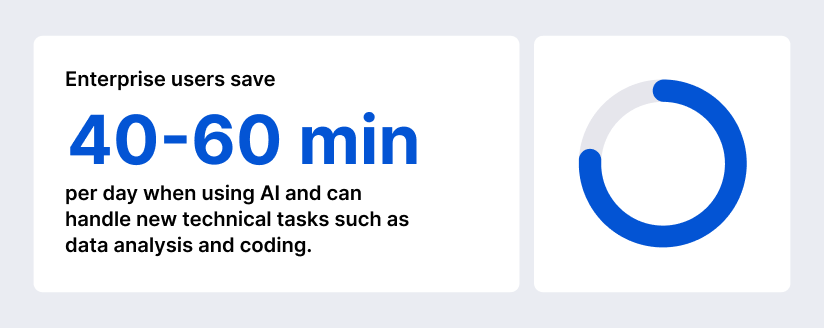
OpenAI’s enterprise AI report (based on usage data and a survey of ~9 000 workers) notes that enterprise users save 40-60 minutes per day when using AI and can handle new technical tasks such as data analysis and coding.
Adding capacity is simple. You add more agents or expand assistant roles. During peak demand, orchestration layers spin up additional agents. During low demand, they scale down. This elasticity aligns AI costs with business needs.
Single-agent systems fail hard. Multi-agent systems fail gracefully. If one assistant goes offline, others compensate. The orchestrator reroutes tasks. According to industry reliability studies often referenced by IBM Research, distributed intelligent systems show significantly higher fault tolerance than monolithic ones.
Teams can develop new agents independently. One team builds a pricing assistant. Another builds a compliance agent. These agents plug into the orchestration layer without redesigning the whole system. Innovation becomes faster and safer.
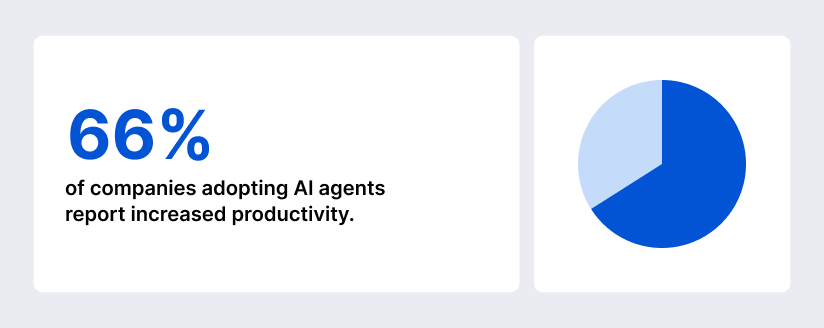
In PwC’s survey, 66% of companies adopting AI agents report increased productivity, 57% report cost savings, 55% faster decision‑making, and 54% improved customer experience. 73% believe their use of AI agents will provide a significant competitive advantage within 12 months, and 75% are confident in their AI‑assistant strategy.
Agents observe different parts of the system. Together, they create a holistic view. Insights are not just reported. They trigger actions. Prices adjust. Alerts fire. Workflows change. Intelligence becomes operational.
Multi-Agent Orchestration vs. Single-Agent
Choosing the right architecture matters.
Limitations of the single-agent approach
Single-agent systems face context limits. Long reasoning chains degrade performance, parallel tasks are hard to manage. They are also brittle — one error can derail the entire process. Debugging is complex because everything happens inside one model.
Advantages of a collaborative multi-agent system
Multi-agent systems distribute reasoning, and they support parallelism. They are easier to test and monitor. Each assistant is simpler. That simplicity improves reliability and transparency. The whole becomes stronger than the parts.
Choosing the right architecture for your needs
Not every use case needs multiple agents. Simple tasks may be fine with one. But if processes span departments, systems, or time, orchestration pays off. The decision should be driven by complexity, scale, and risk tolerance.
Exploring Types of Multi-Agent Orchestration Frameworks
There is no single orchestration model. Different architectures serve different needs.
In this model, one assistant acts as a manager or controller, and all other agents are essentially workers. The manager receives the user request, decomposes it into subtasks, assigns those subtasks to specific agents, and then aggregates the results. All decisions flow through this central point, which makes behavior predictable and relatively easy to observe. This approach is popular in production systems because it behaves more like a traditional software pipeline. Frameworks such as LangGraph and CrewAI are often used this way, even though they can support more advanced patterns.
Hierarchical orchestration extends the centralized idea by introducing multiple levels of control. Instead of a single manager, there is usually a high-level planner that defines strategy, while subordinate coordinator agents handle entire domains or phases of work. Execution agents sit at the bottom and perform concrete actions such as calling tools or generating outputs. This resembles how organizations are structured in real life, with managers managing other managers. The benefit is better scalability and clearer separation of concerns, but the trade-off is increased complexity and coordination overhead. Systems built with AutoGen or MetaGPT often follow this pattern.
In decentralized orchestration, there is no single controlling assistant at all. Every assistant is autonomous, and coordination emerges through communication. Agents announce intentions, share partial results, respond to each other’s messages, and adapt their behavior based on what others are doing. Because no agent has a global view or absolute authority, the system becomes highly flexible and resilient, but also much harder to control and debug. This style is common in academic research and experimental systems, such as those built with CAMEL, where the goal is to study emergent behavior rather than to ship deterministic software.
Market-based orchestration borrows ideas from economics. Tasks are announced to the system, and agents evaluate whether they can perform them, often submitting bids based on cost, confidence, or availability. An allocation mechanism selects the winning assistant, which then executes the task. This allows efficient resource utilization and dynamic load balancing, but it adds significant conceptual and implementation complexity. For that reason, it remains more common in research and simulations than in mainstream LLM products.
Real-World Use Cases and Industry Applications
Multi-agent orchestration is already in production across industries.
Support agents handle intent detection, knowledge retrieval, response drafting, and escalation. Companies report faster resolution times and higher customer satisfaction. Industry surveys referenced by Forrester link AI-driven support orchestration to measurable CSAT improvements.
Agents monitor inventory, demand signals, transport conditions, and supplier performance. They coordinate replenishment and routing in near real time. This reduces stockouts and logistics costs.
Specialized agents watch transactions, patterns, and anomalies. When risk rises, other agents intervene. Trades pause. Alerts escalate. Financial institutions rely on this layered intelligence for speed and safety.
Healthcare systems use agents to analyze diagnostics, schedule resources, and manage patient flow. The result is shorter wait times and better utilization. Studies published in medical informatics journals consistently show operational gains from coordinated AI systems.
Pricing agents analyze demand. Personalization agents tailor offers. Inventory agents ensure availability. Together, they optimize revenue without sacrificing customer trust. Retailers using such systems report higher conversion rates and margin stability.
Potential Challenges in Implementing Multi-Agent Systems
The benefits are real. The challenges are too.
More agents mean more messages. Without discipline, systems become chatty and slow.
Clear boundaries, efficient protocols, and monitoring are essential. Orchestration must reduce complexity, not add to it.
Agents act autonomously. That raises governance questions. Access controls, audit logs, and policy enforcement must be built in. Compliance cannot be an afterthought.
Most enterprises run on legacy systems. Agents must integrate via APIs, events, or adapters. This requires careful architecture and deep system knowledge.
The Future of Enterprise AI and Agentic Operating Systems
Multi-agent orchestration is shaping the next phase of enterprise software.
The emerging Internet of AI agents (IoA)
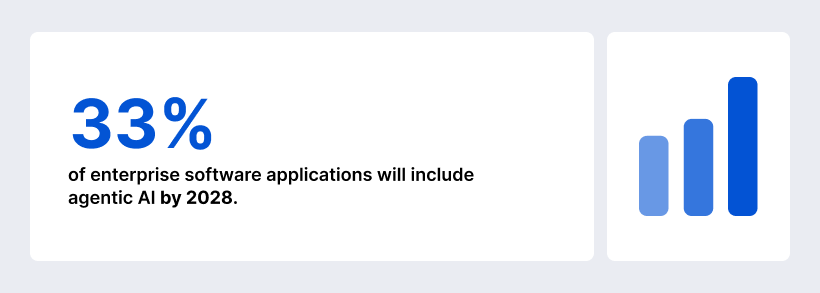
Researchers and vendors talk about an Internet of AI Agents. Systems where agents discover, negotiate, and collaborate across organizational boundaries. This vision is early but compelling. It points toward interoperable, agent-driven ecosystems. A Gartner report (summarized by Slack) forecasts that 33% of enterprise software applications will include agentic AI by 2028 and that at least 15% of work decisions will be made autonomously by such agents.
Strategic imperative for business leaders
AI strategy is no longer about models alone. It is about systems. Leaders who invest in orchestration gain agility. They build AI that acts, not just predicts. That capability will define competitive advantage.
Why SaM Solutions for AI-Agentic Development?
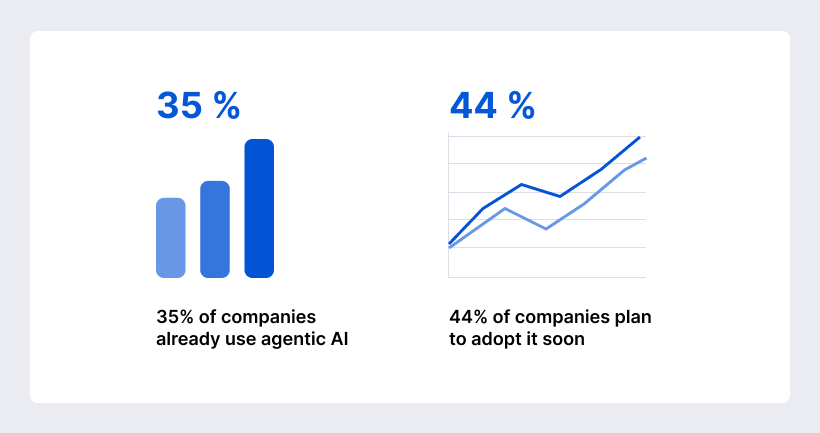
A survey by MIT Sloan Management Review and BCG of 2,102 respondents from 21 industries reported that 35 % of companies already use agentic AI and 44% plan to adopt it soon, yet 47% lack a clear AI strategy. That means companies need a strong technology partner to provide reliable AI consulting and development services.
Companies choose SaM Solutions for AI-agentic development because SaM Solutions builds AI agents as production software integrated into existing enterprise systems, not as standalone demos. Their agents are designed to work with real data, tools, and workflows by integrating with CRMs, ERPs, databases, and cloud platforms.
The company follows a structured delivery process that covers architecture, development, integration, deployment, and ongoing support, which is essential for agentic systems that must be controlled, observable, and maintainable over time. SaM Solutions uses established technologies and model-agnostic architectures, allowing agent logic to evolve without vendor lock-in.
In practice, SaM Solutions is chosen when AI agents must be deployable, governed, and operable in real business environments, rather than experimental or short-lived solutions.
Ready to implement AI into your digital strategy? Let SaM Solutions guide your journey.
Conclusion
Despite high interest, the gap between experimentation and scaled deployment remains wide. Most organizations have yet to integrate AI deeply into workflows, and fewer than one‑tenth have scaled agentic systems in any given function. This underscores the importance of partners like SaM Solutions that focus on production-grade, integrated AI agents rather than isolated demos.
Evidence from PwC and Capgemini demonstrates that properly deployed AI agents deliver significant productivity gains, cost reductions, and ROI. Incorporating agents into real business systems (CRMs, ERPs, databases) can free up employees’ time (40-60 minutes/day) and unlock new capabilities.
Forward‑looking forecasts from Gartner indicate that AI agents will soon be ubiquitous; by 2026-2028, 33-40 % of enterprise applications may include agents. Investing now in integrated agentic platforms positions organizations to capture this wave of adoption.
FAQ
The best platform depends on scale, compliance requirements, and integration complexity. Enterprises often choose solutions that enable cooperative multi-agent architectures, where agents operate as a coordinated swarm rather than isolated components. Strong governance, modular agent design, and deep system integration are essential to support effective collaboration between AI agents and existing enterprise systems across customer-facing and back-office workflows.




![15 Best AI Tools for Java Developers in 2026 [with Internal Survey Results]](https://sam-solutions.com/wp-content/uploads/fly-images/18712/title@2x-6-366x235-c.webp)


