


AI Agents in Healthcare: Revolutionizing Patient Care and Medical Innovation


(If you prefer video content, please watch the concise video summary of this article below)
Key Facts
- AI agents in healthcare are intelligent software systems that simulate human reasoning to assist or automate medical tasks.
- These systems use technologies like machine learning (ML), natural language processing (NLP), and computer vision.
- Five basic modules in AI agents: perception, learning, reasoning, action, communication.
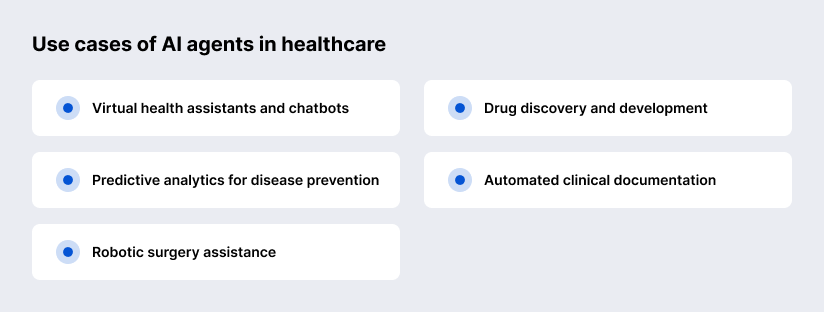
- How medical organizations use AI agents: virtual health assistants and chatbots, predictive analytics for disease prevention, robotic surgery assistance, drug discovery and development, automated clinical documentation.
- Benefits: faster and more accurate diagnoses, personalized treatment plans, reduced administrative burden, lower operational costs, continuous patient monitoring and support.
- Challenges to adoption: data privacy and security concerns, ethical and legal considerations, the need for trust and transparency.
- Future trends: autonomous diagnostics, personalized medicine, AI-assisted surgery, expanded telemedicine.
Healthcare is under pressure. Costs are rising, medical staff are stretched thin, and patient expectations continue to grow. To meet these challenges, many healthcare providers are turning to digital solutions, and AI agents are quickly becoming one of the most impactful tools in their toolbox.
The global market for AI in healthcare is growing explosively, from about $28 billion in 2024 to a projected $180+ billion by 2030. This surge is driven by AI’s potential to save costs and improve outcomes; for example, Accenture estimates that key AI applications could create $150 billion in annual savings for the US healthcare economy within a few years.
AI agents in healthcare are already helping with diagnostics, managing schedules, monitoring patients, handling documentation, and more. What used to take hours can now be done in seconds.
In this article, we’ll explore what AI agents are, the types and roles they play in healthcare, how they work, key benefits and use cases, as well as the challenges and future outlook that decision-makers should consider.
Leverage AI to transform your business with custom solutions from SaM Solutions’ expert developers.
What Are AI Agents?
An AI agent is an intelligent software system based on a large language model (LLM). It has memory and a set of tools (knowledge base, internet access, APIs, etc.) to autonomously interact with its environment, collect data, make decisions, and take actions on behalf of users or other systems in order to achieve defined objectives.

AI agents can adapt and perform better by learning from interactions and feedback. This means they can handle complex workflows and dynamic situations.
Key characteristics of AI agents
- Autonomy: Ability to perform tasks independently and make rational decisions based on environmental data.
- Perception: Sensing and understanding the environment they work in.
- Action: Implementing decisions via actuators or software commands.
- Goal-oriented behavior: Planning and executing actions to meet predetermined goals.
- Learning: Improving performance through experience and feedback.
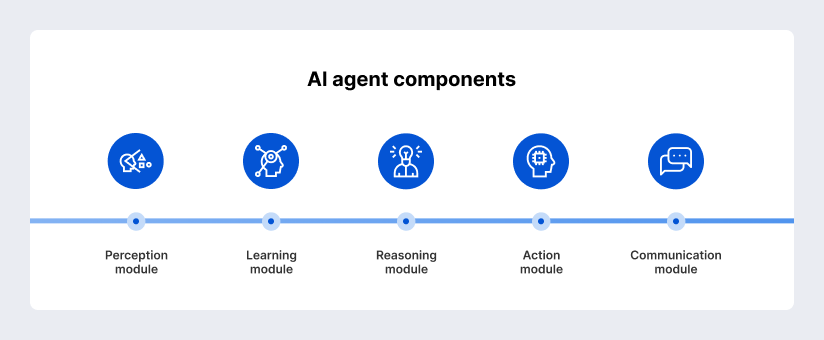
There are five basic modules in AI agents.
- Perception module: Gathers data (text, images, audio, video) from the environment and translates it into a structured format the smart agent can understand. In healthcare, this can be EHR entries, medical scans, or signals from monitoring devices.
- Learning module: Enables the agent to improve by recognizing patterns in data and adjusting its internal models. For example, a triage agent might refine its risk predictions as it encounters more patient outcomes.
- Reasoning module: Analyzes data, applies logic, and evaluates options to make informed decisions. An example is comparing symptoms against known clinical pathways or recommending treatment plans based on guidelines and patient context.
- Action module: Executes tasks or initiates processes based on the agent’s decisions, such as flagging abnormal lab results, updating medical records, or scheduling a follow-up.
- Communication module: Interfaces with users or other systems to share insights, ask questions, or receive feedback. This includes generating alerts, delivering chatbot responses, or integrating results into clinical dashboards.
The Expanding Role of AI Agents in Healthcare
AI agents are being deployed across hospitals, clinics, and digital health platforms, streamlining workflows and engaging patients at every stage of their care journey.
A 2024 survey found that approximately 65% of US hospitals are already using AI-based predictive tools in some capacity, and physician adoption of artificial intelligence is rising sharply. Roughly two-thirds of US healthcare systems are integrating AI agents for tasks ranging from patient triage to administrative automation.
Touchpoints across the patient journey
Whether embedded in electronic health record systems or accessed through a chatbot, the AI agent for healthcare has become a constant presence, quietly managing tasks in the background or directly interacting with patients.
- Diagnosis: Agents analyze imaging, lab results, and patient history to assist in early and accurate detection of conditions.
- Treatment planning: AI evaluates treatment options, taking into account clinical guidelines, patient preferences, and historical outcomes.
- Monitoring: Virtual agents check in with patients between visits, track recovery progress, and escalate concerns when needed.
- Follow-up: Agents handle reminders, medication adherence, and post-discharge support, reducing readmission risk.
Augmenting medical staff, not replacing them
One of the most valuable roles of AI agents is taking repetitive, time-consuming work off the shoulders of clinicians. A virtual assistant that auto-generates chart notes from a doctor–patient conversation can free up hours of manual documentation. An agent that pre-screens imaging results can highlight potential concerns before a radiologist even opens the file.
The goal isn’t to replace professionals, but to let them focus on where human judgment matters most: decision-making, empathy, and complex care.
Running the operational backbone
AI agents are also improving what patients don’t see: hospital logistics, staffing, and resource management. For example, AI agents manage inventory of medications and medical supplies: by analyzing usage patterns, an agent can predict when a certain drug will run low and automatically reorder it, preventing shortages.
At Johns Hopkins Hospital, introducing AI into patient flow management led to a 30% reduction in emergency room waiting times, meaning patients got treated faster and staff workflows improved.
Types of AI Agents
Smart agents can be categorized by their degree of autonomy, by the level of sophistication and how they make decisions, and by whether they have a physical embodiment or exist purely in software.
Autonomous vs. semi-autonomous agents
Fully autonomous agents can make decisions and act completely on their own in their domain. In practice, full autonomy in healthcare is rare today due to safety and ethical concerns. Most agents are semi-autonomous, meaning they are assistive and work in tandem with humans or under certain constraints. For example, an AI may draft a treatment plan, but a human doctor must review and approve it before it’s implemented.
Reactive agents
Reactive agents (simple reflex) operate on a condition-action basis, reacting to current sensor inputs with predefined responses. They do not maintain internal state or memories of past events.
In healthcare, a reactive agent might be a simple monitoring system: a blood pressure monitor that triggers an alarm if readings go above a threshold. It responds in the moment to specific cues but doesn’t consider patient history.
Model-based agents
Model-based agents have an internal representation of their environment. They don’t just react but evaluate what’s happening based on both current and past data. In healthcare, many clinical AI systems are model-based.
For instance, an agent managing an ICU ventilator might keep track of a patient’s recent blood gas levels (its internal state) to decide how to adjust settings, rather than just reacting to the latest reading.
Goal-based agents
Goal-based agents evaluate different possible actions by whether those actions move them closer to a defined goal state.
For example, a hospital scheduling agent could have the goal to “minimize patient wait time and optimize resources.” It will explore various scheduling configurations, shift appointment slots, and reallocating staff to improve efficiency.
Learning agents
Learning agents use feedback to learn from experience and improve their performance over time. They are arguably the most adaptive: they can start with basic knowledge and get better with each data point.
A good example is a personalized medicine agent that refines its treatment recommendations as it gathers more data about how a patient responds to medications.
Robotic or physical agents
Some agents don’t just exist in software. Robotic/physical AI agents have a physical embodiment or interface with the physical world. They combine AI decision making with mechanical components to handle real-world tasks.
A robotic surgery assistant is a prime example: it executes movements with steadiness beyond human ability. Physical agents can also reduce manual labor (e.g., robots that disinfect rooms and deliver medications) or assist patients directly (robotic exoskeletons for rehabilitation).
How AI Agents Work in Healthcare
The effectiveness of AI agents for healthcare depends on two core capabilities: how they process data and how well they fit into existing digital infrastructure.
Data processing and machine learning
Hospitals generate enormous amounts of data.
The average hospital produces about 50 petabytes of data per year (equivalent to 137 terabytes per day). This data comes in many forms: structured data like lab results, and unstructured data like doctor’s notes, medical imaging, and patient questionnaires. In fact, over 80% of healthcare data is unstructured, meaning it’s not neatly organized in databases.
AI agents are uniquely equipped to handle this mix of data. They use natural language processing (NLP) to “read” unstructured text and computer vision to interpret medical images. Meanwhile, structured data can be fed into machine learning or deep learning models as numerical inputs.
Integration with healthcare systems
Even the smartest AI agent is only useful if it connects smoothly to the existing digital tools. This is often a bigger challenge than developing the model itself: success depends on how well the agent can communicate with electronic health record systems (EHRs), medical devices, and other software.
Healthcare has specific data standards for exchanging information. HL7 (Health Level 7) is a long-standing standard for clinical data exchange, and FHIR (Fast Healthcare Interoperability Resources) is the modern web-friendly format that many systems are adopting. An AI agent needs to speak the language of healthcare data.
Most smart agents expose or consume APIs to talk to other software. Modern EHRs often have API marketplaces or app galleries where third-party AI apps can be launched within clinician workflow. Additionally, integration might involve embedding artificial intelligence in edge devices or medical equipment via SDKs.
Benefits of AI Agents in Healthcare
Why are healthcare organizations investing heavily in AI agents? The benefits span clinical improvements, operational efficiencies, and better patient experiences.
Clinical impact


Operational efficiency


Patient-centered experience


Key Use Cases of AI Agents in Healthcare
AI agents come in different forms optimized for various tasks. Here we’ll highlight several high-impact use cases of AI agents in healthcare.
Virtual health assistants and chatbots
Virtual assistants are often the first touchpoint for patients. These solutions engage users via web, app, or voice interfaces to handle routine tasks like:
- Symptom checks and triage
- Appointment scheduling and rescheduling
- Medication reminders and FAQs
- Post-visit follow-ups
A chatbot can assess a patient’s symptoms, guide them to the right level of care, and initiate appointment booking. This improves patient access while easing the burden on front-desk and nursing staff.
Predictive analytics for disease prevention
AI agents trained on historical and real-time data can identify patterns that suggest early-stage or future health risks. Common applications include:
- Predicting hospital readmissions
- Flagging patients at risk for sepsis or stroke
- Identifying population health trends
- Detecting early signs of chronic disease
Such agents allow care teams to intervene earlier and allocate resources more effectively, reducing complications and long-term treatment costs.
Robotic surgery assistance
In the operating room, AI agents are enhancing robotic systems with real-time guidance and surgical planning support. Their contributions include:
- Identifying anatomical structures during procedures
- Enhancing precision by stabilizing tool movement
- Assisting in pre-op planning through image analysis
These agents don’t replace surgeons but act as digital co-pilots, improving outcomes.
Drug discovery and development
AI agents in pharmaceutical research speed up the drug development lifecycle by:
- Screening and ranking chemical compounds
- Identifying new drug targets using genomic and molecular data
- Predicting trial outcomes and optimizing study design
By narrowing down viable candidates quickly, AI reduces time and cost, which are key advantages in highly competitive drug markets.
Automated clinical documentation
Documentation is one of the most time-consuming aspects of clinical care. AI agents can now:
- Transcribe and summarize doctor–patient conversations
- Auto-complete structured forms and encounter notes
- Suggest billing and diagnosis codes
- Generate discharge summaries
These tools save hours of manual input, reduce documentation errors, and help clinicians spend more time with patients.
Challenges and Ethical Considerations
As you can see, AI implementation in healthcare offers tremendous promise. However, new risks and ethical considerations also arise, so healthcare organizations must learn how to carefully manage them.
Data privacy and security
AI agents need data to be effective, but healthcare providers must ensure patients retain control over their data and trust that their privacy is maintained.
Sadly, healthcare is already a prime target for cyberattacks, and new AI systems broaden the “attack surface” if not managed well. A stark reminder: In 2023, about 540 healthcare organizations reported data breaches, affecting over 112 million individuals.
Thus, AI agents must safeguard Protected Health Information (PHI) at every step. This means using robust encryption when data is stored or transmitted, strict access controls, and thorough auditing. Any solution must comply with strict regulations (HIPAA in the United States and GDPR in the European Union). These laws govern how patient data is collected, stored, processed, and shared.
Many organizations prefer to deploy AI locally or within private cloud environments to retain greater control.
Compliance also includes ensuring that AI models do not repurpose patient data for uses beyond their intended scope. In the EU, patients may even have the right to request that their data be removed from training sets, raising further questions about how and where AI models store information.
Regular security assessments, penetration testing, and monitoring are required for AI systems just as for any critical IT system.
Bias and fairness in AI decisions
Another key challenge is algorithmic bias, when an AI model’s decisions reflect the imbalances or gaps in its training data. In healthcare, this can have serious consequences. For instance, if a diagnostic model is trained mostly on data from one demographic group, its accuracy may suffer when applied to others. This can lead to underdiagnosis or overtreatment of certain patient populations.
To mitigate these risks, developers and healthcare organizations must actively test models for performance across different subgroups — by gender, age, race, or underlying conditions — and take steps to retrain or recalibrate where needed.
Explainability and trust
In life-critical decisions, doctors and patients need to trust the AI agent’s recommendations. If an AI flags a patient as high-risk or recommends a treatment, but it cannot explain in understandable terms why, doctors may be rightly hesitant to act on it. Hence the push for Explainable AI (XAI) in healthcare. Explainable AI techniques aim to provide reasoning or highlight the key factors that led to a decision (like “this patient is high-risk for sepsis because of a rising lactate, low blood pressure, and rapid heart rate trend”).
The Future of AI Agents in Healthcare
Looking ahead, the role of AI agents in healthcare is poised to grow even more transformative.
Autonomous AI-driven diagnostics
We are moving towards a future where AI agents handle an increasing share of diagnostic work, possibly even providing autonomous medical diagnoses in certain domains.
A notable example is IDx-DR, an AI agent for diabetic retinopathy screening that can examine a retinal photograph and give a clinical referral recommendation without a human specialist’s interpretation. It was the first of its kind, and it demonstrated that for certain well-defined tasks (like detecting diabetic eye disease), an AI can operate independently to make a call with high sensitivity and specificity.
The autonomous diagnostic agents will likely handle tasks that meet certain criteria: well-defined problem, plenty of training data, and significant benefit in speed/scale. Regulators will ensure safety, requiring rigorous trials.
AI-powered personalized medicine
The future of healthcare is often described as precision medicine — treatments tailored to the individual’s genetic makeup, environment, and lifestyle. AI agents will be the engines making sense of all the data required to drive personalized medicine on a large scale.
- Individualized treatment planning: AI will help design treatment plans optimized for each patient. We already see hints of this with models predicting which patients will respond to immunotherapy. In the future, this could extend to genome-driven prescriptions for many conditions: AI parsing your whole genome to predict drug efficacy and side effect risk (pharmacogenomics) and advising the doctor on the best medication and dose specifically for you.
- Virtual twins: A futuristic concept is each patient having a digital “twin” — a computational model of their physiology that AI agents can experiment on. For instance, before deciding on a surgery or a risky therapy, doctors could run simulations on the patient’s virtual twin (with AI simulating how that patient would respond) to pick the safest, most effective approach. Some early work on “virtual hearts” and “virtual lungs” for testing interventions exists.
Seamless human-AI collaboration in surgery
Future operating rooms may have AI-driven robotic systems where tasks flow naturally between human and machine. The surgeon might delineate goals (“remove this tumor with 1 cm margin”) and the AI robot might handle much of the execution, asking for human confirmation or intervention at key points.
- Augmented reality: Surgeons in the future might wear AR glasses that show AI annotations on the surgical field (e.g., highlighting blood vessels behind tissue, labeling organs, showing exactly where a tumor boundary is beyond visible surface). AI agents could also retrieve and display relevant data on demand (“Show me the patient’s MRI from last week”). With 5G and IoT, all devices and scopes could feed data to an artificial intelligence hub in real time.
- Training and spreading expertise: As AI captures the techniques of top surgeons, it can help disseminate those skills globally. A surgeon in a remote area might operate with an agent that has “learned” from world experts. Additionally, surgical AI could assist in bridging the gap in surgeon shortages, perhaps allowing less specialized doctors to perform certain procedures under AI guidance safely.
Decentralized AI for telemedicine and remote care
The future will also see healthcare moving beyond traditional hospital walls, with AI agents enabling care anywhere, anytime, from urban homes to rural villages, through edge devices and home-based solutions.
Distance and time become less of a barrier to healthcare — care becomes omnipresent thanks to AI and connectivity.
In remote areas, handheld diagnostic tools and kiosks with built-in artificial intelligence will enable instant triage and local care, supported by telemedicine. AI-powered virtual nurses and home monitoring systems are managing chronic conditions, adjusting treatments, sending prescriptions to pharmacy automatically, and supporting hospital-at-home programs.
Why Choose SaM Solutions for Successful AI Development?
At SaM Solutions, we help companies across industries turn ideas into secure, effective, and scalable digital solutions with intelligent features. Our cross-functional teams custom AI development services, including contextual search, NLP, MCP development, secure LLM integration, AI agent creation, and more.
Summing Up
AI agents are disrupting healthcare, improving diagnostics, reducing administrative burden, accelerating emergency response, and bringing personalized care to more patients. Their ability to work continuously, learn from data, and integrate into existing systems makes them a powerful asset for hospitals, clinics, and digital health platforms alike.
However, success depends on more than just the technology. It requires careful implementation, compliance with security standards, and a development partner who understands the complexities of healthcare.
FAQ
Costs vary depending on the scope of the project, integration needs, data readiness, and infrastructure. While upfront investment is required, many healthcare organizations see a fast return through time savings, improved outcomes, and lower administrative costs.




![15 Best AI Tools for Java Developers in 2026 [with Internal Survey Results]](https://sam-solutions.com/wp-content/uploads/fly-images/18712/title@2x-6-366x235-c.webp)


