Top 10 Mobile App Development Trends 2026


(If you prefer video content, please watch the concise video summary of this article below)
Key Takeaways
- AI, personalization, and real-time intelligence dominate. Mobile apps are evolving into adaptive, user-centric, and context-aware experiences that anticipate user needs.
- Cross-platform, low-code, and no-code tools accelerate development. Faster time-to-market, broader reach, and easier maintenance make these approaches mainstream.
- Next-gen connectivity and immersive tech drive engagement. 5G, AR/VR, IoT integration, and voice interfaces enable richer, more interactive experiences.
- Security, privacy, and super apps are critical differentiators. Users demand trust, seamless ecosystems, and all-in-one solutions, pushing mobile apps beyond simple functionality.
Mobile application development has become a priority and the new normal for many businesses. Without mobile-optimized solutions, companies undoubtedly risk losing a significant number of clients and lagging behind the competition. In this article, we’ve compiled the key mobile app development trends impacting the industry in 2026.
Make your services or business accessible at your clients’ fingertips with mobile app development from SaM Solutions.
The increased adoption of mobile devices has led to the remarkable growth of the mobile app sector. Here are some impressive statistics.
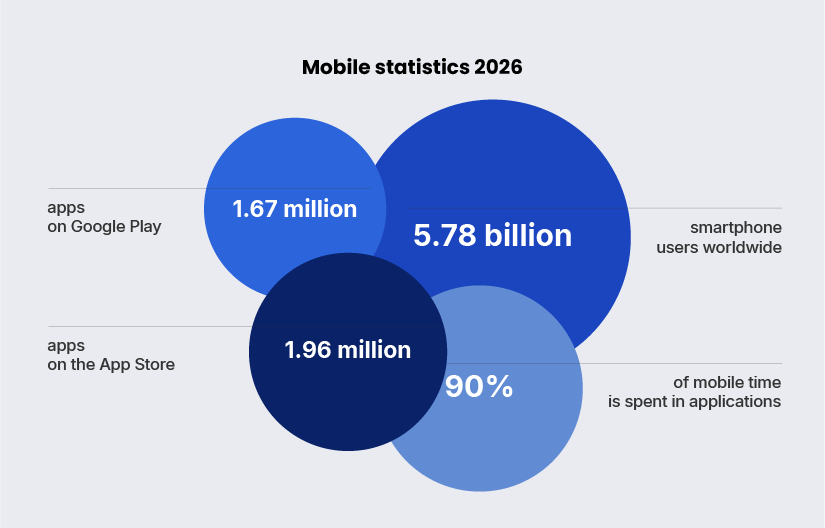
- In late 2025, the number of unique smartphone users worldwide was estimated at 5.78 billion.
- As of January 2026, the Google Play Store hosts approximately 1.67 million apps, while the Apple App Store hosts roughly 1.96 million apps. These figures reflect a significant decrease in total app numbers from previous years due to strict quality enforcement and the removal of low-quality, inactive content.
- Smartphone users now spend over 90% of their mobile time inside apps, with average daily usage hovering around 4+ hours, reinforcing that apps dominate mobile engagement.
- The most downloaded app categories are social media, games, and creative editing tools.
Using these figures, it’s evident that mobile apps are creating exciting new business prospects. Why? Well, today’s consumers prioritize convenience, freedom, and speed when engaging with any business’s products or services. The applications installed on smartphones, tablets, and other portable devices serve as the optimal tools to guarantee the convenience, freedom, and speed that customers seek. But there is a catch: not all applications appeal to users and perform as intended. This happens when mobile app providers don’t consider customer needs and fail to follow the top mobile app development trends when designing their solutions.
A great number of technologies, solutions, and social factors influence the mobile market. We want you to get a holistic view of the current trends in mobile app development to understand what direction to take. The following information can be valuable for both business leaders and those who develop software solutions for mobile devices. Take a look to discover something new or spark fresh ideas.
1. AI-Driven Personalization and Integration
The year 2017 was the point of no return for the mobile industry: Apple integrated the Siri voice assistant into applications and thus paved the way for numerous artificial intelligence and machine learning features in mobile apps.
In 2026, AI-driven personalization is a core mobile development trend that transforms apps into adaptive, intelligent experiences. Apps now learn from how people use them, adapting content, recommendations, and interactions in real time to create experiences that feel smarter, more relevant, and genuinely engaging.
At the same time, personalization is deeply integrated with back-end systems such as analytics platforms, payment services, and customer data platforms. This allows mobile apps to deliver real-time insights aligned with broader business processes.
Among the popular AI frameworks for iOS and Android development are Core ML, TensorFlow and TensorFlow Lite, ML Kit, Turi Create, Vision, PyTorch and PyTorch Mobile, Keras, to name a few.
2. On-Device AI and Edge Computing
On-device AI and edge computing have become essential pillars of modern mobile development.
- On-device AI: Intelligent models run directly on the mobile device, enabling faster responses, offline functionality, and better data privacy.
- Edge computing: Processing data closer to the user (on devices or nearby servers) instead of the cloud, reducing latency and improving performance for real-time mobile experiences.
Instead of sending every request to the cloud, mobile applications can process data directly on smartphones, tablets, and connected edge devices. This enables faster response times, reduced latency, and a noticeably smoother user experience, which is especially crucial for real-time use cases.
From a practical perspective, on-device AI powers features such as:
- offline voice recognition
- real-time image and video analysis
- predictive text input
- biometric authentication
- context-aware recommendations.
Because data is processed locally, applications remain functional even with limited or unstable network connectivity, which is critical for mobile-first users and global markets.
Edge computing also plays a key role in privacy and compliance. By minimizing data transfer to centralized servers, sensitive information such as biometric data, location signals, or behavioral patterns can stay on the device. This approach aligns well with growing regulatory requirements and rising user expectations around data protection and transparency.
3. Cross-Platform Development Dominance
Cross-platform development has become a highly popular approach in modern mobile app creation, because developers can write a single codebase that runs seamlessly on iOS, Android, and even emerging platforms like wearables and foldables.
The rise stems from businesses demanding faster time-to-market and broader reach in a fragmented device ecosystem — over 24,000 Android device models and counting.
The cross-platform approach slashes development time by up to 40% compared to native builds, according to recent industry reports from Stack Overflow and Gartner. Costs are also reduced without sacrificing performance. Cross-platform tools now deliver near-native speed through advanced rendering engines and hot-reloading features.
Currently, the most widely used frameworks for cross-platform apps are Flutter, React Native, .NET MAUI (formerly Xamarin), and Kotlin Multiplatform.

4. Voice and Conversational Interfaces
Voice and conversational interfaces have evolved from novelties to essential components of mobile app ecosystems, powering hands-free interactions that align with modern user lifestyles.
Advancements in natural language processing (NLP) and speech recognition, driven by models like Whisper and multimodal LLMs, enable apps to handle complex, context-aware dialogues across industries, from ecommerce voice shopping to fitness coaching.
Daily active users of voice assistants like Siri, Google Assistant, and Alexa-integrated apps exceed 2 billion globally, with voice queries growing 35% year-over-year as per recent analytics.
These interfaces excel by combining voice with chatbots and AR overlays, reducing taps by up to 70% and boosting usability and engagement for on-the-go scenarios like navigation or quick transactions.
5. Augmented Reality (AR) and Virtual Reality (VR)
An increasing number of apps are incorporating augmented reality (AR) and virtual reality (VR) features, and this trend shows no signs of fading.
According to The Business Research Company, mobile augmented reality (MAR) market size has reached $27.57 billion in 2024 and is expected to grow to $110.68 billion in 2029.
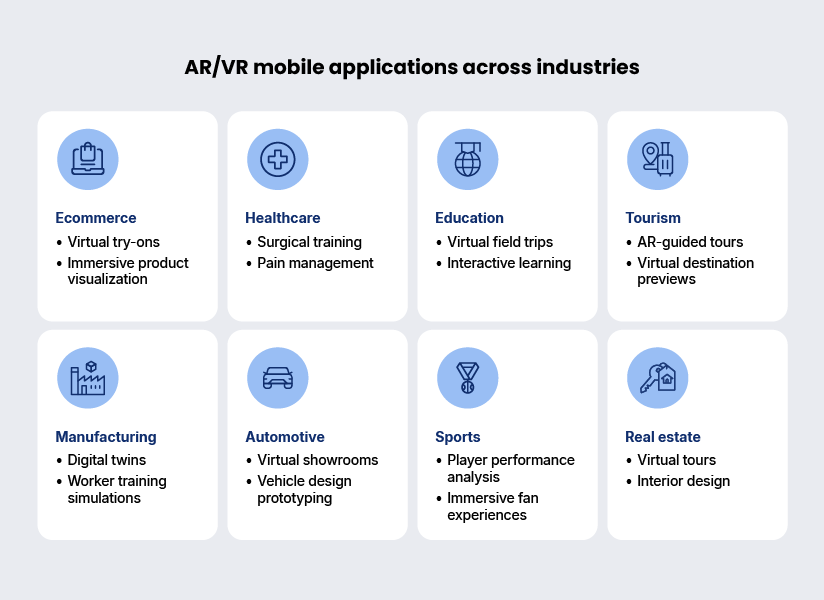
A couple of years ago, AR and VR technologies were primarily utilized in gaming apps (remember the overwhelming success of Pokemon Go?) and marketing campaigns to entertain and impress customers. Today, AR/VR is among the latest trends in mobile application development. The mobile world leverages augmented and virtual reality for more practical purposes, such as object measurement, navigation, interior design, user manuals, and more. AR/VR-powered apps provide incredible opportunities for virtually all industries, including ecommerce, healthcare, education, tourism, manufacturing, automotive, sports, and others.
6. Low-Code and No-Code Development
Simplicity and speed — these are the two ingredients that all businesses strive for. Low-code/no-code development is a modern approach that doesn’t require deep coding knowledge to create mobile apps quickly and affordably. This approach can reduce development time by up to 90%, so it is ideal for rapid prototyping and iteration. It also enables non-developers and business stakeholders to participate directly in app creation, which can add value to the final product.
Gartner’s long‑term forecasts show that low‑code and no‑code technologies are no longer niche — they’re shaping mainstream software development. By 2026, around 70–75 % of new applications are expected to be built using low‑code or no‑code tools, a dramatic rise from less than 25 % in 2020 and reflecting strong enterprise and citizen developer adoption.
Today’s popular platforms for visual mobile app development include:
- FlutterFlow — Visual low‑code builder for cross‑platform mobile apps (iOS and Android) with drag‑and‑drop UI and Firebase integration.
- Adalo — No‑code app builder for native mobile apps and PWAs, letting creators design and publish without coding.
- Thunkable — No‑code platform focused on building iOS and Android apps with block‑style logic.
- Glide — No‑code mobile app creator that builds apps from Google Sheets and other data sources.
- AppGyver (SAP Build Apps) — No‑code platform suited for mobile and business applications with extensive integrations.
- GoodBarber — No‑code mobile and PWA builder with strong design tools.
- ViziApps — No‑code mobile app platform for Android and iOS with data interface designers.
- Infinite Monkeys / Appy Pie — User‑friendly no‑code builder for native mobile apps.
7. 5G-Enabled Applications
The implementation of advanced features (IoT, AI/ML, AR/VR, cloud computing) into mobile devices is possible due to the enhancement of wireless connectivity. Hence, 5G is gaining traction in the world of mobile app development.
Currently, the fifth-generation network is expanding globally. Ericsson reported there were 2.9 billion 5G subscriptions at the end of 2025, accounting for one-third of all mobile subscriptions.
Main benefits of 5G for mobile solutions:
- Speed. The 5G standard is up to 100x faster than 4G.
- Low latency. Ultra-reliable low latency communication (URLLC) that comes with 5G ensures real-time data processing.
- Connectivity. With 5G, it is possible to connect up to a million mobile devices, compared to a couple of thousands supported by 4G. This opens up new opportunities for the development of IoT apps.
- Bandwidth. 5G offers excellent connectivity when working with low, mid, and high bands.
8. IoT-Connected and Integrated Apps
The Internet of Things (IoT) is everywhere now. So are mobile IoT applications. We can see the surge in the development of mobile IoT apps in various industries, from healthcare and agriculture to manufacturing and transportation.
These apps empower users to monitor connected devices and sensors, access live video footage, analyze data, create charts, generate reports, manage devices, and perform many more critical tasks.
Thus, mobile applications serve as the central interface for human interaction with smart systems. For example, you can manage a smart coffee maker through an app and make coffee while comfortably lying on the sofa. Or, you can check what’s left in your smart refrigerator right from the store.
IoT apps offer equal advantages for consumer-focused solutions (like smart home appliances) and for enterprise-grade management. A popular use case is when companies develop predictive analytics systems and interact with them via mobile IoT apps.
For example, an oil and gas company equips pipeline networks with control sensors. Engineers access real-time data and manage the system through mobile apps while out in the field. Similarly, railway companies place sensors on tracks to monitor rail load. Responsible specialists use mobile apps to analyze data, get alerts, and quickly handle any problems as they arise.
9. Privacy-First and Secure App Design
Today, all the major stores, banks, or airline companies have their own mobile applications. Since their users are feeding and managing confidential information in these apps, they need excellent security measures in place. Unfortunately, many apps are full of vulnerabilities that open loopholes for hackers.
Cyberattacks can cost a business dearly: they lead to direct financial losses, provoke fines from regulators, cause an outflow of customers, and worsen the company’s reputation on the market.Therefore, app security remains the hottest issue for providers and consumers. The mobile development priority for the near future is to pay extra attention to creating built-in security features in applications.
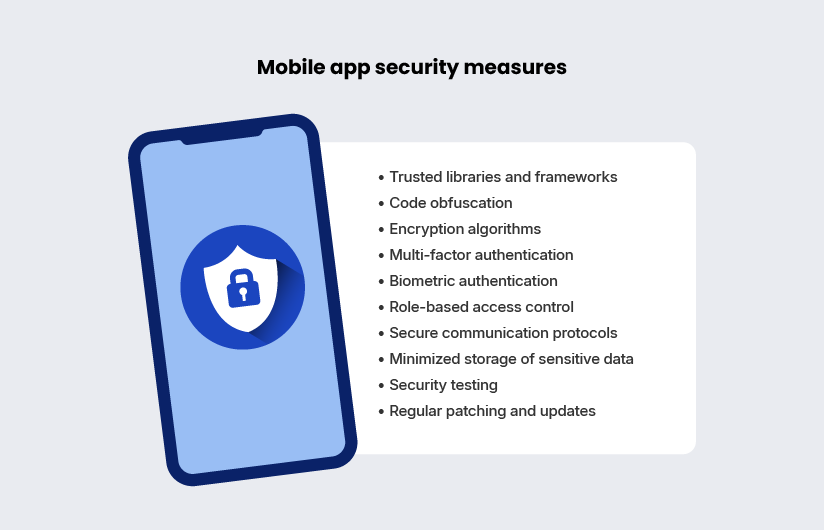
Developers should implement a range of measures to secure mobile applications effectively. To begin with, it’s important to use trusted libraries and frameworks: be cautious with third-party tools, ensure they are secure and regularly updated.
Code obfuscation and encryption are meant to protect the application code from reverse engineering. Multi-factor authentication (MFA), industry-standard encryption algorithms (e.g., AES), and secure communication protocols (e.g., HTTPS) safeguard sensitive data. Biometric authentication is another innovative method to protect apps. Role-based access control (RBAC) limits user permissions based on their roles. It’s also required to minimize the amount of sensitive data stored locally on devices, conduct regular security testing, patching, and updates.
10. Super Apps Expansion Beyond Asia
Super apps, once confined to Asia’s bustling markets, are rapidly expanding westward, consolidating multiple services into single, all-in-one platforms that redefine mobile engagement.
Super apps are dominant mobile platforms that combine payments, messaging, transportation, delivery, and financial services. They evolved from a single key function (e.g., a messenger or ride-hailing), offering users a seamless digital experience without switching apps. The leading super apps in Asia are WeChat, Grab, Gojek, Alipay, and Kaspi.
Giants like WeChat and Grab inspire Western counterparts — think evolved versions of PayPal, Uber, or Venmo integrating payments, messaging, ride-hailing, food delivery, and even mini-apps for shopping or gaming. North American and European adoption surges, with the US super app pilots reaching 150 million users and Europe seeing 30% growth in multi-service platforms, driven by demands for seamless, one-tap lifestyles.
This trend thrives on embedded finance, low-code mini-app ecosystems, and regulatory shifts favoring open banking, slashing app-switching friction and boosting retention by 40–50%.
Key drivers include:
- Unified ecosystems: Combine chat, finance, ecommerce, and services without downloads.
- Mini-app marketplaces: Host third-party tools, mirroring WeChat’s model for rapid innovation.
- Regulatory tailwinds: PSD3 in Europe and the US open banking enable secure cross-service flows.
- Personalization: AI tailors feeds across functions, enhancing daily utility.
Why You Should Choose SaM Solutions as Your Mobile Development Partner
SaM Solutions has been present on the market for over three decades. Mobile app development is among the key services we offer to our clients.
Whether you seek consultancy, app modernization, or custom development from the ground up (be it for iOS, Android, Windows, or a cross-platform solution), we have something to offer.
Regardless of the complexity of your concept, our team of mobile developers are enthusiastic about turning your ideas into a viable strategy. Armed with hands-on expertise in advanced technologies such as Flutter, .NET MAUI (Xamarin) and React Native, they prioritize the security and quality of the final product. Your expectations are carefully considered throughout the development process, so you get a tailored solution that aligns with your vision.
To Sum Up: Going Mobile Is the Right Way for Business
New trends in mobile app development prove that technology continues to penetrate ever deeper into our lives. Applications that previously were just another touchpoint with the brand have come to the forefront of digital transformation.
Mobile development follows the latest innovations and offers powerful and convenient solutions. Companies focus on apps to attract loyal customers, while customers expect more services to be available via apps.
Soon, we’ll see an increasing number of smartphone solutions that will use multiple advanced technologies. Many companies will turn to apps as a complementary or even primary source of income.
FAQ
Why are these trends considered the most important for the upcoming year?
They reflect both user expectations and technological capabilities. Consumers now demand personalization, instant interactions, and integrated experiences, while businesses seek efficiency, scalability, and competitive advantage. These trends collectively shape how apps are built, used, and monetized in 2026.
What skills should developers focus on to stay ahead of these trends?
Do these trends apply equally to all types of mobile applications?