IT Strategic Planning: How to Build a Future-Ready Technology Roadmap


(If you prefer video content, please watch the concise video summary of this article below)
Key Facts
- IT strategic planning helps companies decide which systems, platforms, investments, and modernization initiatives will create the most value.
- A strong IT strategy includes a practical roadmap, clear priorities, budgets, responsibilities, risks, KPIs, and regular review cycles.
- Future-ready IT roadmaps must stay flexible. Cloud, AI, automation, cybersecurity, and changing business priorities require continuous updates rather than one-time planning.
Technology rarely fails in one dramatic moment. It usually fails by accumulation: one outdated system, one rushed integration, one underfunded security gap, one department buying a tool that does not speak to the rest of the business. Over time, these decisions create friction. Costs rise. Delivery slows down. Data becomes fragmented. Innovation turns into a negotiation with legacy systems.
That is why IT strategic planning has become a business discipline that connects technology investments with revenue growth, operational resilience, customer experience, security, and long-term scalability. For business owners and C-level managers, the key question is whether the company has a clear plan for using technology wisely.
What Is IT Strategic Planning?
It is the process of defining how technology should support business goals over a defined period of time. It turns business priorities into a practical technology roadmap that covers systems, infrastructure, data, security, budgets, resources, risks, and measurable outcomes.
In simple terms, if corporate strategy explains where the business wants to go, the IT strategy explains what digital capabilities are needed to get there. It is a decision-making framework that helps leaders invest in the right technologies, in the right order, for the right business reasons.
Why IT Strategic Planning Matters for Modern Businesses
Modern companies run on software, even when they do not think of themselves as technology companies. Manufacturers use IoT platforms and predictive maintenance. Retailers depend on ecommerce, CRM, analytics, and supply chain systems. Financial organizations rely on secure data flows and automation. Healthcare companies need interoperable platforms, compliance, and reliable digital services.
Without strategic planning, technology grows chaotically. Teams solve urgent problems with isolated tools. Data remains trapped in disconnected systems. Cloud spending increases without clear governance. Security becomes reactive.
The cost of poor planning is not theoretical.
- Gartner has reported that only 47% of enterprises meet their strategy objectives.
- IBM’s 2025 Cost of a Data Breach Report placed the global average cost of a breach at about $4.4 million.
- Foundry’s 2026 CIO research shows that 69% of organizations expect IT budgets to increase, which means more companies are investing heavily but higher spending alone does not guarantee better outcomes.
Main Objectives of an IT Strategic Plan
An IT strategic plan gives leadership a structured way to decide what to modernize, what to build, what to retire, and what to protect.
Aligning technology with business goals
The first objective is alignment. Every major IT initiative should answer a business question: What outcome does this support?
For example, a manufacturer may want to reduce equipment downtime. The technology response could include IoT sensors, a data platform, predictive analytics, and integration with maintenance workflows. Alignment prevents technology from becoming a collection of disconnected experiments.
Building a long-term technology roadmap
A roadmap shows what should happen now, what can wait, and what depends on earlier work. This is especially important for companies with legacy systems. A full replacement may be too risky or expensive at once. A phased roadmap can prioritize API enablement, data migration, cloud modernization, user-facing improvements, and gradual decommissioning.
Improving resource allocation
Budgets, internal teams, vendors, and executive attention are limited. Strategic planning helps companies allocate these resources where they create the most value. This includes deciding which initiatives require in-house ownership, which can be outsourced, which should be handled by a product team, and which need external consulting or software engineering expertise.
Managing technology risks
Risks appear in many forms: cybersecurity threats, vendor lock-in, compliance gaps, unstable legacy systems, poor data quality, cloud misconfiguration, or lack of internal expertise.
An IT strategic plan brings these risks into the open before they become operational problems. It also defines mitigation measures, such as security controls, disaster recovery planning, architecture reviews, and governance policies.
Supporting digital transformation
Digital transformation becomes practical only when it is broken into executable steps. Strategic planning connects ambition (automation, AI, cloud, data-driven decision-making) with architecture, people, budgets, and measurable milestones. Without that connection, transformation remains a slogan.
What Is an IT Strategic Plan Document?
An IT strategic plan document is a structured record of the company’s technology direction, priorities, investments, risks, and roadmap. It is usually created for a one- to three-year horizon, though some enterprise roadmaps extend further.
The document should be detailed enough to guide decisions but concise enough for executives to use.
Key Components of an IT Strategic Plan
A strong plan combines business context with technical reality. It should help executives understand not only what needs to change, but why it matters and how the company can execute it.
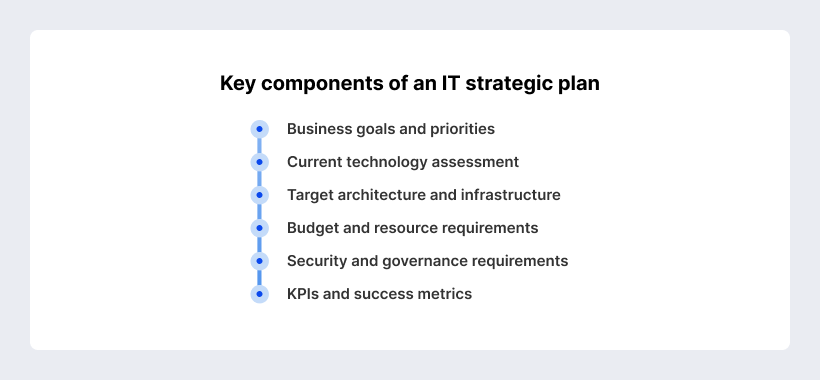
Business goals and priorities
The plan should begin with business priorities, not technology categories. Revenue growth, market expansion, cost reduction, customer retention, compliance, resilience, and operational efficiency may all require different digital capabilities.
For instance, a company planning international expansion may need multilingual ecommerce, scalable cloud infrastructure, tax and payment integrations, data residency controls, and global support processes.
Current technology assessment
Before defining the future, companies need an honest view of the present. This includes applications, infrastructure, integrations, data flows, security controls, vendor contracts, licenses, team capacity, and technical debt. The assessment should identify what works, what is outdated, what is risky, and what limits business growth.
Target architecture and infrastructure
The target architecture defines the future-state technology environment. This may include cloud or hybrid infrastructure, microservices, APIs, data platforms, cybersecurity architecture, mobile applications, AI components, or modernized enterprise systems.
Budget and resource requirements
Every strategy needs financial realism. The plan should estimate costs for software development, infrastructure, cloud services, licenses, migration, integrations, cybersecurity, testing, support, and change management.
It should also define the talent model: internal teams, external consultants, outsourced development teams, managed services, or a hybrid approach.
Security and governance requirements
Security must be part of the roadmap from the start. The plan should define access management, data protection, compliance requirements, incident response, vendor governance, audit processes, and security testing. With AI and automation entering more workflows, governance also needs to cover data usage, model validation, explainability, and human oversight.
KPIs and success metrics
Without metrics, the plan becomes subjective. KPIs may include system uptime, deployment frequency, cloud cost optimization, application response time, support ticket reduction, project delivery speed, user adoption, cybersecurity maturity, ROI, and revenue impact.
The right metrics depend on the business goal. A modernization program should not be measured only by whether the new system launched. It should be measured by whether it improved performance, reduced maintenance costs, or enabled new capabilities.
How to Develop an IT Strategic Plan
Developing an IT strategic plan requires structured discovery, executive input, technical assessment, prioritization, and continuous review. The process should be collaborative, not isolated inside the IT department.
Assess the current technology environment
Start with a clear inventory. Map systems, integrations, infrastructure, data sources, security policies, vendors, licenses, and known pain points. This step reveals hidden dependencies: a customer portal may rely on an outdated ERP interface; a reporting dashboard may depend on manual spreadsheet exports.
Collect stakeholder and executive input
Technology priorities should reflect business needs across departments. Interview executives, department heads, operational managers, IT leaders, finance, compliance, and customer-facing teams.
Ask direct questions. What slows the business down? Which systems cause the most friction? Where do customers experience delays? What risks worry leadership? Which opportunities cannot be pursued because the technology foundation is not ready?
Define scope, timeline, and priorities
Not everything can be done at once. Define the planning horizon, major workstreams, expected outcomes, dependencies, and decision criteria.
Prioritization should consider business impact, urgency, cost, complexity, risk, and readiness. A high-value initiative may still need to wait if the data foundation or integration layer is not prepared.
Evaluate vendors, tools, and systems
Tool selection should follow strategy, not drive it. Evaluate vendors and platforms based on scalability, security, integration capabilities, total cost of ownership, support model, compliance, and long-term fit.
For custom software, assess whether the company needs a new application, modernization of existing software, extension of a platform, or integration between systems.
Create a technology roadmap
The roadmap should group initiatives into phases. For example:
- Phase 1: IT audit, security improvements, infrastructure stabilization
- Phase 2: Cloud migration, API strategy, data platform implementation
- Phase 3: Application modernization, workflow automation, customer-facing improvements
- Phase 4: AI-enabled services, advanced analytics, continuous optimization
This structure helps leadership understand dependencies and prevents teams from launching advanced initiatives on unstable foundations.
Set KPIs and performance metrics
Define success before execution begins. Each initiative should have measurable targets, owners, deadlines, and review points.
For example, a cloud optimization initiative may target a 15% infrastructure cost reduction. A customer portal modernization may target faster response times and higher self-service adoption. A DevOps initiative may target shorter release cycles and fewer production incidents.
Review, approve, and update the plan
Executive approval is not the final step. It is the start of governance. The plan should be reviewed quarterly or semiannually, depending on the pace of change. Business priorities shift. Vendors change pricing. New regulations appear. AI capabilities mature. A useful plan adapts without losing strategic direction.
IT Strategic Planning and Budgeting
Budgeting forces leaders to choose between attractive ideas and affordable, valuable initiatives.
Connecting technology investments to business value
Every major investment should be tied to a business case. That does not mean every initiative must produce immediate revenue. Some investments reduce risk. Some improve resilience. Some prepare the company for future growth.
A cybersecurity program may protect revenue rather than generate it. A data platform may not deliver value on day one, but it can enable analytics, automation, AI, and better decision-making later.
Prioritizing initiatives based on impact
A practical scoring model can help leaders compare initiatives. Common criteria include expected business value, urgency, implementation complexity, regulatory importance, customer impact, and technical dependencies. This helps avoid the loudest-department-wins approach.
Reducing costs without reducing performance
Cost reduction should not mean cutting essential capabilities. It should mean reducing waste. Examples include retiring unused licenses, consolidating redundant tools, optimizing cloud workloads, automating manual processes, modernizing expensive legacy systems, and improving vendor contracts. Strategic cost control protects performance while freeing the budget for innovation.
Best Practices for Effective IT Strategic Planning
The strongest plans are clear, measurable, and executable. They are built not for a presentation but for decisions.
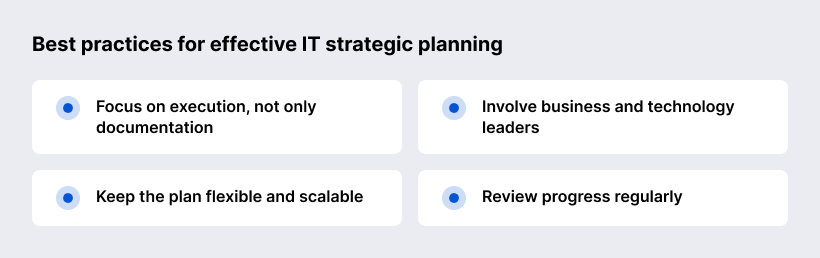
Focus on execution, not only documentation
A strategy that never reaches implementation has no business value. Assign owners, define milestones, set governance routines, and connect the roadmap to delivery teams.
Keep the plan flexible and scalable
Markets change. Technology changes faster. Build flexibility into the plan through modular architecture, phased delivery, cloud scalability, API-first integration, and regular review cycles.
Involve business and technology leaders
IT leaders understand systems. Business leaders understand priorities, customers, risks, and market pressure. A strong plan needs both perspectives. When the plan is co-owned, execution becomes easier.
Review progress regularly
Quarterly reviews help leadership track progress, remove blockers, adjust budgets, and update priorities. They also prevent the roadmap from becoming outdated after the first budget cycle.
Common Challenges in IT Strategic Planning
Even experienced organizations struggle with planning. The problem is rarely lack of ambition. It usually lacks alignment, visibility, or execution capacity.


The Future of IT Strategic Planning
IT planning is becoming more dynamic. The next generation of technology roadmaps will be shaped by AI, cloud maturity, cybersecurity, sustainability, and faster innovation cycles.
Artificial intelligence and automation
AI is moving from experimentation to operational use. Companies are exploring AI agents, intelligent automation, predictive analytics, code generation, customer support assistants, and more innovations.
Strategic planning must define where AI creates real value, what data is required, how outputs are validated, and how risks are governed.
Cloud and hybrid infrastructure
Cloud remains central, but many companies are moving toward hybrid models. Sensitive workloads, legacy systems, compliance requirements, and performance needs often require a balanced architecture.
Future-ready roadmaps should define not only where workloads run, but how they are monitored, secured, optimized, and integrated.
Cybersecurity and governance
Security will remain one of the highest priorities for CIOs and boards. The expansion of cloud, AI, remote work, APIs, and connected devices increases the attack surface.
Planning must include security architecture, compliance, identity management, backup and recovery, vendor risk, and incident response.
Sustainability and green technology
Sustainability is becoming part of IT decision-making. Cloud optimization, energy-efficient infrastructure, device lifecycle management, and responsible software architecture can reduce both costs and environmental impact.
Green IT is not only a branding topic. It is increasingly connected to procurement, compliance, and investor expectations.
Emerging technologies and innovation
Quantum computing, edge AI, advanced robotics, digital twins, blockchain, and immersive interfaces will not be relevant for every company immediately. But executives should track emerging technologies through a business lens. The better question here is “Which emerging capability could change our operating model, customer experience, or competitive position?”
IT Strategic Planning from SaM Solutions
SaM Solutions helps companies turn complex technology decisions into practical, executable roadmaps. With over 30 years of software engineering experience, more than 1,000 completed projects, and a global delivery presence, we support organizations across industries with IT consulting, custom software development, cloud solutions, AI and data services, legacy modernization, QA, DevOps, and long-term maintenance. We also offer complex modernization, multi-system integration, cloud transformation, AI implementation, and dedicated development team models.
Our approach to IT strategic planning services combines business analysis with deep engineering expertise. This is especially valuable for companies that need more than high-level recommendations.Our roadmap does not stop at “modernize legacy systems” or “move to the cloud.” It explains what to modernize first, which systems must be integrated, what risks need to be addressed, how much capacity is required, and how success will be measured.
Summing Up
IT strategic planning is the difference between technology as a cost center and technology as a business advantage. It gives leaders a clear view of where they are, where they need to go, and which digital capabilities will help them get there.
With the right technology partner like SaM Solutions, an IT strategy becomes a working plan for modernization, innovation, and long-term resilience.
FAQ
How often should an IT strategic plan be reviewed?
An IT strategic plan should be reviewed at least once a year, but quarterly reviews are more practical for fast-changing businesses. Annual reviews help confirm long-term direction, while quarterly check-ins allow leadership teams to adjust priorities, budgets, risks, and timelines. The plan should also be revisited after major business changes, such as mergers, market expansion, new regulations, cybersecurity incidents, or large technology investments.
What tools can help manage IT strategic planning?
How is IT strategic planning different from enterprise architecture?





![Digital Transformation Strategy [+ Key Trends in 2026]](https://sam-solutions.com/wp-content/uploads/fly-images/16958/title-366x235-c.webp)