What Is Quantum Computing?


(If you prefer video content, please watch the concise video summary of this article below)
Key Facts
- Quantum computing uses qubits, which are different from regular bits, as they can exist in a superposition, allowing quantum computers to use probabilities as opposed to regular 0s and 1s.
- Quantum advantage has already been demonstrated in certain situations, as Google’s 53-qubit Sycamore quantum processor completed a task in ~200 seconds, which would be impossible for a regular computer given the same conditions.
- Quantum algorithms use interference and entanglements, not the ability to try all possibilities at once, as demonstrated in Grover’s search and Shor’s factoring algorithms.
- Quantum computers are currently in the NISQ (Noisy Intermediate-Scale Quantum) era, which means they are prone to errors, are not large-scale, and must use a combination of quantum and regular computing.
- Fault-tolerant quantum computing is still a difficult problem, as estimates suggest that millions of physical qubits are needed for certain tasks, such as breaking RSA encryption, due to error correction.
Quantum computing is often described as “the next big thing,” but the most useful way to think about it is simpler: it’s a different kind of computing that uses different physics. Instead of using 0s and 1s to store information, it uses fragile quantum states.
To manipulate information, it also uses operations that are more similar to controlling waves instead of using switches. Quantum computing explained through real-world experiments shows how different physics can produce headline-grabbing milestones.
In 2019, a group at Google described a process in which a random quantum circuit was sampled using its 53-qubit “Sycamore” processor in 200 seconds, a process which, according to the authors, would take a state-of-the-art supercomputer an impractically long time to reproduce, based on the benchmarking process. However, prominent scientists have also pointed out that these quantum devices are still “noisy” and that significant advances in error correction are still needed for most transformative applications.
Achieve digital transformation with software engineering services delivered by SaM Solutions’ seasoned engineers.
Definition of Quantum Computing
What is quantum computing? At a high level, the definition of quantum computing refers to computation performed by controlling quantum systems — systems that can exist in superpositions and become entangled — and extracting answers through measurement. In practice, a quantum computer is a stack of hardware and software used to prepare qubits, perform a series of quantum operations on them (quantum gates), and measure the result to estimate the output of a given algorithm.
It is also important to understand the context of this idea. The original motivation is often traced back to Richard Feynman’s argument that it becomes increasingly difficult to simulate quantum physics using classical computers as the number of particles increases — arguably making a computer built out of quantum components a more natural simulator of nature. The idea of a universal, programmable quantum computer was formalized by David Deutsch in the mid‑1980s, providing a theoretical foundation for quantum algorithms and complexity theory.
A brief working definition to keep in mind:
Quantum computing uses qubits and quantum gates to manipulate a probability distribution over possible outcomes, which is then sampled through measurement.
How Does Quantum Computing Work?
Under the hood, it’s less “try every answer at once” and more “construct a wave of possible answers, and then carefully arrange interference so the right ones become more probable upon measurement.” Because of the probabilistic nature of measurement, a quantum program is usually run many times (“shots”) to estimate the probability of different results.
Most of today’s quantum computing is performed using the “quantum circuit model”: initialize qubits, apply a sequence of unitary gates (including entanglement gates between two qubits), and measure at the end (or sometimes during) the computation. The “magic” of quantum computation comes from the wave-like nature of quantum states. Algorithms work by carefully choosing a sequence of gates so that the right answers have large wave amplitudes, and the wrong ones have small or destructively interfering wave amplitudes.
Two examples of algorithms that demonstrate what’s meant by speedup are well known:
- Grover’s search algorithm provides a speed advantage over classical methods: it can find a marked item in a list much faster, needing only about the square root of the number of items to check, while classical algorithms may need to examine each item one by one.
- Factoring and discrete logarithm computation (Shor): Peter Shor’s quantum algorithm for factoring large composite numbers and computing discrete logarithms has a significant speedup over classical algorithms for the same problem; these algorithms are the basis for public-key encryption when implemented classically.
One very simple example that’s often useful for illustrating the basic concepts is if you create a quantum entangled state for a pair of qubits in a so-called Bell state, measuring one qubit immediately puts constraints on the probabilities for the second qubit, even though the actual result for each qubit is still random.
Quantum Computing vs. Classical Computing
Before we dive into superposition and entanglement, let’s take a look at these two paradigms side by side. In a classical computer, the hardware (transistors, voltage levels) is deterministic, and probabilistic behavior occurs only as a result of the introduction of random behavior. In a quantum computer, the measurement process is probabilistic by design, and the state of a quantum computer is controlled by quantum amplitudes.
| Aspect | Classical computing | Quantum computing |
| Fundamental unit | Bit (0 or 1) | Qubit (quantum state measured as 0 or 1) |
| State space scaling | (n) bits represent one of (2^n) configurations at a time | (n) qubits are described by (2^n) amplitudes (in general) |
| Core operations | Boolean logic gates, arithmetic | Quantum gates (unitary evolution) + measurement |
| Output behavior | Deterministic (typically) | Probabilistic; repeated runs estimate results |
| Noise tolerance | Very high (robust digital abstraction) | Low; noise, drift, and decoherence are central constraints |
| Best-known “native” strengths | General-purpose computing, control, databases, most workloads | Certain simulations and algorithmic patterns (e.g., phase estimation, amplitude amplification, some optimization formulations) |
| Maturity | Ubiquitous, highly standardized | Emerging; devices are still error-prone and limited |
This table reflects core textbook-level facts about quantum state scaling and measurement, and widely discussed constraints about noise and the current “NISQ” era.
The limits of classical bits
Classical bits are extraordinarily reliable abstractions: once a transistor is interpreted as “0” or “1,” digital error-correction and well-understood engineering deliver the stable computing you use every day. The limitation isn’t that classical computing is “weak” — it’s that some problems appear to scale poorly when forced into classical representations.
A famous example is simulating quantum systems. In chemistry and materials science, exact methods can scale exponentially with system size for certain formulations, which is one reason quantum simulation became an early “killer app” candidate for quantum computers. More broadly, the general description of an (N)-qubit quantum state requires on the order of (2^N) amplitudes — so even storing or updating that information explicitly can become infeasible for large (N) in naïve classical simulation approaches.
The power of quantum bits
If classical bits store definite states, quantum bits store states of possibility — with careful control over phases (relative “wave angles”) that determine how amplitudes interfere. This is not automatically a speedup: quantum algorithms must be designed so that the “right” outcomes gain probability mass when measured. At the heart of quantum computing lies a set of principles that fundamentally redefine how information is represented and manipulated:
- Superposition — when a qubit is measured, it gives a classical 0 or 1 with probabilities determined by the squared amplitudes.
- Entanglement — any number of qubits may share a common nondecomposable state. This allows for correlations and information structures that have no classical analogs.
- Interference — quantum amplitudes can add or cancel like waves. Many algorithms can be understood as interference-engineering: reinforce amplitudes associated with correct answers and suppress the rest.
- Decoherence — quantum information tends to be unstable, and unwanted interactions with the environment (noise, heat, external fields) cause loss of coherence, turning quantum information into classical noise.
Key Components of a Quantum Computer
However, a practical quantum computer is not just a “quantum chip.” It is a highly integrated system that combines a quantum computer, which is often built with hardware that works in extreme conditions, with a classical computer that is used for software.
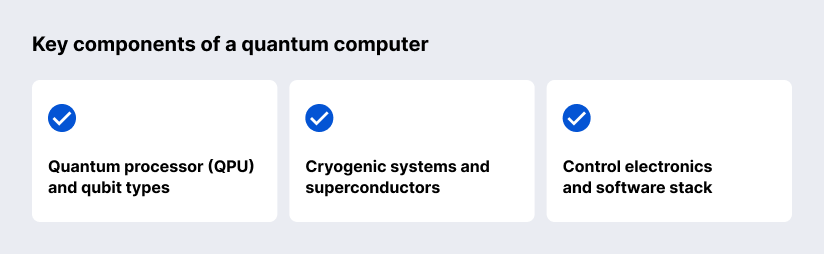
The quantum processing unit (QPU) implements qubits and gates with a specific physical technology, and that choice strongly affects scaling, error rates, connectivity, and operating requirements. Common qubit modalities include:
- Superconducting circuits (a leading gate-based approach): engineered electrical circuits that behave quantum-mechanically at cryogenic temperatures.
- Trapped ions: qubits encoded in ions held by electromagnetic traps and manipulated with lasers; a mature research platform with demonstrated high-fidelity operations.
- Neutral atoms (often Rydberg-based): atoms held in optical traps and coupled via Rydberg interactions, offering promising scaling characteristics.
- Photonics: quantum information carried by photons, attractive for networking and potentially modular architectures.
- Silicon spin qubits: qubits based on electron spins in silicon devices, with a long-term promise of leveraging industrial semiconductor fabrication.
A practical, business-relevant takeaway is that “qubit count” alone is insufficient for comparing systems: connectivity, gate fidelity, error structure, calibration stability, and attainable circuit depth can matter as much as raw qubit numbers.
Many quantum hardware platforms require isolation from the environment; qubits in superconductors are typically operated at millikelvin temperatures, which is why dilution refrigerators and carefully engineered cryogenic wiring, filtering, and shielding are central components of many systems. The cryogenic stack is not “supporting equipment” — it is part of the compute system. For example, microwave components and cables must be thermalized and filtered to reduce heat loads and suppress unwanted radiation that can degrade qubit performance and inject noise into readout.
Quantum processors do not run in isolation; they depend on classical systems for control, readout, compilation, and orchestration. In superconducting systems, this typically includes generating precisely shaped microwave pulses, synchronizing timing across channels, and digitizing readout signals.
In trapped-ion and neutral-atom systems, lasers and optical control systems play an analogous role. On the software side, developers write circuits or hybrid programs, the software compiles/transpiles them into hardware-native gate sets, schedules operations subject to device constraints, submits jobs, and post-processes measurement results. Cloud platforms now provide standardized “quantum-as-a-service” workflows, including job management and integration with classical computers.
Practical Applications and Use Cases
A realistic view of applications starts with a key point: today’s quantum computers are still rudimentary and error-prone, and many of the biggest promised advantages require fault-tolerant machines with vastly lower effective error rates. That said, there are credible, well-studied domains where quantum computing offers either clear theoretical advantages or compelling research pathways — especially in simulation and certain algorithmic primitives like amplitude estimation.
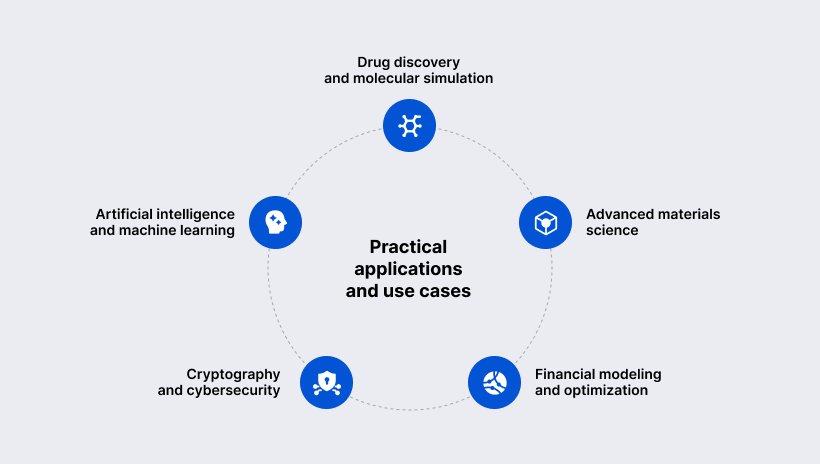
Drug discovery and molecular simulation
Quantum chemistry is one of the most rigorously developed application areas because chemical systems are quantum by nature. Early, influential work argued that quantum algorithms can compute molecular energies with more favorable scaling than classical exact methods, and demonstrated simulations of such algorithms for molecules like water and lithium hydride.
In the near term, hybrid algorithms such as the variational quantum eigensolver (VQE) are widely explored because they are designed to work with shorter circuits, using a classical optimizer wrapped around quantum measurements. At the same time, modern perspectives remain clear-eyed: many large-scale electronic-structure approaches are still too expensive for near-term hardware, and better algorithms and error reduction will be required for practical, large-molecule utility.
Advanced materials science
Materials science overlaps with chemistry but often emphasizes extended systems, defects, and properties relevant to catalysts, batteries, and quantum materials. A growing body of work discusses “quantum-centric supercomputing,” where quantum processors are integrated into high-performance computing workflows to tackle parts of materials problems that are especially hard classically.
It’s also worth distinguishing hardware types: some studies explore quantum annealing for specific formulations (for example, energy calculations in particular defect-structure settings), which may be relevant for optimization-like mappings even if they differ from gate-based universal quantum computing.
Financial modeling and optimization
Many financial workloads rely on Monte Carlo simulation (pricing, risk measures, scenario analysis). Quantum computing enters the conversation because quantum amplitude estimation and related techniques can offer a quadratic improvement in certain sample-complexity measures compared with classical Monte Carlo under standard assumptions.
A concrete example is “quantum risk analysis,” which proposes using amplitude estimation to evaluate risk measures like Value at Risk (VaR) and Conditional Value at Risk (CVaR), and discusses implementation tradeoffs with circuit depth.
For combinatorial optimization (routing, scheduling, portfolio constraints, etc.), the Quantum Approximate Optimization Algorithm (QAOA) is a widely studied candidate. Its original formulation includes provable approximation guarantees in specific graph settings — for instance, for (p=1) on 3-regular graphs, the authors derived a lower bound of about 0.6924 of optimal for MaxCut.
Cryptography and cybersecurity
Cybersecurity is where quantum computing has the clearest “negative” impact: large-scale, fault-tolerant quantum computers would threaten widely deployed public-key cryptography based on factoring and discrete logarithms, because those problems have polynomial-time quantum algorithms.
This is why post-quantum cryptography (PQC) is not speculative anymore. National Institute of Standards and Technology announced on August 13, 2024 that it released its first three finalized post-quantum cryptography standards (FIPS 203, 204, and 205). NIST’s PQC project guidance explicitly urges organizations to begin migrating, emphasizing the need to identify where quantum-vulnerable algorithms are used and plan replacements.
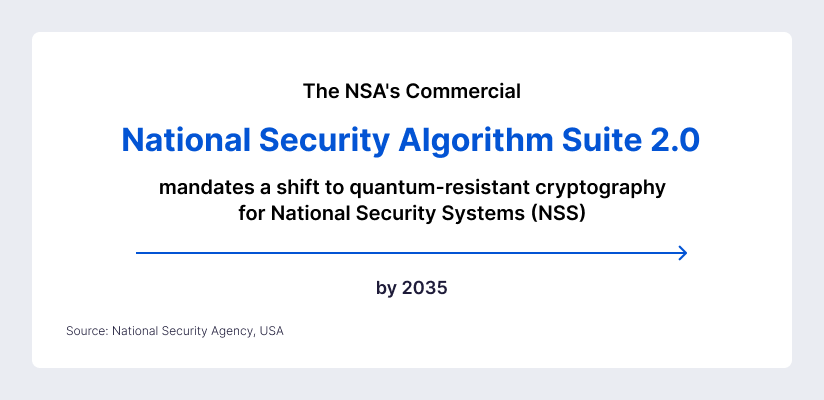
Governments are also publishing concrete migration timelines and procurement guidance. The National Cyber Security Centre (UK) sets milestones that culminate in completing migration to PQC by 2035, with earlier planning and discovery expectations by 2028 and prioritized migration activities by 2031. In the US, the NSA’s Commercial National Security Algorithm Suite 2.0 (CNSA 2.0) mandates a shift to quantum-resistant cryptography for National Security Systems (NSS) by 2035. The Cybersecurity and Infrastructure Security Agency has also published guidance (including product categories) aimed at accelerating PQC adoption decisions.
A key practical driver is “harvest now, decrypt later”: adversaries can record encrypted traffic today and attempt decryption later if quantum capability emerges, which is why migration planning is often framed as a data-protection and lifecycle problem, not just a future hypothetical.
Artificial intelligence and machine learning
Quantum machine learning (QML) explores whether quantum resources could accelerate or improve parts of AI workflows — through quantum kernels, variational circuits, or subroutines such as amplitude estimation used inside learning pipelines.
However, QML proposals must compete with extremely strong classical baselines, and near-term devices face issues like noise and trainability barriers. The “barren plateau” phenomenon — where gradients vanish exponentially with system size in some variational settings — has become a major topic because it can make training variational models difficult in practice.
Major Challenges and Future Outlook
Quantum computing progress is real, but its bottlenecks are unusually fundamental: you are trying to compute information that naturally wants to leak into the environment. The roadmap is therefore as much about engineering and error correction as it is about algorithms.
The dominant technical barrier is achieving fault-tolerant computation, where logical qubits are protected by quantum error correction and can run long algorithms reliably. Surface-code approaches are a widely studied route to fault tolerance, and foundational work provides resource estimates and fault-tolerance properties for such architectures.
Recent experiments show incremental but meaningful progress. For example, a 2023 result reported performance scaling in a surface-code logical qubit experiment, with a distance‑5 logical qubit modestly outperforming distance‑3 logical qubits under their tested conditions — an important signpost on the path to scalable error correction.
The scale implied by error correction can be enormous. A concise statement from the neutral‑atom computing literature notes that “a few hundred” logical qubits for deep calculations could require on the order of a million physical qubits — illustrating why today’s devices (even at hundreds or thousands of physical qubits) may still be far from broadly fault-tolerant general-purpose use.
Security-related resource estimates underline the same point. In one widely cited study, Craig Gidney and Martin Ekerå estimated that factoring RSA‑2048 in about 8 hours could require on the order of 20 million noisy physical qubits under specific architectural and error-rate assumptions. Later work by Gidney revisited assumptions and circuit constructions, estimating that RSA‑2048 factoring might be achievable with fewer than a million noisy qubits but on longer (multi‑day) runtimes under stated assumptions — illustrating both progress in algorithm engineering and the sensitivity of forecasts to architecture and error models.
Because today’s hardware is noisy, many practical approaches are hybrid: a classical system orchestrates iterative loops while the processor performs subroutines that are hard to emulate classically at scale (state preparation, sampling, energy estimation, etc.). The “NISQ” framing — coined and popularized by John Preskill — explicitly anticipates this era: devices with tens to hundreds of qubits may be scientifically valuable, but noise limits circuit depth and delays broader transformation.
VQE and QAOA are emblematic hybrid algorithms: each combines short or structured quantum circuits with classical optimization. Their foundational papers and modern learning resources describe this loop explicitly. This hybrid framing is also increasingly tied to HPC integration, especially in domains like materials science, where subroutines may eventually function as accelerators inside larger classical workflows.
Commercial viability is best thought of as a sequence of capability thresholds rather than a single finish line: improved physical qubits and gates, stable calibration, scalable control systems, demonstrably better logical qubits, and ultimately reliable fault-tolerant computation for economically meaningful workloads. The key nuance is that progress must happen across the whole stack. Hardware reviews emphasize the engineering complexity of superconducting platforms; control-interface work highlights scaling constraints in wiring, electronics, and cryogenic integration; and error-correction experiments show that the step from “more qubits” to “useful, protected computation” is not automatic.
Getting Started with Quantum Computing Today
The good news is you no longer need a physics lab to experiment with quantum computing. Cloud services provide access to real QPUs as well as simulators, while educational resources have matured enough for software engineers, data scientists, and R&D teams to build practical intuition.
Cloud-based quantum processors (QPUs)
Today’s easiest on-ramp is cloud access:
- IBM provides cloud access to its systems and associated tooling through the IBM Quantum Platform (with Qiskit-centered workflows).
- Amazon Web Services offers Amazon Braket, a managed service that provides access to multiple hardware types and built-in simulation options.
- Microsoft provides Azure Quantum, including tooling and the ability to submit jobs to quantum hardware through an Azure workspace and develop using languages such as Q# and Python integrations.
Even if your near-term goal is “learning,” running small circuits on real devices is valuable because it forces you to confront real constraints: noise, calibration drift, limited connectivity, compilation overhead, and statistics from repeated measurements.
Educational resources and simulators
A practical learning path usually alternates between theory and hands-on experimentation:
- For fundamentals (clear, rigorous, and free), MIT OpenCourseWare includes lecture notes on quantum computing and the underlying mechanics concepts that matter most for algorithms.
- For developer-focused practice, Microsoft’s Quantum Katas offer structured exercises for learning computing and Q# programming.
- For prototyping, cloud services typically include simulators. For example, Amazon Braket supports local simulation for rapid testing without submitting jobs to hardware.
- For broad, plain-language orientation and realistic expectations, NIST’s “Quantum computing explained” overview is a strong starting point.
Identifying early business use cases
The most productive early business work is usually use-case discovery + feasibility analysis, not “replace your servers with qubits.” A defensible approach is:
Choose a problem family with a credible angle (chemistry simulation, materials modeling, Monte Carlo-heavy risk analyses, or structured optimization), map it to a known algorithmic approach (e.g., VQE/QAOA/amplitude estimation), and then estimate resources and constraints before running pilots.
Two practical filters can keep teams honest:
- Is there a known quantum primitive that changes scaling in a way that matters for your problem? (e.g., amplitude estimation vs. Monte Carlo).
- Can the workload tolerate near-term constraints (noise, limited circuit depth), or does it fundamentally require fault tolerance? This distinction is central to the NISQ framing and to modern application reviews.
Develop your custom software with SaM Solutions’ engineers, skilled in the latest tech and well-versed in a wide range of industries.
Conclusion
Quantum computing is best understood as a new computational medium: it manipulates probability amplitudes and correlations (entanglement) to reshape which outcomes are likely when you measure. That enables remarkable algorithmic results in carefully defined settings — search speedups, factoring/discrete-log breakthroughs, and strong theoretical foundations for simulation and estimation.
At the same time, today’s quantum computers remain constrained by decoherence and error rates, making fault tolerance — and the massive overhead it implies — the central engineering challenge. The near-term reality is hybrid quantum-classical workflows, cloud access for experimentation, and targeted R&D where quantum subroutines might eventually become valuable accelerators in chemistry, materials, finance, and optimization.
FAQ
How can enterprises get started with cloud-based access to real quantum computers for research and development?
Start by using a cloud platform that supports both simulators and real QPUs so teams can iterate quickly and then validate on hardware. IBM Quantum Platform, Amazon Braket, and Azure Quantum all provide pathways to submit jobs to real devices, manage runs, and integrate classical code for hybrid workflows. A sensible enterprise pilot usually begins with (1) sandbox learning and governance, (2) simulator-based prototyping, (3) hardware experiments sized to device limits, and (4) metrics that compare outputs to high-quality classical baselines.
What is the best way for a business to explore quantum computing solutions for optimization, chemistry, and financial modeling?
Can quantum computers solve NP-complete problems instantly?