How Agentic AI Transforms SaaS Companies


(If you prefer video content, please watch the concise video summary of this article below)
Key Facts
- Core shift: SaaS is moving from tools users operate to platforms that help plan, act, and optimize.
- Business value: Faster workflows, less manual work, better personalization, sharper analytics.
- Architecture needs: Clean data, secure APIs, orchestration, integration, governance, monitoring, and scalability.
- Best first use cases: Support, sales, finance, compliance, product analytics, QA.
- Main risk: Autonomy without guardrails can break trust, security, and compliance.
- Strategic upside: Winners will sell outcomes, not just software access.
Agentic AI is changing the SaaS promise. The old contract was simple: log in, use the tools, do the work. The new one is more ambitious: define the goal, and let the platform help carry the process.
This is not a cosmetic AI layer. It changes product design, architecture, pricing, customer expectations, and how SaaS companies prove value.
Why SaaS Companies Need Agentic AI Transformation
SaaS buyers are flooded with tools. What they lack is clean execution.
The shift from software interfaces to autonomous AI agents
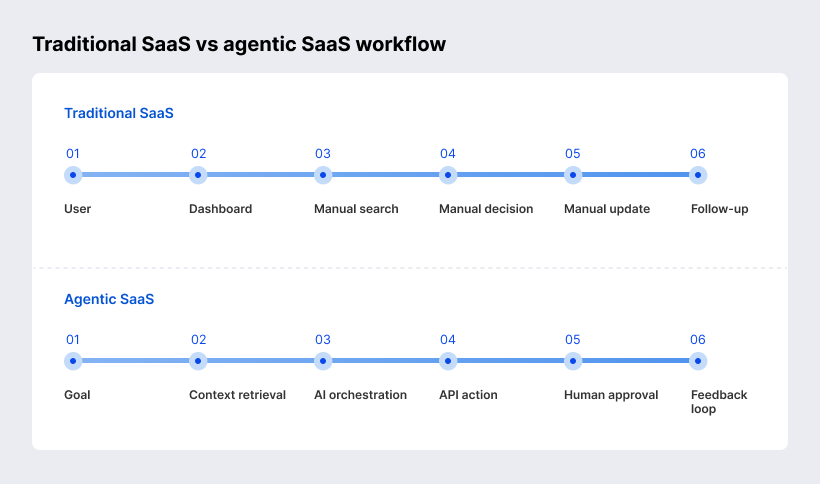
Traditional SaaS is dense with dashboards, tabs, filters, alerts, and forms. Each screen gives control. Together, they create work.
Take customer success. A manager preparing for renewals may check CRM notes, product usage, support history, billing status, contract terms, and email threads. The task is ordinary. The effort is not.
With autonomous AI agents inside the product, the platform can detect churn risk, explain the cause, suggest a recovery playbook, draft outreach, and create follow-up tasks. The human still decides. The software does the digging.
The interface becomes less cockpit, more newsroom desk: signals arrive, context is assembled, action is ready.
Rising enterprise demand for intelligent automation
Enterprises have automated the obvious: ticket routes, reminder fires, and status updates.
The bottleneck now sits in messy middle work. An invoice does not match a contract. A supplier lacks one compliance document. A customer issue depends on policy, account tier, and prior exceptions.
Basic automation breaks when context matters. AI-driven workflows can compare records, ask for missing information, recommend next steps, and escalate when confidence is low.
That is where SaaS products can become harder to replace: not by adding sparkle, but by removing drag.
Competitive pressure in the AI-native SaaS market
AI-native SaaS vendors start with a different assumption. Intelligence is not an add-on. It is part of the product’s nervous system.
Buyers notice. They ask sharper questions: How much work will this remove? Can it reduce cycle time? Will it catch problems before people do?
For established vendors, agentic AI SaaS transformation is no longer an innovation project on the edge. It is becoming a core strategy.
What Is Agentic AI in SaaS?
Agentic AI in SaaS means embedding autonomous or semi-autonomous capabilities into cloud platforms so they can plan tasks, use tools, call APIs, and support business workflows.
How AI agents work inside SaaS platforms
Within a SaaS product, AI agents typically understand a goal, gather context, choose a step, use a tool, check the result, and continue or escalate.
In support software, the system may read a ticket, identify the customer tier, review past cases, search the knowledge base, draft a reply, update the case, and request approval.
In finance, it may compare an invoice with contract terms, flag a mismatch, request documentation, and prepare an exception report.
The principle is controlled autonomy: permissions, policies, thresholds, audit trails, and human checkpoints.
Agentic AI vs traditional automation
Traditional automation works when the path is predictable. Agentic AI works better when context changes the path.
| Dimension | Traditional automation | Agentic AI |
|---|---|---|
| Logic | Rule-based | Goal-based and adaptive |
| Workflow | Linear | Dynamic and multi-step |
| Data | Mostly structured | Structured and unstructured |
| Decisions | Fixed conditions | Context-aware reasoning |
| Integration | Scripts, RPA, workflow tools | APIs, tools, orchestration |
| Human role | Configure and monitor | Supervise, approve, improve |
| Best fit | Repetitive tasks | Complex business processes |
Agentic AI vs generative AI
Generative AI creates content. Agentic AI uses generation, reasoning, and access to tools to help complete a task.
| Dimension | Generative AI | Agentic AI |
|---|---|---|
| Main purpose | Create text, code, summaries | Achieve a business goal |
| Interaction | Prompt and response | Goal, plan, action, feedback |
| Autonomy | Limited | Higher, with controls |
| Tool use | Optional | Essential |
| SaaS value | Productivity support | Workflow execution |
| Example | Summarize a ticket | Resolve or escalate it |
Why Agentic AI Is Changing SaaS Business Models
Agentic AI changes SaaS economics because value moves from access to outcomes. Customers care less about feature volume and more about what the platform helps finish.
That shift reaches pricing, packaging, and retention.
From user-led actions to outcome-based software
Classic SaaS gives users tools. People still assemble the process.
A sales platform stores contacts, logs meetings, tracks the pipeline, and produces reports. The seller still decides who needs attention, what to say, when to follow up, and how to update the record.
AI-powered SaaS can take on more of that sequence. It spots stalled deals, summarizes account activity, drafts outreach, recommends next steps, and schedules reminders.
The value story becomes blunt: faster response times, fewer missed opportunities, higher conversion rates, and less administrative burden.
From static features to adaptive workflows
Static features assume that business processes remain static. They do not.
A low-risk renewal may need one approval. A new vendor handling customer data may require legal review, security checks, budget approval, and proof of compliance.
Adaptive workflows bend with the case. They adjust to risk, policy, behavior, and context.
For SaaS vendors, this is more than configuration. It is software that reads the room.
From SaaS subscriptions to AI-powered value delivery
Seat-based pricing will remain, but it fits less neatly when software performs work once assigned to people.
Vendors may blend subscriptions with usage-based, workflow-based, or value-based models. The unit may be tickets resolved, documents reviewed, risks assessed, tests generated, or hours saved.
How Agentic AI Transforms SaaS Platforms
Agentic AI changes SaaS products in four visible ways, which together turn software into a coordinator of people, data, tools, and outcomes.
Autonomous workflow execution
Autonomous workflow execution means the platform can complete approved steps without asking users to click through each stage.
In support, that may include classification, account lookup, answer retrieval, response drafting, and status updates. In finance, it may include invoice matching, anomaly detection, and reminder creation.
The hard part is not action. It is a boundary design. What can happen alone? What needs approval? What must always go to a person?
Great SaaS products make those lines obvious.
Intelligent decision support
Not every workflow should run on autopilot. Sometimes, the right role for AI is preparation.
A risk platform can gather vendor records, compare them with policy, highlight missing evidence, and suggest a risk level. A human reviewer then approves, rejects, or asks for more.
The expert remains accountable. The scramble for context shrinks.
Cross-system process orchestration
Real workflows rarely live in one product. Customer onboarding may touch CRM, e-signature, billing, identity management, analytics, support, and email.
AI orchestration connects those systems through APIs and integration layers. Instead of copying data between tools, the platform coordinates the work.
That makes integration a front-office issue. If intelligence cannot retrieve records, update fields, trigger tasks, or notify the right person, it is cosmetic.
Continuous optimization through feedback loops
A mature platform learns from results. Did the recommendation work? Was the ticket resolved? Did the customer renew? Did the test catch a defect?
Feedback loops improve performance and strengthen governance. Teams can see what happened, why, and whether outcomes are improving.
Without feedback, autonomy is guesswork. With it, autonomy becomes optimization.
Leverage AI to transform your business with custom solutions from SaM Solutions’ expert developers.
Core Components of Agentic SaaS Architecture
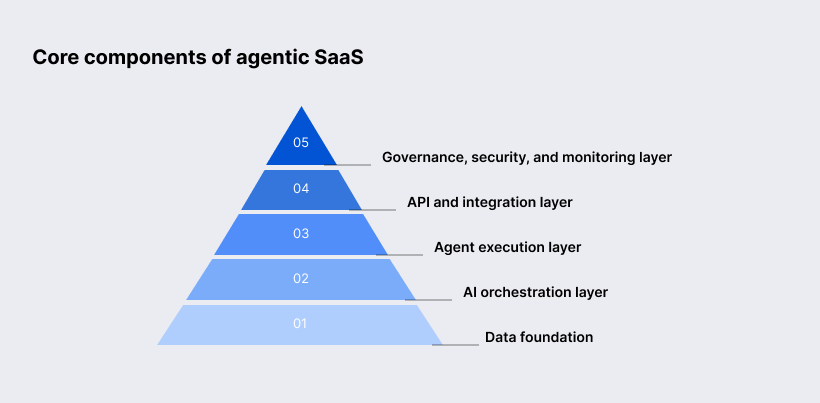
Agentic SaaS architecture is not a model bolted to chat. It needs data, orchestration, execution controls, APIs, governance, security, and monitoring.
These layers decide whether autonomy scales or stalls.
Data foundation for AI agents
Data is the base layer. SaaS products need accurate customer records, product events, support history, billing details, knowledge bases, and permission-aware retrieval.
Consider B2B onboarding. To guide a new customer, the system needs contract terms, user roles, implementation status, open tickets, configuration details, and training progress.
Bad data does not improve because AI touched it. It becomes faster bad data.
AI orchestration layer
The orchestration layer coordinates models, tools, prompts, memory, rules, and workflows. It decides what happens next and which system acts.
Without it, teams build scattered AI features that follow different policies, use different data, and produce inconsistent results.
Orchestration brings order to the swarm.
Agent execution layer
The execution layer is where AI-driven work happens: creating tickets, updating records, sending messages, generating reports, running tests, or requesting approvals.
It needs controls: role-based permissions, action limits, audit trails, rollback options, test environments, and escalation paths.
Autonomy should expand slowly: recommendations first, approved actions next, limited independent execution later.
API and integration layer
AI needs tools to act. APIs connect it to CRM records, billing systems, ERP platforms, data warehouses, messaging tools, analytics products, and internal services.
This layer separates useful AI from decorative AI.
If the system cannot update a record or trigger a workflow, it remains a clever side panel. Integrated AI becomes part of operations.
Governance, security, and monitoring layer
Governance defines what the system can do, what data it can use, when approval is required, and how actions are recorded.
Security covers identity, privacy, compliance, encryption, retention, prompt injection risks, and unauthorized use of tools. Monitoring tracks cost, errors, escalations, user feedback, performance, and business impact.
Enterprise buyers will ask hard questions here. They should.
Practical Use Cases of Agentic AI in SaaS
The best use cases have volume, pain, measurable value, and enough structure to control risk. Start where autonomy improves speed, accuracy, or customer experience.
Several areas stand out.


Key Steps for SaaS Companies to Adopt Agentic AI
SaaS companies should follow a focused roadmap. Small, governed wins beat broad pilots with no owner.
Assess existing product architecture
Start with the foundation. Can the platform expose secure APIs? Are permissions granular? Are workflows configurable? Can actions be audited? Is telemetry available?
If the architecture is monolithic, poorly documented, or hard to integrate, modernization may come first.
Autonomy needs room to move. It also needs brakes.
Modernize data and integration capabilities
AI needs trusted context. SaaS teams should improve data quality, connect fragmented systems, standardize events, and build secure retrieval pipelines.
The goal is not a model bolted on top. It is an AI-ready SaaS foundation.
Clean data. Reliable APIs. Clear access rules.
Identify high-value agentic use cases
Prioritize workflows with clear pain and measurable value: support resolution, lead qualification, renewal risk, onboarding, invoice exceptions, compliance evidence, and QA automation.
Avoid the grand “AI assistant for everything.” It sounds ambitious. It usually collapses under fuzzy ownership, unclear data, and weak ROI.
Specific beats spectacular.
Build or integrate AI agents
SaaS companies can build custom AI agents, integrate third-party platforms, or use both.
Custom development fits proprietary workflows, sensitive data, and differentiated product experiences. Third-party platforms may work for common tasks such as document handling, internal productivity, and service support.
SaM Solutions provides AI agent development services for companies that need tailored capabilities inside SaaS products.
Measure performance, ROI, and business impact
Measure more than model accuracy. Track completion rate, escalation rate, time saved, cost per workflow, error rate, adoption, revenue influence, and customer satisfaction.
Autonomy must earn trust.
Start with recommendations. Move to approved actions. Later, allow limited independent execution where risk is low, and performance is proven.
Challenges of Agentic AI SaaS Transformation
The main obstacles are data fragmentation, security, reliability, explainability, and trust. These problems are solvable only when addressed early.
Ignore them, and innovation becomes risk.
Data quality and system fragmentation
AI performs poorly when data is outdated, duplicated, incomplete, or trapped in disconnected systems.
A customer may look healthy in CRM but show repeated complaints in support and falling usage in analytics. Without integration, the platform may recommend the wrong action.
Data readiness is not housekeeping. It is a strategy.
Security, privacy, and compliance risks
Autonomous systems can access sensitive data and trigger real actions. That raises the bar for identity management, access controls, encryption, audit logs, and compliance policies.
Healthcare, fintech, insurance, and enterprise IT need careful governance. The more valuable the workflow, the stronger the guardrails must be.
Trust is built in architecture before it appears in the interface.
Reliability, explainability, and human oversight
Business users need to know why a recommendation was made or why an action happened.
Important outputs should show evidence, sources, confidence signals, and escalation options. High-risk workflows should keep humans in the loop.
Reliable AI is not only accurate. It is inspectable, reversible, and honest about uncertainty.
Change management and user trust
AI changes daily work. Some employees resist it because they fear losing control. Others overtrust it too quickly.
Both reactions create risk.
Adoption improves when users can review decisions, override actions, give feedback, and see measurable benefits. Trust grows through repeated usefulness.
Need expert guidance on designing and implementing AI solutions for your business?
The Future of SaaS in the Agentic AI Era
The future of SaaS will be more autonomous, connected, personalized, and outcome-oriented. Platforms will compete on business context, not screen count.
This will reshape product roadmaps.
AI-native SaaS platforms
AI-native SaaS platforms will design around intelligent workflows from the beginning. Data, permissions, analytics, APIs, and user experience will all support autonomous execution.
The screen will remain. Its job will change.
Users will spend less time navigating and more time setting goals, approving decisions, and reviewing results.
Multi-agent enterprise ecosystems
Enterprises will use many AI systems across sales, service, finance, HR, operations, security, product, and QA.
The hard part will be coordination: shared governance, common identity, interoperability, monitoring, and conflict resolution.
That creates an opening for SaaS vendors that can become trusted orchestration hubs.
Strategic opportunities for SaaS vendors
SaaS vendors can use this shift to deepen product value, expand into adjacent workflows, and introduce new pricing models.
A logistics SaaS platform could coordinate shipment exceptions, carrier communication, customer updates, billing events, and performance analytics. That is harder to copy than a dashboard.
The strongest opportunities sit where domain expertise, proprietary data, and workflow ownership meet.
Why SaM Solutions for Agentic AI Development?
SaM Solutions helps SaaS companies move from AI ideas to secure, scalable product capabilities. Work may include strategy, architecture, integration, custom development, testing, governance, and long-term optimization by dedicated teams.
We support SaaS vendors through AI consulting and AI software development, including building and testing AI agents.
Whether the task is modernizing a legacy platform, creating autonomous workflows, connecting APIs, or validating reliability, the aim is practical AI that delivers measurable value.
Conclusion
Agentic AI SaaS transformation is not about adding a smarter chatbot to an old product. It is about redesigning SaaS platforms so they can understand goals, coordinate workflows, act through integrations, learn from feedback, and operate under governance.
The reward is clear: faster operations, better personalization, stronger analytics, less manual work, and new value-based models. The safest path is focused. Start small. Prove ROI. Keep humans in control where risk is high. Scale what works.
FAQ
How much does it cost to implement agentic AI in a SaaS product?
Costs vary sharply. A narrow pilot may cover one workflow, a few APIs, and basic monitoring. A production rollout needs more: data cleanup, orchestration, security controls, testing, governance, and ongoing tuning. The real cost driver is not the model. It is the messy work around data, integration, and risk.
Which SaaS industries will benefit most from agentic AI?
What skills do SaaS teams need for agentic AI development?
How can SaaS vendors choose between custom AI agents and third-party agent platforms?