What Is Microsoft Azure IoT and How Does It Work


(If you prefer video content, please watch the concise video summary of this article below)
Key Facts
- Azure IoT is Microsoft’s portfolio of services for connecting, managing, and deriving intelligence from IoT devices and industrial equipment at scale.
- Azure IoT Hub is the cloud message hub at the center of many solutions, while Azure IoT Central provides a higher-level application platform with dashboards, rules, templates, and data export.
- Azure Digital Twins adds a semantic layer for modeling real-world environments with DTDL-based twin graphs, and Azure IoT Hub Device Provisioning Service enables zero-touch provisioning at scale.
- Azure IoT Edge brings analytics and logic closer to devices, while Azure IoT Operations extends Microsoft’s edge story with Arc-enabled Kubernetes, MQTT, OPC UA, and industrial data flows.
- Its pricing is service-specific: IoT Hub pricing is tier- and message-based, IoT Central pricing is based on active devices and message allowances, Azure Digital Twins is billed by operations, messages, and query units, and the IoT Edge runtime itself is free, though associated cloud services are billed separately.
What is Microsoft Azure IoT? It is Microsoft’s broader Internet of Things portfolio for connecting devices, managing them securely, collecting telemetry, processing data at scale, and turning that data into operational insight. The connection between Microsoft Azure and IoT gives enterprises a cloud, edge, analytics, and security foundation for building connected systems at scale.
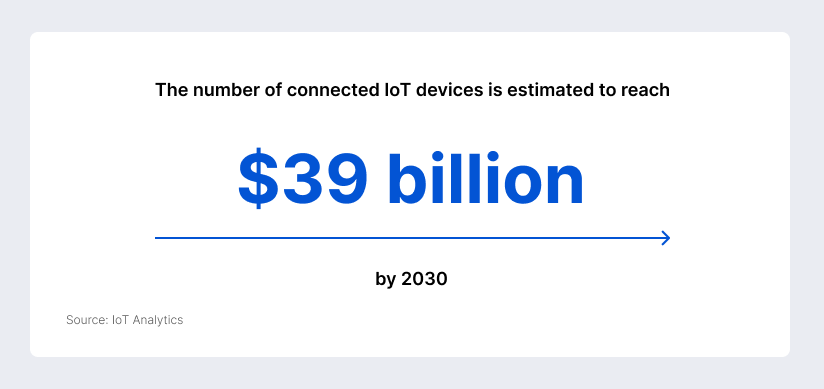
That matters because modern enterprises rarely need “connected devices” in isolation. The number of connected devices is estimated to reach 39 billion by 2030, which means businesses will need stronger platforms for device provisioning, security, fleet management, and data processing.
Why Azure IoT Matters for Modern Enterprises
Companies use the Microsoft Azure IoT platform because connectivity plays an important role in today’s factory, fleet, building, utility, and medical device ecosystem operations. Microsoft Azure IoT does not just involve the ingestion of devices but offers features for provisioning, monitoring, updating, modeling, analysis, and integration of IoT through services like DPS, IoT Hub, IoT Central, Digital Twins, Device Update, Fabric, Power BI, Logic Apps, Event Grid, and ML.
Transform your business or gain a competitive advantage in your industry with custom IoT software solutions from SaM Solutions.
Core Components of Azure IoT Ecosystem
Azure IoT can be much clearer when viewed not as having one star product but as different elements that play certain roles in its architecture.
IoT Hub is the key cloud-based messaging hub between the devices and applications. It provides bi-directional communication, telemetry from device to cloud, commands from cloud to device, device twins, as well as message routing to Event Hubs, Service Bus, Storage, and other tools for analytics.
It is the application platform offered by Microsoft as a service. The platform allows companies to quickly connect devices, employ templates, create dashboards, establish rules, manage device life-cycle, and export data, all without implementing something from scratch.
Digital Twins service provides structure and context to IoT data. It allows businesses to build a model of physical environments using twin graphs based on the DTDL schema, modeling assets, locations, systems, and interconnections.
The service offers a combination of a secure MCU, Linux-based OS, and cloud security services to provide hardware root of trust, certificate-based authentication, automatic updating, and defense in depth.
It is able to bring cloud-based computing capabilities closer to the device because it executes containerized applications locally. The Edge solution can help achieve lower latencies, less bandwidth consumption, offline operations, and modular edge architecture.
Machine Learning brings smart technologies to the platform. It enables users to create, train, deploy, and manage machine learning models, as well as edge-based models. After collecting and contextualizing telemetry data, ML is capable of performing anomaly detection, predicting maintenance, conducting image reviews, and executing processes automatically.
How Microsoft Azure IoT Works
Azure IoT solutions work as a layered architecture: devices generate data, connectivity services ingest it securely, cloud services manage it, processing tools transform it, and analytics layers turn it into business insight.
Devices comprise all kinds of sensors, controllers, gateways, appliances, vehicles, wearables, and machinery. The solution provides support for constrained microcontrollers as well as the gateway class of devices, along with IoT Plug and Play and DTDL devices.
The connectivity layer provides a way for devices and the platform to communicate in a secure manner. Devices either communicate with the IoT Hub directly through MQTT, AMQP, and HTTP protocols or use local edge runtimes and industrial connectors where low latency, OPC UA, and limited internet access are required.
The cloud layer provides identity management, communication, device provisioning, updates, and orchestration capabilities, with IoT Hub providing communication capabilities, DPS helping with zero-touch provisioning of devices, Device Update enabling over-the-air update capabilities, IoT Central adding the application layer, and Digital Twins offering semantic modeling.
After telemetry arrives, the services process it in real time or route it to downstream systems. Stream Analytics supports real-time analysis, while IoT Hub routing and Event Grid connect data to Event Hubs, Service Bus, Functions, Storage, Logic Apps, and other services.
This is where IoT data becomes actionable. Power BI supports dashboards, the Digital Twins service adds graph-based context and 3D visualization, and IoT Operations can send processed edge data into Microsoft Fabric Real-Time Intelligence.
Cloud-Connected and Edge-Connected Architectures
Azure IoT services support different architectural patterns depending on connectivity, latency, security, and operational needs.
Cloud-connected pattern
In the cloud-connected pattern, devices send data directly to the cloud for processing and analysis. This works well when devices have reliable internet access and no strict latency, regulatory, or plant-level restrictions.
Edge-connected pattern
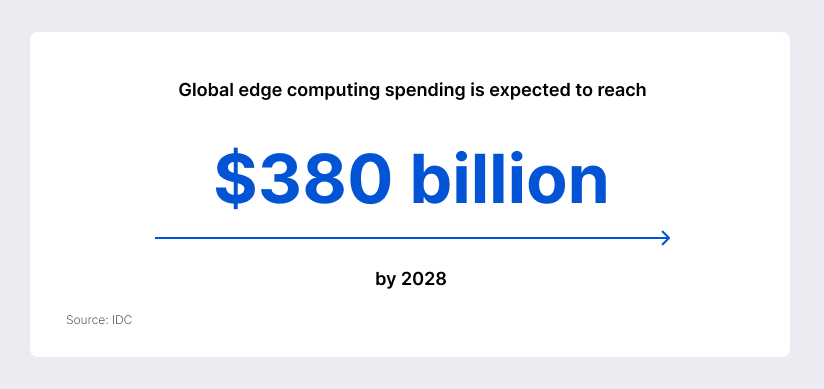
In the edge-connected pattern, devices process data locally before sending selected information to the cloud. With global edge computing spending expected to reach $380 billion by 2028, this model is becoming more important for low-latency, resilient, and industrial IoT environments.
Hybrid IoT architecture
Hybrid architecture combines local edge execution with cloud-based governance, analytics, and AI. It is often the best fit for enterprises that need fast local response and scalable cloud intelligence.
Key Features of Azure IoT
Azure IoT helps companies monitor devices in real time, manage fleets remotely, predict failures, automate decisions, model connected environments, and secure the entire device lifecycle.


Common Azure IoT Use Cases
Azure is broad enough to fit multiple industries, but the strongest use cases tend to share one trait: they combine connected assets with a clear operational decision loop.


Azure IoT Security and Compliance
The cybersecurity model is strongest when organizations treat device identity, certificate lifecycle, network controls, update management, and monitoring as part of the platform design from the beginning.
Identity management
Identity starts at the device level. IoT Hub maintains an identity registry for devices and modules, DPS enables at-scale automated provisioning, and Microsoft recommends X.509 certificate-based authentication instead of SAS for production-grade security.
Encryption and data protection
The platform’s Hub uses TLS to secure device and service connections, and Microsoft ended support for TLS 1.0 and 1.1 in Hub in 2025 while emphasizing TLS 1.2 and strong cipher suites.
Threat detection
Threat detection is primarily handled through Microsoft Defender for IoT, which Microsoft describes as a unified security solution for identifying IoT and OT devices, vulnerabilities, and threats. For OT environments, Defender for IoT emphasizes agentless monitoring and visibility across industrial networks and specialized protocols.
Regulatory compliance
The compliance documentation is broad, but teams should always verify service-by-service scope. Microsoft’s central compliance documentation points organizations to regulatory offerings, and the HIPAA guidance confirms that the service offers the required safeguards and a BAA for in-scope services.
Azure IoT Pricing and Cost Factors
The pricing is modular and depends on the services used. IoT Hub is billed by tier and message capacity; IoT Central by active devices and message allowances; Digital Twins by operations, messages, and query units; and Operations by billable nodes. The Edge runtime itself is free, but related cloud services, paid modules, storage, analytics, and integrations are billed separately.
In real projects, key cost drivers include message volume, number of devices, data retention, analytics, edge hardware, ML training and inference, and connected services such as Event Hubs, Storage, Logic Apps, Service Bus, or Microsoft Fabric. Scalability should be planned early because every increase in device count, telemetry volume, and analytics workload affects architecture and cost.
Benefits of Microsoft Azure IoT for Businesses
Azure helps businesses improve efficiency, reduce downtime, support faster decisions, and create better-connected customer experiences.


Challenges of Implementing Azure IoT
Azure is powerful, but it is not plug-and-play at enterprise scale. One challenge is architectural choice. Microsoft supports constrained devices, gateways, cloud-connected patterns, edge-connected patterns, and hybrid designs. That flexibility is useful, but it means teams must make deliberate decisions about identity, connectivity, routing, local autonomy, and lifecycle management rather than expecting one default blueprint to fit every use case.
Another challenge is integration complexity. Internet of Things value usually appears only after device data reaches the systems that run the business, such as data platforms, service workflows, care systems, or ERP processes.
Cost governance is the third challenge. Because Azure solutions often involve multiple services and usage meters, underestimating downstream analytics, storage, edge compute, or ML consumption is easy.
How to Get Started with Azure IoT
Start Azure by defining the goal, choosing the architecture, selecting secure devices, planning telemetry flows, and deciding what belongs at the edge.
Start by choosing the right solution pattern. If devices can connect directly and cloud latency is acceptable, Hub or Central may be enough. If you are dealing with factory networks, industrial protocols, local resilience requirements, or strict data-boundary rules, plan for Edge or Azure Operations from the outset.
Select hardware that matches the operating environment and the data model you need. In Azure, that often means preferring devices that support standard protocols and can expose capabilities through Plug and Play or DTDL-based models when appropriate. For device security-sensitive products, Azure Sphere is the right discussion early in the process, not late in deployment.
Next, decide what should happen to telemetry after ingestion. Azure supports hot-path streaming through Stream Analytics, event-driven routing through Hub and Event Grid, and export into downstream systems such as Storage, Service Bus, Azure Data Explorer, and Fabric.
Deploy edge computing when latency, resilience, or bandwidth makes local execution worthwhile. Edge is ideal when you want containerized logic on devices with cloud-driven management, while Azure Operations is stronger when you need Kubernetes-based industrial edge services, MQTT brokering, and standardized asset connectivity.
Azure IoT vs Other Cloud IoT Platforms
Azure is often compared with AWS and Google Cloud, but the current market is not perfectly symmetrical. Azure still offers a broad native portfolio spanning connectivity, app enablement, digital twins, and edge operations, while AWS offers a strong set of modular building blocks, and Google Cloud now emphasizes connected-device architectures rather than a native Core service.
| Area | Microsoft Azure IoT | AWS IoT | Google Cloud connected-device stack |
|---|---|---|---|
| Core device connectivity | Azure IoT Hub and IoT Central | AWS IoT Core | Architecture-based approaches using Pub/Sub, standalone MQTT brokers, or partner platforms |
| Edge runtime | Azure IoT Edge and Azure IoT Operations | AWS IoT Greengrass | Customer-designed edge patterns on GKE, Compute Engine, or gateways |
| Digital twin capability | Azure Digital Twins | AWS IoT TwinMaker | No comparable first-party digital twin service in the current connected-device architecture guidance |
| Higher-level managed app layer | IoT Central | Usually assembled from multiple AWS services | Usually assembled from messaging, analytics, and partner tools |
| Best fit | Enterprises that want an integrated Microsoft stack across cloud, edge, workflow, analytics, and digital twins | Teams that prefer modular AWS-native assembly | Teams comfortable building or partnering for a custom connected-device architecture |
Future Trends in Azure IoT
The clearest trend in Azure is a stronger edge-first and adaptive-cloud direction. Microsoft now describes Azure Operations as a unified data plane for the edge, built on Arc-enabled Kubernetes and open standards such as MQTT and OPC UA. That points to a future where enterprise IoT is less about one monolithic cloud service and more about consistent operations across distributed edge and cloud environments.
Another trend is deeper convergence between IoT, data platforms, and AI. Microsoft explicitly describes Microsoft Fabric as the unified data platform for Azure IoT, and Azure Operations already includes official paths into Fabric Real-Time Intelligence. Meanwhile, Microsoft’s manufacturing guidance increasingly groups Azure Operations, Azure Machine Learning, Microsoft Fabric, and Azure AI tooling together in the same industrial architecture story.
The next trend is richer spatial and semantic operations. Azure Digital Twins already supports DTDL-based graph models and 3D Scenes Studio, which suggests that more Azure solutions will move beyond flat dashboards toward contextual, low-code, visually navigable operational environments.
Microsoft Azure IoT Services from SaM Solutions
SaM Solutions is a software development company that supports Azure IoT projects with the expertise needed to move from early concept to stable production. Our services cover consulting, architecture assessment, research and prototyping, custom development, end-to-end implementation, cloud development, and enterprise system integration.
With Azure cloud engineers, real-time data processing expertise, and secure infrastructure design, SaM Solutions helps businesses build reliable connected ecosystems. Our teams can support device-to-cloud implementation, edge and cloud integration, data pipeline development, dashboards, modernization of surrounding systems, and long-term operational support for scalable Azure solutions.
With SaM Solutions’ wide range of IoT services, you get professional support and hands-on assistance at any stage of your IoT project.
Conclusion
Microsoft Azure IoT services represent a platform family for device connectivity, management, security, edge processing, digital twins, and AI-driven analytics. Depending on the use case, businesses can rely on IoT Hub, IoT Central, Azure Digital Twins, Azure Sphere, IoT Edge, Azure IoT Operations, Azure Machine Learning, or Microsoft Fabric.
For enterprises, the main value is flexibility. Azure connects physical assets with digital operations across cloud, edge, and hybrid architectures. The strongest implementations start with clear business goals and treat security, integration, and lifecycle management as core design principles.
FAQ