Types of IT Outsourcing Models: Complete Guide for 2026


(If you prefer video content, please watch the concise video summary of this article below)
Key Facts
- The IT talent shortage is reshaping strategy: by 2026, over 90% of companies face skills gaps, pushing outsourcing from cost-cutting to a core growth lever.
- Outsourcing models fall into three pillars — location, relationship, and pricing, each directly impacting speed, cost, and control.
- There is no universal “best” model: success depends on aligning the model with project complexity, internal expertise, and business goals.
- In 2026, advanced approaches like hybrid, multisourcing, and AI-driven outsourcing are becoming the standard for scalable, innovation-focused companies.
If you feel like the tech talent gap is getting wider, you aren’t imagining it. By the end of 2026, IDC predicts that over 90% of organizations worldwide will be feeling the sting of the IT skills crisis. We’re looking at a potential $5.5 trillion in losses globally due to delayed product launches and missed opportunities.
It’s no wonder the IT outsourcing market is barreling toward the $600 billion mark this year. But here’s the thing: in 2026, outsourcing isn’t just a way to save a few bucks on payroll. It’s become a high-stakes chess move. Whether you’re trying to integrate AI agents into your workflow or keep your IoT ecosystem from falling apart, the model you choose is the difference between a seamless launch and a total bottleneck.
Turn your product vision into reality faster with a dedicated outsourcing team aligned to your goals.
What Is IT Outsourcing and Why It Matters Today
Stripped of the corporate jargon, IT outsourcing is simply finding a partner to do the tasks that your internal team can’t or shouldn’t handle. But in today’s economy, “doing the work” is only half the story.
Evolution of outsourcing in the digital economy
Outsourcing has undergone a massive identity shift over the last two decades.
Back in the early 2000s, it was purely a tactical play. You sent your basic maintenance or “keep the lights on” tasks to the lowest bidder. It was about cost, period. Then came the 2010s, the functional era, where we started looking for specialized help with mobile apps and cloud migrations.
Now, we’ve entered the age of strategic partnerships. We don’t just throw projects over the wall anymore. Modern outsourcing is about co-innovation. Many companies are now looking to external experts to fill strategic roles, even up to the fractional CTO level. When you’re building something as complex as a blockchain-based energy grid or an AI-driven mobility platform, you don’t just need a vendor; you need an extension of your own R&D department.
Business drivers behind external tech partnerships
Why are so many leaders leaning on external partners right now? Because they need to survive in a market that moves at breakneck speed.
- Bridging the specialized skill gap: You might be able to find a decent Java developer locally, but finding a team that truly understands predictive maintenance for EV charging stations? That’s a different story. Outsourcing lets you tap into niche pockets of global expertise instantly.
- Speed is the new currency: Traditional hiring takes 3 to 6 months. Staff augmentation can put a senior developer at your desk in two weeks. In a world where being first to market is everything, you can’t afford to wait on a recruiter.
- Operational elasticity: Let’s be real — the economy is unpredictable. Outsourcing gives you a volume knob for your workforce. You can scale up for a massive Q3 push and scale back down once the project hits maintenance mode, without the headache of layoffs.
- Focus on the “Big Picture”: If you’re a logistics giant, your core value is moving goods efficiently, not managing a 100-person software house. Partnering for your tech needs lets you get back to the business you actually started.
Types of IT Outsourcing Models Explained
Choosing a model means choosing developers that fit into your daily workflow. Today, the lines have blurred thanks to ultra-high-speed connectivity and AI-driven project management, but the physical distance still dictates the vibe and rhythm of your collaboration.
Location-based IT outsourcing models
Geography is the most traditional way to categorize outsourcing. While the cloud makes location feel irrelevant, reality sets in when you’re trying to schedule a high-priority meeting across ten different time zones. We generally break this down into four distinct shores.
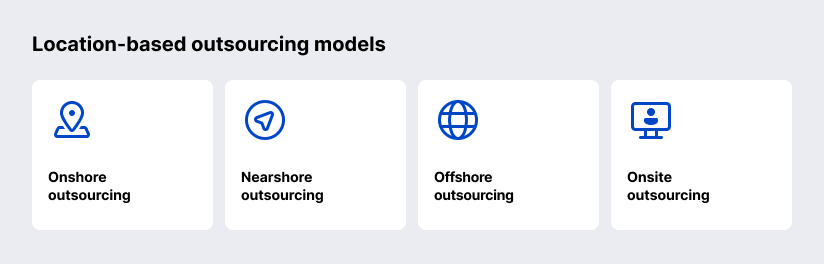
Onshore outsourcing
This is the “neighbor” approach. You’re hiring a team located in your own country.
- The big win: Zero cultural friction and zero time zone lag. If you’re in New York and your partner is in Chicago, you’re speaking the same language (literally and figuratively) and working the same hours.
- The reality check: It’s almost always the most expensive option. You’re paying local market rates, which are at an all-time high for senior specialized talent.
Nearshore outsourcing
Nearshoring is the sweet spot for many scaling enterprises. This involves partnering with providers in neighboring countries or regions, think a German firm working with a team in Poland, or a US company hiring in Mexico or Costa Rica.
- The big win: You get a significant cost reduction without the jet lag of offshore work. You typically share a 1-to-3-hour time zone difference, making real-time Slack chats or Zoom calls easy.
- The reality check: While cultural alignment is usually high, you still need to account for slight differences in labor laws and public holidays.
Offshore outsourcing
This is the classic model: hiring a team in a distant location (like India, China, or the Philippines) to take advantage of massive talent pools and significantly lower overhead.
- The big win: Unbeatable cost-efficiency. It also allows for a “follow the sun” development cycle: your internal team finishes their day, hands off the tasks, and the offshore team works while you sleep.
- The reality check: The 8-to-12-hour time difference is a real hurdle. You need rock-solid documentation and an asynchronous communication culture to keep things from breaking down.
Onsite outsourcing
Think of this as renting experts to sit in your actual office. The provider hires the talent, but they work under your roof, using your coffee machine.
- The big win: Total integration. This is perfect for high-security projects or highly sensitive R&D where data cannot leave the building. It’s the ultimate way to tackle communication bottlenecks.
- The reality check: It’s essentially Staff Augmentation plus. You’re still responsible for providing the workspace, and it carries a premium price tag because of the relocation or travel involved for the vendor’s staff.
| Feature | Onshore | Nearshore | Offshore | Onsite |
|---|---|---|---|---|
| Cost | Highest | Moderate | Lowest | High |
| Time zone sync | Perfect (0 hrs) | High (1-3 hrs) | Low (8+ hrs) | Perfect (0 hrs) |
| Cultural fit | Identical | Very similar | Varies | High |
| Best for | High-touch, local projects | Agile, collaborative development | Large-scale, cost-sensitive development | High-security or R&D |
Relationship-Based Outsourcing Models
If the location models tell you where the work happens, relationship models tell you how the partnership actually functions. It means how much control you want to keep versus how much responsibility you want to offload.
Think of it like choosing between buying ingredients to cook yourself, hiring a chef to help in your kitchen, or just ordering the full meal delivered to your table.
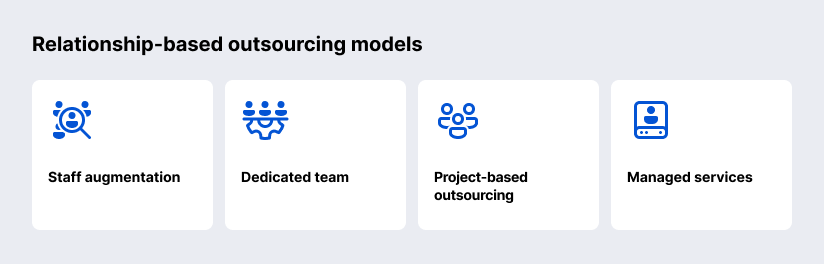
Staff augmentation model
This is essentially plug-and-play talent. You have an existing team, but you’re missing a specific piece of the puzzle, maybe a Senior DevOps engineer or a QA specialist. You borrow a pro from your partner to work directly under your managers.
- The big win: It’s incredibly fast. You don’t have to worry about the overhead of full-time hiring, but you keep 100% control over the project.
- The reality check: You are responsible for the outcome. If your management is messy, the augmented staff won’t magically fix it. You’re paying for their time, not a guaranteed finished product.
Dedicated team model
This is a step up. Instead of just one or two people, you hire a full, self-contained squad (developers, QA, PM, etc.) that works exclusively on your project long-term. They act like a remote branch of your company.
- The big win: Domain knowledge. Because this dedicated team isn’t jumping between different clients, they eventually understand your business and your code as well as you do. It’s the gold standard for complex, evolving products.
- The reality check: It requires a steady roadmap. You’re paying for the team’s capacity, so if you don’t have enough work to keep them busy, you’re essentially burning the budget.
Project-based outsourcing model
This is the handover model. You give a partner a specific set of requirements, a deadline, and a budget. They take it from there, managing the team and the process internally until they hand back a finished piece of software.
- The big win: Low management overhead. You don’t need to worry about daily stand-ups or micro-decisions. It’s “fixed price, fixed outcome,” which is great for well-defined, one-off projects.
- The reality check: It’s rigid. If you realize halfway through that you want to change a major feature, get ready for a Change Request and a price hike. It’s not built for the pivot-a-week reality of many startups.
Managed services model
As systems become more automated, this model is exploding. Instead of hiring people to build something new, you’re hiring a partner to take over an entire function, like your cloud infrastructure, cybersecurity, or your IoT device monitoring.
- The big win: Peace of mind. You aren’t paying for hours; you’re paying for uptime or security. The provider is incentivized to make things run perfectly because they own the risk.
- The reality check: It can feel like a black box. You have very little say in how they do the work, as long as they meet the agreed-upon Service Level Agreements (SLAs).
| Feature | Staff augmentation | Dedicated team | Project-based | Managed services |
|---|---|---|---|---|
| Management | You manage them | Shared / Vendor | Vendor manages | Vendor manages |
| Flexibility | Extremely high | High | Low | Moderate |
| Scalability | Easy to add/remove | Medium-term commitment | Fixed scope | Long-term partnership |
| Best for | Filling skill gaps | Long-term R&D | Defined MVPs | Maintenance and Ops |
Pricing-Based Outsourcing Models
At the end of the day, the best model usually comes down to how the money flows. In 2026, we’ve moved past simple hourly rates. Modern pricing is about aligning the vendor’s incentives with your actual business goals. If they get paid the same whether the code is buggy or brilliant, you’ve got a problem.
Here is how the bills get settled in today’s tech landscape.
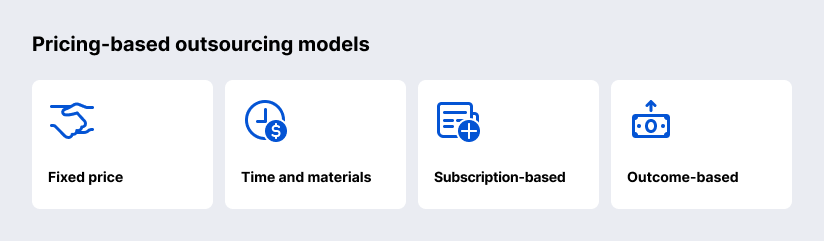
Fixed price model
This is the handshake deal of the software development world. You agree on a set price for a set result before a single line of code is written.
- The big win: Budget certainty. Your CFO will love this because there are no surprises. It forces both sides to be extremely disciplined about the project scope from the beginning.
- The reality check: It’s notoriously anti-agile. If you discover a killer new feature three months in, you can’t just add it. You’ll have to open a new contract negotiation. It also often carries a risk premium. Vendors often pad the price to cover potential unknowns.
Time and materials model
The most common model for agile development. You pay for the actual hours worked and the resources used. It’s the pay-as-you-go version of software building.
- The big win: Total flexibility. You can pivot, change priorities, or pause the project whenever you need to. It’s perfect for complex projects where you don’t know exactly what the finished product looks like yet.
- The reality check: The budget is a moving target. Without a strong Project Manager, T&M projects can suffer from scope creep, where the project grows bigger and more expensive than anyone originally planned.
Subscription-based model
A newer trend that’s gaining massive traction. Instead of paying for a project, you pay a flat monthly fee for a specific capacity or a set of recurring services. It’s essentially Software Development as a Service (SDaaS).
- The big win: Extreme predictability for your monthly burn rate. You know exactly what’s coming out of the bank account every month, making it much easier to manage cash flow.
- The reality check: You’re paying for the slot, even if you don’t use it. If your development needs vary wildly from month to month, you might end up overpaying during slow periods.
Outcome-based model
This is the “skin in the game” model. Instead of paying for hours or features, you pay based on measurable business results, like reaching a certain number of users, achieving a specific system uptime, or hitting a performance benchmark.
- The big win: Absolute alignment. The vendor is hyper-motivated to ensure the product actually works and delivers value, because if you don’t win, they don’t get paid.
- The reality check: It’s incredibly difficult to track and negotiate. You need very sophisticated data tracking and a high level of trust to agree on what success actually looks like.
| Feature | Fixed price | Time and materials | Subscription-based | Outcome-based |
|---|---|---|---|---|
| Budget predictability | High | Low | Very high | Variable |
| Flexibility | Low | Very high | Moderate | Moderate |
| Risk carrier | Mostly vendor | Mostly client | Shared | Mostly vendor |
| Best for | Small, clear projects | Agile R&D / Startups | Ongoing maintenance | Strategic partnerships |
Advanced IT Outsourcing Models and Strategies
The standard models often aren’t enough for enterprise-level complexity. We’ve moved into an era of high-speed, high-stakes digital architecture where your outsourcing strategy needs to be as sophisticated as the software you’re building.
These advanced strategies are designed to break down the silos between your internal team and your global partners.
Hybrid outsourcing approach
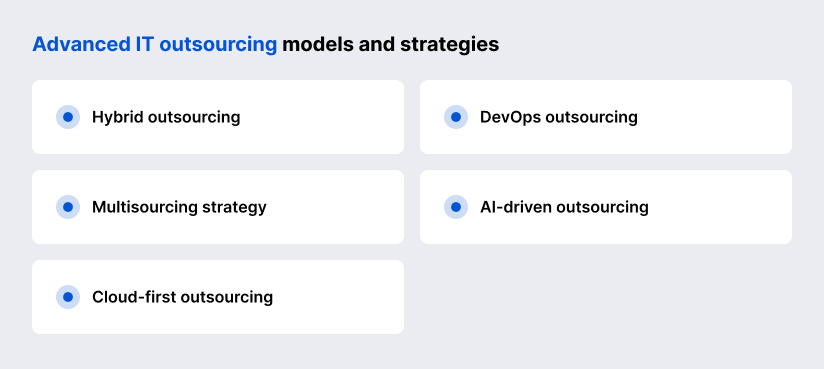
The hybrid model is the best-of-all-worlds strategy. It involves keeping your core IP, strategic planning, and high-level architecture in-house while using a mix of onshore, nearshore, and offshore partners for execution.
- How it works: Your internal product owners and lead architects sit in your headquarters, while a nearshore team handles agile development and an offshore team manages 24/7 testing and maintenance.
- The 2026 edge: It provides massive resilience. If one region faces a local disruption or a talent shortage, your entire roadmap doesn’t grind to a halt.
Multisourcing strategy
The one-stop-shop vendor is becoming a rarity for large enterprises. Multisourcing is the practice of hiring different specialized vendors for different parts of your tech stack.
- Why it matters: You wouldn’t hire a plumber to fix your roof. Similarly, you shouldn’t necessarily use your cloud infrastructure partner to design your mobile UX.
- The catch: You need a world-class internal governance team to make sure these different vendors actually talk to each other and don’t spend their time pointing fingers when a bug appears.
Cloud-first outsourcing
This implies choosing partners who operate entirely within a cloud-native ecosystem.
- The strategy: You outsource the management of your entire cloud environment (AWS, Azure, or GCP). The vendor is responsible for optimizing costs, ensuring 99.9% uptime, and managing the automated scaling of your applications.
- The 2026 edge: It removes the need for you to own any physical hardware. Your infrastructure is now a line item on a service agreement, not a server room in your basement.
DevOps outsourcing
DevOps used to be an internal-only culture, but now, it’s a massive outsourcing segment. This involves hiring a partner specifically to build and maintain your CI/CD pipelines, container orchestration (like Kubernetes), and security automation.
- The goal: To bridge the gap between writing code and running code.
- The benefit: By outsourcing the “plumbing” of your software delivery, your developers can focus 100% on building features that your customers actually care about.
AI-driven outsourcing
This is the newest frontier. It’s not just outsourcing AI development; it’s using AI-augmented vendors who leverage Agentic AI to deliver work faster than traditional human-only teams.
- The reality: These vendors use AI agents to handle routine code generation, automated documentation, and predictive bug detection.
- The 2026 impact: You are now paying for a hybrid human-AI workforce. This model is slashing time-to-market for complex systems like predictive maintenance platforms.
| Strategy | Hybrid | Multisourcing | Cloud-first | DevOps | AI-driven |
|---|---|---|---|---|---|
| Core focus | Resilience and balance | Specialized excellence | Agility and OpEx | Delivery speed | Hyper-efficiency |
| Complexity | Moderate | High | Low | Moderate | Emerging |
| Best for | Mid-to-large enterprises | Enterprise ecosystems | Startups and migrating firms | Scaling tech products | Innovation-led R&D |
Benefits and Challenges of IT Outsourcing
Outsourcing has matured into a strategic necessity for global agility. The key advantages include:
Key advantages for modern businesses
- Access to “impossible” talent: Bypass local bidding wars and access specialized experts instantly.
- Drastic reduction in time-to-market: Transition from concept to MVP in weeks by leveraging established external workflows.
- Financial agility: Shift from heavy CapEx (Capital Expenditure) to flexible OpEx (Operational Expenditure) to keep your balance sheet lean.
- Continuous development: Use “Follow-the-Sun” cycles to ensure your project progresses 24/7.
Common risks and limitations
Even the best partnerships can hit a wall if you aren’t prepared for the friction points.
- Communication debt: Subtle context loss over digital tools can turn small misunderstandings into massive technical debt.
- Security and IP risks: Sharing code means sharing your secret sauce, requiring enterprise-grade security and firm legal protections.
- Hidden management costs: If overseeing a low-cost team consumes your entire week, the perceived savings quickly vanish.
- Vendor lock-in: Lack of documentation can trap you with a single partner, making it a nightmare to transition if rates rise.
Cost of IT Outsourcing in 2026
While the baseline cost of living still dictates the floor of prices, the AI tax and the premium on specialized, for example, green tech expertise have created a wider spread between junior developers and high-level consultants.
Regional price differences
Here is a snapshot of what hourly rates for a Senior Developer look like across the 2026 map:
- North America and Western Europe (Onshore): Expect to pay $120–$250+ per hour. You aren’t just paying for code here; you’re paying for local legal compliance, identical time zones, and deep integration.
- Eastern Europe (Nearshore/Offshore): Regions like Poland, Romania, and Ukraine (with its resilient tech hubs) are hovering around $50–$95 per hour. This remains the premium outsourcing destination due to the high density of STEM graduates and strong cultural alignment with the West.
- Latin America (Nearshore for US): Countries like Mexico, Colombia, and Uruguay have seen rates climb to $45–$85 per hour as US demand for “same-day” collaboration has skyrocketed.
- Asia (Offshore): India, Vietnam, and the Philippines remain the most budget-friendly at $25–$50 per hour. However, for specialized roles in these hubs, prices are increasingly mirroring Eastern European rates.
Cost factors influencing pricing
- The tech stack premium: Standard web developer (React/Node) is priced at market average. However, if you need developers who understand Embedded Systems for Automotive, expect a 30-40% markup.
- Seniority mix: A team of five juniors is cheaper than two seniors, but the industry has realized that senior-heavy teams actually cost less in the long run due to lower technical debt.
- Urgency and ramp-up speed: If you need a team of 10 people ready to commit code by next Monday, you will pay a speed premium to bypass the standard vendor bench-warming process.
- Engagement duration: A two-year Dedicated Team contract will always get you a better daily rate than a three-month Staff Augmentation sprint.
Hidden costs to consider
- Onboarding and context sharing: It takes time for an external team to learn your internal logic and legacy code. You are essentially paying for their learning curve during the first 4-6 weeks.
- The communication tax: This includes the cost of specialized tools (Jira, Slack, high-end Repo management) and the time your internal managers spend in stand-ups and reviews.
- Legal and compliance fees: Don’t skim here. Ensuring your partner meets GDPR or SOC2 standards requires legal audits and potentially higher-cost infrastructure setups.
- Post-launch maintenance: Many firms forget that once the software is done, it still needs security patches and OS updates. Budgeting 15-20% of the initial build cost for annual maintenance is the gold standard.
How to Choose the Right IT Outsourcing Model
Selecting an outsourcing model is a strategic maneuver that requires you to look honestly at your internal capabilities and your long-term roadmap.
Aligning with business goals
Before you look at a single CV, you need to define what winning looks like for this specific partnership.
- Is it about speed? If you need to hit the market before a competitor, Staff Augmentation or Nearshoring are your best bets. You need people who can jump into your “time zone” and your workflow immediately.
- Is it about cost? If you’re managing a tight budget for a non-core product, Offshore Project-Based models offer the highest ROI.
- Is it about innovation? If you’re building something that’s never been done, you need a Dedicated Team.
Evaluating project complexity
The shape of your project should dictate the shape of your team.
- Low complexity (The known project): If you have a 40-page requirement document and a clear UI/UX design, a Fixed-Price, Project-Based model works perfectly. There’s little room for interpretation, so there’s little room for budget surprises.
- High complexity (The evolving project): If you’re working with emerging tech like IoT or Blockchain, your requirements will change. Using a Fixed-Price model here is a recipe for disaster. Instead, go with Time and Materials or a Dedicated Team. You need the Agile freedom to pivot as you discover what actually works.
Selecting engagement and pricing structure
Once you know your goals and complexity, you can map them to the right contractual fit. Use this decision matrix to narrow it down.
- Do you have internal tech leads?
- Yes: Staff Augmentation is your winner. You just need the extra hands; you provide the brain.
- No: You need a Managed Service or a Dedicated Team with its own Project Manager. Don’t try to manage developers if you aren’t a developer yourself.
- Is your budget rigid or fluid?
- Rigid: Stick to Fixed-Price or Subscription-based models.
- Fluid: Time and Materials will almost always result in a better final product because you aren’t cutting corners to stay under a hard cap.
- How long is the engagement?
- Short (< 3 months): Project-Based or Staff Augmentation.
- Long (> 6 months): Dedicated Team. The time you spend onboarding them will pay for itself ten times over in productivity by month four.
IT Outsourcing Trends for 2026 and Beyond
If you’re still using a 2020 playbook for your 2026 partnerships, you’re likely leaving money and innovation on the table.
Shift toward nearshore collaboration
The Big Reset of the last few years has solidified nearshoring as the dominant strategy for high-growth firms. While offshore hubs still handle high-volume, repetitive tasks, the core engineering work is moving closer to home.
- The agile mandate: Software is never finished; it’s constantly evolving. Trying to maintain a fail-fast agile culture with a 12-hour time difference is a logistical nightmare.
- Cultural synchronicity: Companies are realizing that shared work ethics and communication styles are massive productivity multipliers. Being able to hop on a call at 10:00 AM and speak with a team that gets your market nuances is now valued more than a 20% savings on labor.
Demand for niche expertise
The days of the Generalist Outsourcer are numbered.
- Vertical specialization: We are seeing a massive surge in demand for partners who specialize in specific sectors, e.g., Energy Tech (smart grids, EV infrastructure), Healthcare, and Automotive IoT.
- The rise of the agentic developer: With AI handling much of the boilerplate code, the human outsourced expert is now expected to be a high-level problem solver. The value has shifted from writing code to architecting systems and managing the AI agents that do the heavy lifting.
Security and compliance priorities
With the rise of sophisticated AI-driven cyber threats, your outsourcing partner is either your strongest shield or your weakest link.
- Zero-trust outsourcing: “Trust but verify” is dead. Modern partnerships are built on zero-trust architectures, where external developers have strictly controlled, audited access to only the specific segments of the codebase they need.
- Compliance as a Service: As global regulations (like the EU’s AI Act or updated GDPR mandates) become more complex, companies are choosing vendors who offer built-in compliance.
SaM Solutions’ Software Development Outsourcing Models
With over 30 years in the software development game, SaM Solutions rejects the “one-size-fits-all” mentality, offering a sophisticated suite of engagement models. From end-to-end Full Outsourcing and Dedicated Teams to flexible Staff Augmentation, we align our expertise with your specific technical demands. By combining traditional Fixed Price and Time & Materials contracts with cutting-edge AI-driven outsourcing, we ensure your project is backed by both financial predictability and next-generation efficiency.
Conclusion
Choosing software outsourcing models is a foundational business strategy. As we’ve seen, the tech landscape demands a balance between cost, deployment speed, and specialized niche expertise.
The most successful organizations today aren’t those that find the cheapest labor, but those that find the best cultural and technical fit. By aligning your business goals with the right regional and relationship models, you ensure that your digital transformation isn’t just a project, but a sustainable competitive advantage.
FAQ
What industries benefit most from outsourcing software development?
While almost any sector can outsource, highly regulated and tech-heavy industries (automotive, energy and utilities, FinTech, healthcare) see the highest ROI.
How do outsourcing models impact long-term innovation capabilities?
Are outsourcing models effective for legacy system modernization projects?