Vibe Coding vs Traditional Coding: The New AI-Driven Development Paradigm


(If you prefer video content, please watch the concise video summary of this article below)
Key Facts
- Vibe coding is prompt-led development: a developer describes intent, and AI generates much of the implementation.
- Traditional coding relies on direct human control over architecture, algorithms, testing, security, deployment, and maintenance.
- The central tradeoff is speed and automation versus control and predictability.
- Vibe coding shines in prototypes, internal tools, and early product discovery.
- Traditional coding is usually the safer choice for enterprise platforms, regulated software, and large-scale infrastructure.
- For most companies, the best answer is not either-or. It is a hybrid framework that uses AI for efficiency and engineers for oversight.
Software delivery has changed fast, but the hard part has not. Teams still need to ship code that works, survives debugging, scales under load, passes testing, fits the architecture, and does not turn into a maintenance headache six months later. That is what makes vibe coding vs traditional coding a business decision, not just a developer preference.
What Is Vibe Coding?
To compare the two models fairly, it helps to start with the newer one and strip away the buzz.
Core principles of vibe coding
Vibe coding is software creation by direction. A developer describes a feature, workflow, or interface in natural language, and the model produces a meaningful share of the code. The rhythm is different from classic programming: prompt, inspect, revise, repeat.
That shift sounds small until you feel it in practice. Less time goes into boilerplate. More time is spent on steering, validating, and deciding whether the generated output is actually good enough. The upside is obvious: more productivity, faster iteration, and lower friction on repetitive work. The downside is subtler. A fast first draft can hide weak structure.
How AI agents assist developers
AI agents push the model further. They do not just suggest lines; they help carry out tasks. They can generate tests, explain unfamiliar code, propose bug fixes, refactor functions, and support routine integration work. That is useful, especially when teams need speed, automation, and quick feedback loops.
But the developer does not disappear. The role changes. Someone still has to check the logic, review the security implications, and decide whether the generated code aligns with the broader framework rather than quietly fighting it.
Popular tools used for vibe coding
The tooling changes quickly, but the pattern is stable: copilots, chat-driven IDE assistants, agentic editors, and AI helpers wrapped into the normal workflow. The specific product matters less than the operating style. The developer is no longer doing every step manually; they are orchestrating a system that can perform a surprising amount of work on its own.
Get AI software built for your business by SaM Solutions — and start seeing results.
What Is Traditional Coding?
The older model still matters because it solves a different problem.
Key principles of traditional software development
Traditional development is built on explicit control. Engineers choose the architecture, define the framework, shape the data model, and write the business logic directly. That gives teams stronger visibility into how the system works and why it works that way.
It also creates cleaner ownership. When something breaks, the path to root cause is often easier to find because the logic was designed rather than inferred from a prompt.
Manual development workflow
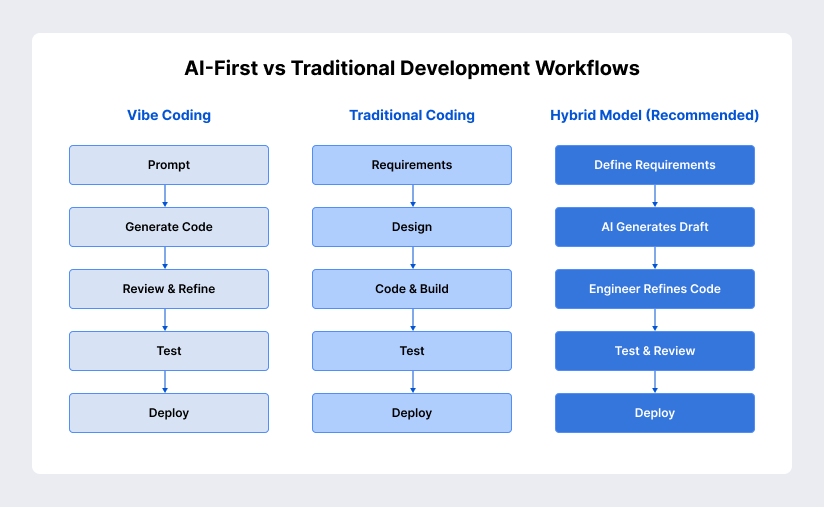
The standard flow is familiar: requirements, design, implementation, testing, deployment, and maintenance. Teams may run those steps iteratively, but the work still depends on direct authorship. That tends to make debugging slower at first and easier later.
This matters more than teams sometimes admit. Software rarely becomes expensive because the first version took a little longer. It becomes expensive because the second, third, and tenth changes are awkward, risky, and poorly understood.
Engineering discipline and best practices
Traditional programming is also a discipline. It comes wrapped in peer review, version control, coding standards, release gates, and structured security practices. Those habits can feel heavy in fast-moving work, but they often pay for themselves by reducing rework and protecting long-term maintainability.
The Evolution of Software Development: From Manual Code to AI Collaboration
The shift from manual development to AI collaboration did not replace engineering. It changed where the effort sits.
The rise of AI coding assistants
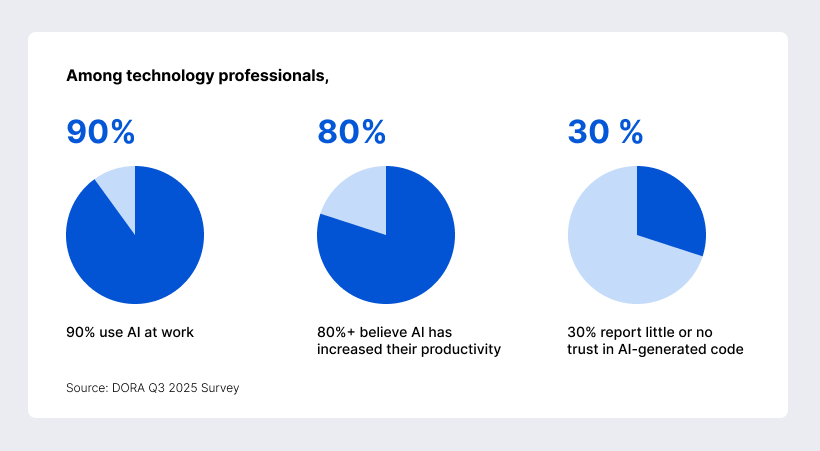
AI has moved from curiosity to routine infrastructure. DORA’s 2025 report found that 90% of respondents use AI at work, more than 80% say it improves productivity, and 30% still report little or no trust in AI-generated code. That mix of enthusiasm and caution says a lot: the tools are useful, but trust still has to be earned.
The shift toward prompt-driven development
That is why vibe coding vs traditional programming is now a real decision point. Prompts increasingly sit between an idea and its implementation. In some cases, that unlocks speed and experimentation. In others, it shifts complexity downstream, making debugging, testing, and maintenance harder than they first appear.
Workflow Differences Between Vibe Coding and Traditional Coding
The clearest contrast appears in the daily workflow. The two approaches do not simply produce code in different ways; they distribute effort differently across planning, implementation, verification, deployment, and refactoring.
| Workflow stage | Vibe coding | Traditional coding | Main tradeoff |
|---|---|---|---|
| Planning | Starts with prompts and rough intent | Starts with requirements and design | Speed vs clarity |
| Implementation | AI generates major blocks | Engineers write code directly | Output vs control |
| Debugging | Fast suggestions, heavy verification | Slower fixes, deeper diagnosis | Patch speed vs understanding |
| Testing | AI drafts tests, humans validate | Tests designed as part of engineering | Coverage speed vs rigor |
| Deployment | Quick to demo and ship small apps | More controlled release path | Momentum vs release discipline |
| Maintenance | Higher refactoring risk | Easier to extend and optimize | Early speed vs long-term stability |
Planning and requirements definition
Vibe coding is comfortable with ambiguity. A rough product idea can become something visible quickly. Traditional development usually asks for clearer requirements earlier, which slows the opening move but reduces confusion later.
Code generation and implementation
Here, the contrast is blunt. In vibe coding, the model handles much of the implementation. In traditional programming, engineers build the logic themselves. One route increases efficiency. The other usually produces stronger ownership and a deeper understanding of the system’s behavior.
Debugging and issue resolution
Vibe coding can make debugging feel almost effortless at first. The model proposes a fix, the team tests it, and the issue appears to go away. But sometimes the problem has only moved. Traditional debugging is slower, yet it often reveals more about the system and its weak spots.
Testing and quality assurance
AI can help with testing, especially repetitive unit cases and obvious edge conditions. Still, generated tests are not automatically meaningful tests. Traditional teams tend to design testing around behavior, failure modes, and system boundaries, which usually gives quality assurance more depth.
Deployment and release cycles
Vibe-coded software can reach a demo with startling speed. Production is another matter. Traditional development usually reaches deployment more carefully because release discipline is built into the process rather than bolted on at the end.
Maintenance and refactoring
This is where rushed code starts charging interest. Generated output can hide duplicated logic, weak abstractions, or awkward integration choices. Traditional codebases are not always elegant, but they are usually easier to refactor because the original decisions were made explicitly.
Key Differences Between Vibe Coding and Traditional Coding
Once the workflow is clear, the broader business differences come into focus. These are the dimensions that shape cost, risk, and long-term software quality.
| Dimension | Vibe coding | Traditional coding | Business impact |
|---|---|---|---|
| Speed | Higher | Lower | Faster first release |
| Code quality | More variable | More consistent | Affects maintenance cost |
| Security | Depends heavily on guardrails | Depends on process discipline | Changes risk exposure |
| Scalability | Less predictable | More deliberate | Affects growth readiness |
| Skills | Prompting, review, validation | Design, implementation, and debugging | Alters team mix |
| Collaboration | More reviewer pressure | More shared authorship | Changes team dynamics |
| Cost | Lower upfront | Often lower over time | Shifts the total ownership cost |
Development speed and iteration cycles
This is the best argument for vibe coding. It strips away friction and shortens the gap between idea and execution. Traditional development is slower at the start, but that slower start often prevents later churn.
Code quality and maintainability
Generated code can be functional without being coherent. It may solve the immediate problem without leaving a clean structure behind. Traditional programming tends to produce code that is easier to understand, extend, and optimize.
Security and risk management
Security is one of the sharpest lines in vibe coding vs traditional coding. GitGuardian’s 2026 report found 28,649,024 new secrets in public GitHub commits in 2025, up 34% year over year, and reported that AI-assisted commits leaked secrets at about twice the baseline. Faster output can raise exposure when review discipline slips.
Scalability of software systems
Vibe coding can create something useful before it creates something robust. That is fine for lightweight tools and early experiments. It is far riskier for systems that need deliberate scalability, resilience, and performance optimization from the start.
Developer skill requirements
Vibe coding does not eliminate the need for strong engineers. It changes the mix of skills that matter. Prompting helps, but so do review quality, testing discipline, security awareness, and the ability to reject bad output without hesitation.
Collaboration and team dynamics
AI can make one developer dramatically faster. It can also increase the burden on reviewers and architects who have to validate what is being generated. Traditional development spreads the cognitive load more evenly, which often makes collaboration clearer across teams.
Cost efficiency in software projects
Vibe coding often lowers the cost of getting to version one. Traditional programming often lowers the cost of living with version one. That difference affects maintenance budgets, refactoring effort, and the extent of hidden complexity a team inherits later.
Advantages and Limitations of Vibe Coding
The appeal of vibe coding is real, but so are its tradeoffs.
Where vibe coding excels
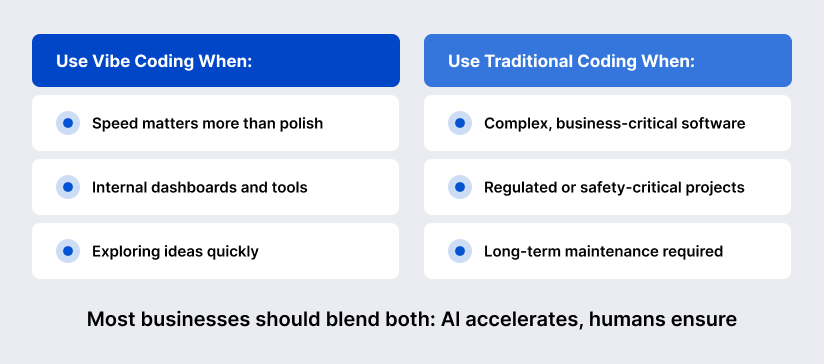
It shines in prototypes, internal tools, process automation, and early product discovery. When requirements are fluid, and the main goal is learning speed, vibe coding can be extremely effective. It helps teams test assumptions before they spend too much time polishing the wrong thing.
Potential risks and technical debt
The danger is not always bad code. Often, code looks finished long before it is ready. Weak architecture, shallow testing, and inconsistent patterns can slip through because the software appears to work. That is how technical debt gets mistaken for progress.
Advantages and Limitations of Traditional Coding
Traditional programming still carries weight because it is built for durability.
Strengths of structured development
Structured development supports clearer architecture, stronger testing, safer deployment, and steadier maintenance. It is usually the right fit for software that has to survive scale, audits, and years of change.
Limitations in modern AI-accelerated environments
The drawback is speed. Teams that rely only on manual implementation may lose efficiency in repetitive work and may validate ideas more slowly than competitors using AI intelligently.
Need expert guidance on designing and implementing AI solutions for your business?
Real-World Use Cases for Vibe Coding
The strongest use cases are practical rather than flashy.
Rapid prototyping and MVP development
If the goal is fast feedback, vibe coding makes sense. It can compress the path from idea to testable product and help teams learn before they overbuild.
Internal tools and automation
Admin panels, reporting tools, workflow helpers, and lightweight automation projects are strong fits. These systems benefit from speed, and their risk profile is usually lower than that of customer-facing core software.
Startup product development
Startups often need evidence before elegance. Vibe coding supports that reality well. It helps lean teams ship, learn, and change direction without carrying a large upfront engineering burden.
When Traditional Coding Is Still the Better Choice
The higher the stakes, the stronger the case for structure becomes.
Enterprise software systems
Enterprise systems depend on stable integration, predictable maintenance, and deliberate architecture. Billing systems, identity platforms, ERP extensions, and customer data systems usually need that level of control.
Safety-critical applications
In healthcare, fintech, and industrial systems, bugs can become compliance issues, financial losses, or operational risk. Traditional development remains the safer base model in those settings.
Large-scale platforms and infrastructure
Large platforms need resilient algorithms, careful optimization, and thoughtful scalability planning. Those qualities rarely emerge from speed-first generation alone.
The Rise of Hybrid Development Workflows
This is where most teams are actually heading.
Combining AI-assisted development with an engineering discipline
The strongest hybrid framework uses AI for scaffolding, boilerplate, automation, and routine implementation while keeping humans in charge of architecture, security, testing, and release quality.
The role of human oversight
Human oversight is the quality gate. It determines whether the generated code is sound, safe, and clear enough to become part of a system that others will have to maintain.
The Future of Software Development
The future is less dramatic than the headlines suggest and more operational.
AI-native development teams
AI-native teams will not just use better tools. They will build better rules around them. DORA’s 2025 findings suggest that AI improves results most when the surrounding system — process, trust, and collaboration — keeps pace with the tooling.
The evolution of developer roles
Developers are moving up a layer. Less time goes into boilerplate. More goes into architecture, integration, debugging, optimization, and deciding what should be automated at all.
What Does SaM Solutions Offer?
SaM Solutions helps companies turn AI from an experiment into a delivery capability. We build AI-enabled applications for customer experience, internal workflows, and data insights, and also offer custom AI agent application development, integration, and deployment.
For businesses, that kind of support matters because the hard part is rarely access to tools. It is deciding where AI belongs in the workflow, how to govern it, and how to connect it to real systems without compromising security, scalability, or maintainability.
Conclusion
The debate over vibe coding vs traditional programming sounds bigger than it is. This is not a choice between old and new. It is a question of fit.
Vibe coding is excellent for speed, experimentation, and lightweight automation. Traditional programming remains stronger where architecture, security, scalability, and long-term maintenance cannot be compromised. For most businesses, the durable answer is not either-or. It is a hybrid.
FAQ
Can vibe coding fully automate development?
No. It can automate large parts of implementation and support testing, documentation, and debugging, but human teams still need to validate business logic, manage security, and own the release.
Can vibe coding be used in regulated industries like healthcare or fintech?
Is vibe coding suitable for enterprise software?
What role do prompt engineering skills play in vibe coding workflows?