Embedded World 2026 Recap: CRA Readiness, Edge AI, and the Future of Embedded Systems


The Embedded World 2026 exhibition in Nuremberg was the largest and most unified edition to date. Organised by NürnbergMesse from 10-12 March 2026, it drew around 36,000 visitors from nearly 90 countries, a 13% increase over 2025, and hosted 1 ,262 exhibitors from 43 countries across seven halls. This growth, combined with a six‑percent increase in exhibitors, underscores the rising global importance of embedded technologies and the show’s role as a central community meeting place.
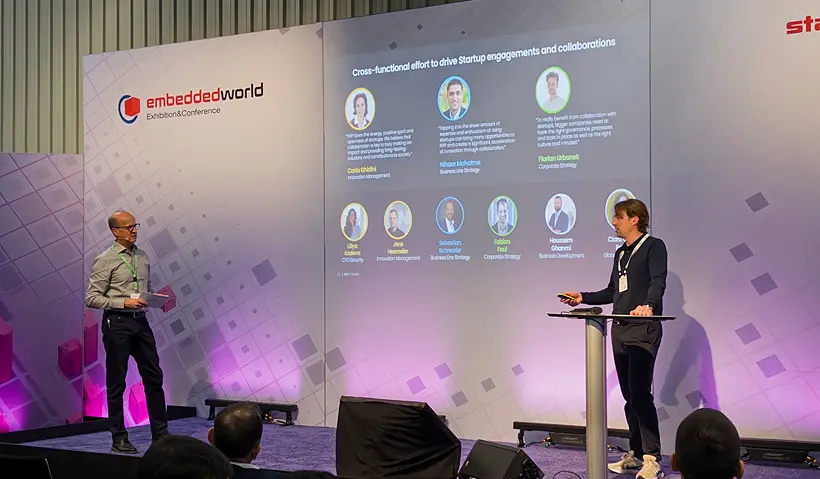
To get a real feel for what was happening beyond the headlines and numbers, we caught up with the SaM Solutions team, who were there in person — Andrei Andreyanov (Team Lead, IoT & Embedded), Andrei Klishevich (Director Client Services DACH), and Eugene Lavnikevich (Project Management Officer).
They spent several days walking the halls, talking to vendors, partners, and engineers, and their impression was clear: this year felt different. Not just bigger — more focused, more practical. Now more on what has felt different this year.
Regulatory Compliance Takes Centre Stage
A defining theme at Embedded World 2026 was the European Union’s Cyber Resilience Act (CRA). With the first enforcement milestone — mandatory 24‑hour vulnerability reporting — coming into force in September 2026, compliance moved from discussion to implementation. Compared to previous years, when regulatory readiness was still in discussion, companies are now actively implementing CRA-related requirements. Across a wide range of solutions — from hardware to platforms and embedded systems — compliance has become a core part of product development and positioning.
Eurotech demonstrated CRA/NIS2‑compliant Eclipse IoT projects, and Codethink highlighted its Trust‑Evidence initiative. For SaM Solutions, which specialises in secure embedded platforms, this alignment confirms that security‑by‑design and transparent SBOMs are now baseline expectations rather than differentiators.
Choose SaM Solutions for your embedded and firmware development needs and take advantage of our extensive experience in the industry.
Practical AI at the Edge
Artificial intelligence was everywhere in Nuremberg, but the focus has evolved from futuristic concepts to practical, application‑focused AI at the edge. Microchip’s keynote, “Learning from the Octopus: Nature’s Blueprint for Intelligence Everywhere,” used the octopus’s decentralized nervous system to illustrate the shift toward distributed intelligence. Speakers argued that decision‑making is moving closer to the data— embedded systems must process data locally to meet latency and resiliency demands.
Forbes’ analysis noted that edge AI accelerators and neural‑processing units (NPUs) are now table stakes across the entire power spectrum, from sub‑milliwatt microcontrollers to appliance‑class processors. Ambiq’s Atomiq SoC, built on a 12‑nm SPOT platform with an Arm Ethos‑U85 NPU, and STMicroelectronics’ STM32U3B5/C5 with a hardware accelerator for signal processing and AI/ML workloads exemplify how vendors are enabling always‑on AI inference at ultra‑low power. NXP’s i.MX 93W, integrating an NPU and secure tri‑radio connectivity in one package, demonstrates that AI, connectivity, and security are converging.
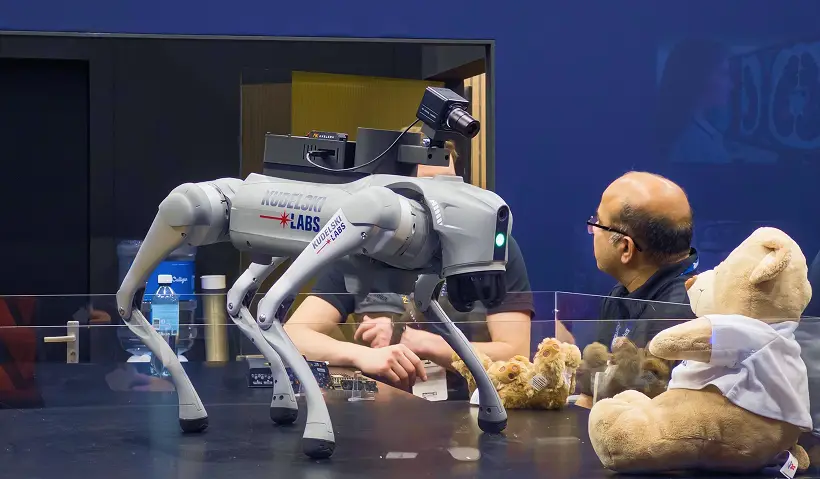
Other exhibitors reinforced the physical AI trend. Lattice Semiconductor explained how its low‑power FPGAs bring AI inference to robotics and machine‑vision systems by placing the compute close to the sensors.

Innovations in Hardware and Systems
Embedded World 2026 served as a launchpad for new processors and system‑level solutions. GigaDevice announced it is evolving from a component supplier to a system‑level enabler. At Hall 5‑129, the company demonstrated how its GD32 microcontrollers, high‑speed Flash memory, analogue and sensor products combine to power humanoid robotics, industrial automation, and edge AI. Its EtherCAT servo‑drive solution, based on the GD32H75E Cortex‑M7 MCU, provides high‑precision motion control and real‑time communication for Industry 4.0. GigaDevice also showcased an AI‑powered voice‑recognition demo on its GD32H7 series and a Matter‑compatible wireless MCU supporting Wi‑Fi, Bluetooth, and environmental sensing for smart‑home devices.
Embedded World 2026 once again brought together leading technology providers and showcased innovations from major industry players such as AMD, NXP, STMicroelectronics, Infineon, Qualcomm, and others.
Across the exhibition, companies presented new approaches in areas such as edge computing, automotive systems, sensor technologies, etc. The event’s awards program also reflected the diversity of innovation, with more than 110 product submissions from companies of all sizes, including global enterprises and startups.
Get AI software built for your business by SaM Solutions — and start seeing results.
Outlook and SaM Solutions’ Takeaways
Embedded World 2026 also signalled the expansion of the trade‑fair brand to India: a new event will take place in Bengaluru on 17–19 November 2026, aligned with the Bengaluru Tech Summit to tap into India’s rapid digital transformation and projected 10.3 % annual market growth. The next Nuremberg edition is scheduled for 16–18 March 2027.
For SaM Solutions, the event confirmed that the embedded industry is maturing. Regulatory compliance, particularly the CRA, is now a baseline requirement rather than an afterthought. Edge‑AI integration has moved from demos to deployment, powered by a wave of new processors, unified NPUs, and system‑level platforms. RISC‑V is rapidly evolving from curiosity to production, and platform ecosystems are emerging to simplify development.