Automation and Digital Transformation: Building Intelligent Business Operations


(If you prefer video content, please watch the concise video summary of this article below)
Key Facts
- Automation and digital transformation have become essential characteristics for businesses rather than just a sideshow, assisting them in becoming more resilient, agile, and competitive.
- It takes more than technology to drive digital transformation, with workflow optimization, governance, integration, and tangible business objectives being crucial.
- AI, cloud, Internet of Things, predictive analytics, and low-code platform stack comprise the key technologies supporting intelligent business operations.
- The most tangible gains can be summarized as increased productivity, error reduction, accelerated decision-making, improved customer experience, cost savings, and enhanced compliance.
- Digital transformation and automation projects must follow a gradual approach that starts with defined objectives, realistic roadmaps, appropriate technology stacks, and ROI measurements.
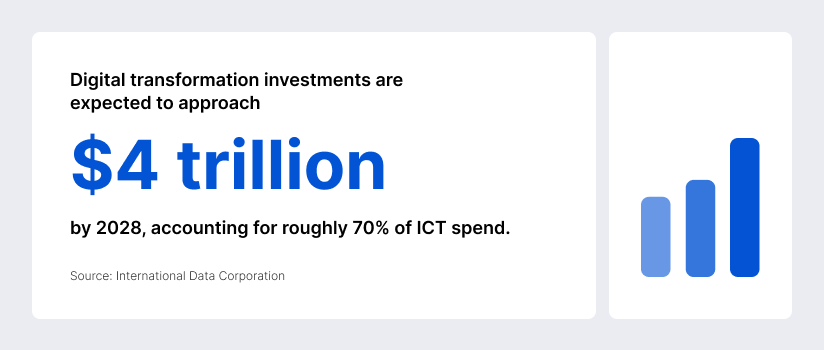
Automation and digital transformation are no longer side projects for large enterprises or innovation-first brands. They have become the operating model of competitive business. IDC says digital transformation investments are on track to approach $4 trillion by 2028, accounting for roughly 70% of ICT spend.
What matters now is not whether businesses should modernize, but how they should do it without creating another layer of complexity. The companies that make real progress are the ones that connect technology choices to process design, governance, and measurable business outcomes instead of treating automation as a collection of isolated tools.
Understanding Automation and Digital Transformation
The two concepts are related but different from each other. The importance of automation vs. digital transformation lies in the fact that the former makes a particular process better, whereas the latter revolutionizes the entire business model.
Why businesses are accelerating modernization
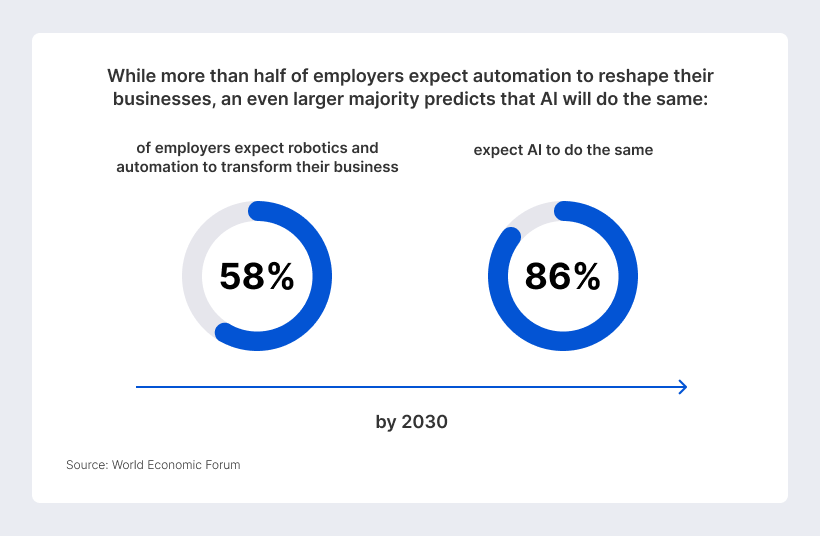
The acceleration is driven by a mix of market pressure, workforce pressure, and technological maturity. IDC reports that organizations continue to invest in digital capabilities despite economic uncertainty because digital maturity is closely tied to resilience, agility, and competitive advantage. At the same time, the World Economic Forum’s Future of Jobs research found that 86% of employers expect AI and information-processing technologies to transform their business by 2030, while 58% expect robotics and automation to do the same.
The connection between technology and operational change
Technologies do not bring any changes independently. Automation without standardization processes and better cooperation will only increase existing problems. This is why there should be operational change along with the technical one. The use of AI is associated with product management, integrations, and specific goals.
Leverage SaM Solutions’ decades-long expertise in IT to develop high-quality custom software for your business.
The Strategic Role of Automation in Modern Enterprises
After companies successfully execute the initial pilot program, automation becomes not just a back-office efficiency initiative but also an integral part of business operations. This is where it begins to impact speed, quality of service, resiliency, and decision-making.
Process optimization across departments
The value of automation becomes strategic once it goes beyond organizational silos. Order management is something that involves sales, logistics, finance, and customer support. This means that bottlenecks typically occur during transfers, and not just in one department. Standardization of processes, common performance indicators, and teamwork become critical prerequisites if organizations wish to use automation to enhance cycle times, visibility, and performance.
Reducing manual work and human error
The simplest benefit of using automation lies in minimizing the efforts of the people behind inconsistencies. People working on manual systems create more chances for mistakes, and thus influence quality, accountability, and efficiency. If done properly, automation eliminates unnecessary rework and leaves only the exceptional part to the people.
Increasing agility through intelligent systems
Rule-based automation works well, but intelligent solutions incorporate the skills of adaptation, prioritization, prediction, and learning through patterns. It allows organizations to test different use cases on a smaller group of users, see how it performs, and scale only those that show promise without risking everything in a single implementation.
Core Technologies Behind Business Transformation
The real value comes from how the tech stack works together: data moves cleanly, systems can scale, decisions improve over time, and teams still have enough control to keep the whole environment secure and governable.


Transforming Key Business Processes
Transformation can be best performed on those processes that are repetitive, high-volume, time-sensitive or require data transfer between processes.
One of the areas of rapid achievement of operational improvements is customer service. Artificial Intelligence is applied in dealing with the most common inquiries like order status checking and creation of cases whenever discrepancies arise. This approach is effective where predictable queries are handled, there is self-service provided to the customer while difficult cases are referred to the person after capturing sufficient data.
Automated finance processes will help streamline invoicing, provide more visibility regarding the status of the invoices, decrease manual entries, minimize mistakes, and eliminate the need for rework in the accounts payable department. Workflow automation, analytics tools, control mechanisms within ERP, and real-time tracking will help decrease the risk exposure and increase efficiency.
It is difficult to distinguish optimization from digitalization, as visibility is the cornerstone for making any subsequent decisions. One of the first steps towards achieving the autonomy of the supply chains is to switch from the current processes based on paperwork and manual handling to a fully automated solution.
HR transformation has a chance of success only when it eliminates the friction associated with HR administration and does not eliminate the human element. Automation may be used to increase the efficiency, accuracy, and responsiveness of HR processes, offer faster processing of regular queries by employees, and decrease HR’s dependency on its own personnel for routine administrative activities.
Business Benefits of Automation and Digital Transformation
The benefits of modernization are often presented in generic terms, but in healthy programs they show up as operational outcomes that leaders can actually see: less waiting, fewer errors, better service, more resilience, and stronger control over how work gets done.


Challenges Companies Face During Transformation
Most transformation problems are not mysterious. They tend to recur in the same places: old systems, weak integration, unclear ownership, shaky data, change fatigue, and gaps between new tools and the skills available to use them well.
Legacy systems continue to pose a challenge due to being costly to maintain, difficult to secure, and highly entangled with key processes. While the solution is typically not a rash ripping and replacing, the process must include phased modernization, an integration architecture, API-based approaches, and tying all the platforms together as one ecosystem.
Resistance is typically viewed as a personnel issue, but it is often also a design issue. This is the reason why it should always be grounded in reality, including understanding what the change is, why it needs to be made, how it will be measured, and where people’s feedback would really make a difference. Otherwise, the process may go live but never become part of standard operations.
The more automation and connectivity there is within a company, the higher the risks regarding cybersecurity and data protection. As noted by the NIST guide on IoT, trust, privacy, security, authenticity, and reliability are key elements of connected systems. In addition, the NIST Cybersecurity Framework exists specifically for this purpose.
Another element that comes into play is AI. With the introduction of the EU AI Act, there are now specific obligations depending on the level of risk, while the GDPR continues to provide the foundation for personal data protection within the EU. Thus, businesses must have stricter control measures for data lineage, access, model governance, monitoring, and incident response, considering the increase in intelligent operations.
As highlighted by the World Economic Forum, the existence of skills gaps presents itself as one of the significant barriers to transformation in businesses. The skills gap is not limited to technical expertise; it also involves soft skills like problem-solving, leadership, and critical thinking. All of these skills make perfect sense because intelligent operations require human judgement, prioritization, and responsibility.
How to Build a Successful Transformation Strategy
A successful transformation strategy will seem more disciplined than radical. It begins with business imperatives, goes through stages, and measures its success in terms of value rather than assumption.


Real-World Examples of Automation and Digital Transformation
The names of the platforms may differ in various industries, but the concept is surprisingly uniform: connect the data, simplify the workflow, augment intelligence where appropriate, and maintain enough governance to scale effectively.
Manufacturing provides an excellent example due to the high correlation between visibility and effectiveness. Best practices in manufacturing rely on cutting-edge technology – specifically AI – to boost performance, robustness, sustainability, customer focus, and talent success in large-scale settings.
Modernization of healthcare is not about showcasing AI but about minimizing the friction inherent in the process of providing care. AI transforms how health systems are designed, operated, and governed. Healthcare modernization through AI is a valuable undertaking since any delay at the administrative level takes away the time that could be used somewhere else.
The retail sector demonstrates how the connection between customer experiences and operational intelligence works. AI can analyze previous purchases and user behavior to predict requirements, optimize stock, and even design products. This is personalization, but it is also planning and fulfillment intelligence.
The industry of finance was one of the first where AI technologies were applied before the advent of the gen-AI boom. For many years already, banks and insurance firms used statistical techniques and machine learning tools in making decisions for assessing risks, preventing fraud cases, detecting money laundering, and more. On the other hand, gen-AI applications are mostly aimed at process optimization inside companies.
The Future of Intelligent Enterprises
Future chapters have already begun writing themselves. The new chapter sees the move from standalone automation to interconnected operation layers capable of orchestrating processes, identifying exceptions, and empowering humans with improved context.
Autonomous systems can design, orchestrate, and automate much more sophisticated business processes than before, which is pretty much the core of hyperautomation for the organizations discussing the topic today. However, autonomy presupposes trust. The future is unlikely to be one of total hands-off of all processes. Instead, it should be “automate more but govern better”.
It would be unwise to expect future organizations to adopt AI technologies to replace employees in full. Today’s AI is expected to automate parts of processes rather than whole processes because AI technologies will enable organizations to perform better and offer greater value as long as they allow space for using AI.
In addition, intelligent business practices are helping businesses become more sustainable through efficient data management in business. The Data Act in Europe offers another example of a concrete way forward, as it encourages the availability of data from connected products and related services according to European regulations. In order for future business models to succeed, they must be smart but also resourceful with data.
SaM Solutions Offers
SaM Solutions is able to help clients transform digital strategies into reality. Our expertise includes software consultation, cloud-native development, artificial intelligence software development, automation, legacy modernization, system integration, DevOps, and secure software engineering.
Instead of being focused purely on technological capabilities, we integrate architecture, data, workflow, and business goals into realistic delivery roadmaps. With over 30 years of experience, more than 1,000 projects delivered, and 800 professionals, SaM Solutions can aid in transformation planning as well as full-cycle implementation of intelligent business practices.
In IT since 1993, SaM Solutions offers professional custom software development services to clients across all industries.
Conclusion
The greatest value of automation and digitization comes only when they are addressed in terms of designing a business rather than a procurement process for some software. Organizations that do business intelligence correctly will be those that standardize where necessary, automate where it makes sense, leave people in the loop where human judgment is important, and evaluate results with sufficient integrity to improve.
FAQ
How long does automation and digital transformation usually take?
Timeframes depend on the scale of transformation, legacy system, quality of data, and change process involved. A small proof-of-concept project takes days or weeks, but transformation of an organization is an ongoing process, not a one-time launch event.
What industries benefit most from automation and digital transformation?
How can companies measure the ROI of automation and digital transformation?








![Digital Transformation Strategy [+ Key Trends in 2026]](https://sam-solutions.com/wp-content/uploads/fly-images/16958/title-366x235-c.webp)