AI-Native Software Development: What It Means and Why It Matters


(If you prefer video content, please watch the concise video summary of this article below)
Key Facts
- AI-native development means that artificial intelligence is the architectural core of software creation, not as a side tool for autocomplete, search, or code generation.
- The main bottleneck moves from coding speed to intent quality. As AI agents generate, test, and package software faster, engineering success depends on clear specifications, strong governance, and precise human oversight.
- The role of software teams is changed. Developers don’t focus mainly on writing syntax; they define intent, validate logic, inspect AI-generated output, and protect the architecture from hidden risks.
The software industry has hit a point of terminal velocity. For the past two years, the conversation has been dominated by AI-enabled tools — copilots sitting in the margins of our code editors, suggesting the next line of a function or automating tedious boilerplate. It felt revolutionary. But the reality? We’ve essentially just been giving developers a faster shovel. Recent data shows that while generative AI tools have helped engineers write code up to 55% faster, overall project delivery timelines haven’t shrunk at nearly the same rate. The bottleneck didn’t disappear; it just shifted further down the pipeline into architecture, testing, and deployment.
We are officially moving past the era of the digital assistant. The future is linked to AI-native software development — a total, ground-up reimagining of how applications are conceived, architected, and sustained.
Leverage AI to transform your business with custom solutions from SaM Solutions’ expert developers.
What Is AI-Native Software Development?
To understand AI-native, it helps to look backward. Remember the transition to Cloud-Native? A decade ago, companies realized that simply taking a legacy, monolithic application and dumping it onto an AWS or Azure server didn’t make it a cloud application. It just made it an expensive, hosted monolith. True cloud-native software had to be designed from scratch using microservices, containers, and dynamic scaling.
AI-native follows the exact same philosophy.
AI-native development is an engineering methodology where artificial intelligence is not an add-on feature, but the foundational fabric of both the system being built and the environment used to build it. It is the transition from a deterministic software world, where humans write rigid, static lines of if/then code, to a probabilistic software world.
AI-Native vs. Traditional Software Development
The transition from traditional coding to AI-native engineering isn’t a step forward but a leap to an entirely different track.
- Role of AI in the engineering workflow. In traditional environments, AI is a passive passenger. It acts as an autocomplete tool or a search replacement, sitting quietly until a developer prompts it for a snippet of code. In an AI-native workflow, it is an active peer. It operates autonomously within agentic workflows.
- Project starting point (Requirements vs. Intent). Traditional development begins with rigid documentation: analysts write exhaustive requirements, and developers translate them into deterministic logic. AI-native development replaces this with Intent-Driven Engineering. The starting point is human intent. Engineers define business constraints, security boundaries, and architectural goals, while specialized AI determines the most optimal path to construct the mechanics.
- Delivery speed and iteration cycles. The traditional software lifecycle is measured in sprints, weeks, or months. Code must be manually written, peer-reviewed, merged, and deployed through a heavily gated pipeline. AI-native cycles shrink from weeks to minutes. Because AI agents can generate, test, and package updates concurrently, iteration becomes continuous.
- Architecture and system design. Classic systems are hardwired. They rely on fixed, deterministic APIs and highly rigid database schemas that break when unexpected data formats arrive. AI-native architecture is built around fluid data streams and multi-model orchestration planes. It is meant to handle probabilistic inputs, utilizing semantic layers and dynamic vector routing so the software can gracefully adapt to changing information.
- Quality assurance and testing approach. Historically, QA is a massive bottleneck. Developers write code, and then either they or a dedicated QA team spend days writing different types of tests. In an AI-native paradigm, testing is embedded natively. As the AI constructs a feature, it simultaneously generates the complete testing suite and infrastructure.
- Technical debt management. Legacy codebases inevitably decay. Documentation becomes outdated the moment it is saved, dependencies rust, and refactoring a massive monolithic block of code becomes too terrifying to attempt. AI-native systems treat code as ephemeral. Because the AI understands the underlying intent rather than just the syntax, it can continuously refactor codebases, auto-update deprecated libraries, and keep documentation perfectly synced with the actual state of the application.
| Dimension | Traditional software development | AI-native software development |
|---|---|---|
| Primary logic | Deterministic (strict if/then rules written by humans) | Probabilistic (context-aware logic driven by models) |
| Development focus | Syntax generation and manual debugging | Architecture design, guardrails, and intent validation |
| Velocity bottleneck | The speed of human typing and code compilation | The clarity of human intent and governance guardrails |
| Code longevity | Maintained indefinitely (accumulating technical debt) | Ephemeral (continuously refactored and auto-updated) |
| System interaction | Rigid, predefined integration endpoints (APIs) | Dynamic orchestration of specialized AI agents |
AI-Native vs. AI-Enabled Software
It is incredibly easy to confuse these two terms. Marketing departments slap the AI label on everything now, muddling the waters. But beneath the buzzwords lies a massive structural divide.
- AI as the core vs. AI as an add-on. AI-enabled software is traditional software with AI features attached, like a CRM with a “summarize this thread” button. If the API fails, the product still works. AI-native software is different: intelligence models are the core logic engine. Remove the model, and the application stops functioning.
- Product architecture and data flows. AI-enabled systems move data through rigid relational databases and call an LLM only at the end to perform inference and polish the response. AI-native architecture works differently. It uses real-time pipelines, vector databases, and semantic routing layers to process probabilistic, unstructured unstructured information natively at every step, adapting its internal data structure based on what the model learns.
- User experience and personalization. In an AI-enabled app, users still face the same static dashboard, menus, and buttons, with perhaps an AI search bar added. AI-native UX is dynamic. Because the system continuously reads user context and behavioral data, the interface itself adapts. Menus, dashboards, and workflows morph in real time to match the user’s immediate intent, making the software feel alive.
- Automation depth across workflows. AI-enabled automation is linear: if a user receives an invoice, parse the text and save it to a folder. AI-native systems go further. Specialized agents reason through discrepancies, compare invoices with vendor contracts, coordinate with supplier agents, and update financial records without human intervention.
- Scalability and adaptability. Upgrading an AI-enabled app usually means new code, schema changes, and heavy releases. AI-native software adapts through context. With foundation models and prompt-driven orchestration, entering a new market often requires updating data context and guardrails, not rewriting the application from scratch.
- Governance, security, and model control. In AI-enabled tools, security is often a basic filter around external API use. AI-native development embeds governance into the runtime itself, with agent control planes, compliance logging, data anonymization, and behavioral regression checks to keep probabilistic systems within enterprise security boundaries.
| Dimension | AI-enabled software | AI-native software |
|---|---|---|
| Core philosophy | AI is treated as a feature, an add-on, or a wrapper layered on top of a legacy system. | AI is the fundamental logic engine; the entire system is built around it from day one. |
| System dependency | Independent. If you turn off the AI features, the core application still functions normally. | Dependent. If you remove the underlying models, the software completely ceases to function. |
| Data architecture | Built on traditional relational databases with rigid, static tables and structured query schemas. | Utilizes real-time streaming pipelines, vector databases, and semantic routing layers. |
| User experience (UX) | Static, predefined dashboards and navigation menus with optional AI helper widgets (e.g., a chatbot side-panel). | Dynamic and generative; the interface morphs, rearranges, and personalizes in real time based on user intent. |
| Automation capabilities | Linear, deterministic automation (strict “if-this-then-that” rules and macro-scripts). | Agentic automation; multi-model orchestrations where autonomous agents solve complex, open-ended tasks. |
| Upgrades and adaptation | Requires manual code rewrites, structural schema alterations, and standard developer deployment cycles. | Scales through context; adapting to new business logic often requires updating data prompts and fine-tuning guardrails. |
| Security and governance | Reactive perimeter defenses (basic keyword filters or API payload blocks retrofitted onto the app). | Embedded control planes; continuous behavioral regression checks and compliance logging built into the runtime fabric. |
Why AI Becomes the Architectural Core
Software complexity has outpaced human cognitive capacity. We can no longer manage millions of lines of interconnected, brittle code without systems that actively think alongside us.
Intent-driven discovery
Traditional project scoping is broken. Teams try to predict every edge case before the first line of code, producing requirements documents that age before they are signed. An AI-native core switches the process to intent. Developers and business analysts define business logic, constraints, and goals in natural language. The system parses that intent and maps it to architectural patterns.
AI-assisted solution design
System architecture once meant static boxes, arrows, and hope. In an AI-native setup, architecture becomes fluid. The core AI analyzes performance data, cloud costs, and dependencies to suggest microservice boundaries, adaptive data schemas, and orchestration logic for specialized models. The engineer stops acting as a draftsman and becomes an editor.
Accelerated engineering workflows
The mechanical act of typing syntax is no more the defining constraint of software delivery. With AI at the center of the development environment, multi-step agentic coding workflows take over the hard job. A developer assigns a feature ticket to an internal AI agent, which builds the module, refactors nearby code, checks for regressions, and prepares a pull request. The engineer only has to validate system logic.
Continuous quality and testing
QA used to arrive late, like a safety net thrown under a project before release. AI-native architecture makes quality continuous. Since the artificial intelligence understands the business intent behind the code, it generates matching test suites as the feature is built. When functionality changes, the tests adapt. Continuous simulations and boundary checks expose vulnerabilities before the code leaves the developer’s environment.
Governed DevOps and deployment
Production deployment should not feel like a gamble. AI-native DevOps replaces fragile CI/CD scripts with intelligent orchestration. The infrastructure reads the context of each code change, scales cloud environments, and monitors telemetry during rollout. If anomalies appear, it isolates the blast radius, rolls back gracefully, and drafts a diagnostic report.
The Generative AI Effect on Engineering Teams
Generative AI has created a strange paradox. Individual developers are flying, cutting administrative work and generating code in seconds. But at the team level, the picture flips: Recent data shows that an increase in team AI adoption often correlates with a slight decrease in total software delivery throughput.
Why? Because raw code was never the real bottleneck.
When code production accelerates, the whole engineering system feels the pressure. Pull requests pile up. Reviews stall. Legacy CI/CD pipelines start to crack under machine-speed output.
This friction is dismantling the old engineering hierarchy where senior architects hand down massive specs and juniors spend weeks translating them into syntax. AI-native teams are becoming smaller, leaner, and more autonomous.
The primary skill of a high-output developer today is the ability to write hyper-precise specifications, establish rigid logic constraints, and build robust verification systems. The human role transforms decisively from generator to inspector.
Business Benefits of AI-Native Software Development
For leadership teams, the ripple effects of this architectural change alter the bottom line across four major areas.


Key Challenges and Risks
Organizations must navigate four critical challenges to prevent their accelerated pipelines from turning into architectural liabilities.


Implications for CIOs, CTOs, and Digital Leaders
To capitalize on this paradigm transformation without crashing into the walls of comprehension and security debt, digital leaders must completely rewrite their operational playbooks across four strategic fronts.
Investment strategy
Smart capital is going away from tools that merely accelerate syntax generation and moving toward foundation models, data infrastructure, and governance frameworks. CIOs must prioritize not the number of developers but the quality of proprietary data, AI capabilities, and operational guardrails.
Team structure
The old hierarchy of junior developers producing boilerplate under a few architects is becoming obsolete. Teams need to evolve into lean, autonomous engineering pods. Talent metrics must move toward systemic design, risk mitigation, and precise intent specification. At the same time, junior engineers need training that protects their core problem-solving skills from prompt-box dependency.
Governance models
Post-development audits and static compliance checklists are not sufficient for probabilistic systems. Governance must live inside the runtime architecture itself. CTOs must establish frameworks for model evaluation, prompt management, security controls, compliance monitoring, explainability, and continuous behavioral testing.
Long-term product velocity
Organizations that successfully adopt AI-native practices can dramatically reduce the time between idea and deployment. However, sustainable velocity will depend on maintaining architectural discipline, preventing comprehension debt, and ensuring human oversight remains aligned with machine-scale output.
How to Start With AI-Native Software Development
The transition requires a deliberate, tactical crawl-walk-run approach.
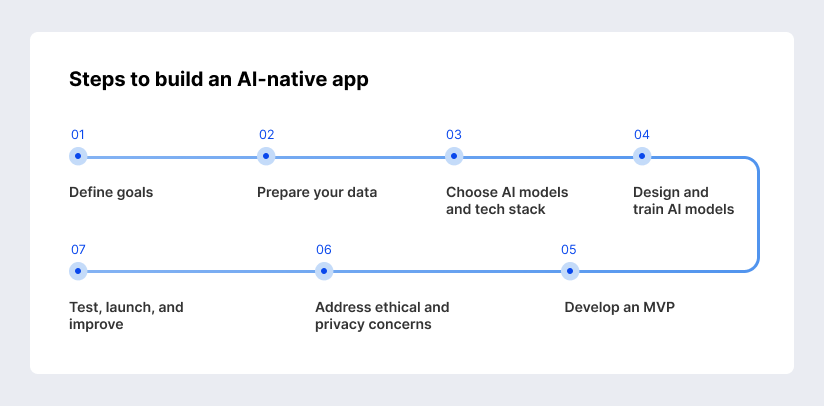
- Define goals. Start with a business objective, not a tool. Decide where AI should create measurable value: faster delivery, smarter automation, better user experience, or lower operational costs.
- Prepare your data. Clean documentation, reliable system context, secure data flows, and structured knowledge bases are essential before AI can make useful decisions.
- Choose the right models and tech stack. Select suitable AI models, frameworks, cloud services, vector databases, orchestration tools, and integration technologies.
- Design and train AI models. Fine-tune or configure models around real workflows, business rules, and domain-specific requirements.
- Develop an MVP. Start with a narrow use case and strict guardrails to validate performance, usability, and business impact early.
- Address ethics and privacy. Build in data anonymization, access control, bias checks, explainability, and compliance from the beginning.
- Test, launch, and improve. Test deeply, release carefully, monitor continuously, and refine the system based on real user feedback and runtime behavior.
SaM Solutions’ AI-Native Software Development
SaM Solutions approaches AI-native software development as more than adding a model to an existing product. It starts with the business problem, the data behind it, and the systems that must keep working when artificial intelligence enters the workflow. We build AI agents, chatbots, LLM-powered tools, contextual search, predictive analytics, and process automation solutions that fit into real enterprise environments instead of sitting beside them. Our teams also support AI readiness assessment, use case prioritization, architecture design, data governance, PoC development, integration, deployment, and long-term support.
To Sum Up: AI-Native Software Development as a Structural Shift
We need to stop looking at AI-native development as a tool upgrade. It isn’t. It’s a structural demolition of legacy engineering assumptions.
For decades, the tech industry treated code like a delicate heirloom. We wrote it line by tedious line, documented it defensively, and protected it from changing because refactoring was too expensive and risky. AI-native architecture completely changes this, turning raw code into a disposable commodity.
Think about what happens when writing code costs next to nothing. You stop hoarding it. If a module needs an update or a feature needs to adapt, you don’t spend three days manually untangling technical debt or hunting down legacy dependencies. You simply rewrite the high-level intent, trash the old module, and let the AI agent spin up a pristine, optimized version from scratch in seconds. Code becomes ephemeral.
FAQ
How is AI-native software development different from using coding assistants?
Coding assistants simply help developers write code faster within a traditional development process, while in AI-native development artificial intelligence is the basis of the entire engineering process.
Does AI-native software development reduce project costs?
What industries benefit most from AI-native software development?
How can companies measure the ROI of AI-native software development?