AI and Quantum Computing: How Two Technologies Are Reshaping the Future of Computation


Key Facts
- Quantum AI involves using AI for quantum computing to explore new forms of computation.
- Hybrid computing entails the combination of AI and quantum computing for specific applications.
- Possible uses include optimization, machine learning, drug design, and materials science.
- AI enables development through self-calibration, error correction, and noise reduction. Current commercial usage is limited due to hardware instability, high cost, and lack of superiority over classical AI.
AI and QC technologies are changing how data analysis and automation are done by companies, offering them computational power that goes beyond classical computers.
QC technologies can be used in the future to increase the speed of machine learning and optimization as well as other scientific simulations, while AI is helping today in building quantum computers and minimizing errors.
Nevertheless, much more work needs to be done before these technologies become more practical.
Leverage AI to transform your business with custom solutions from SaM Solutions’ expert developers.
What is Quantum AI?
What is quantum computing in AI? Quantum AI is the synergy between artificial intelligence and quantum technology aimed at solving computational tasks. Quantum AI includes such fields as machine learning, quantum-enhanced optimization, and AI-assisted tools for the development and management of devices.
Classical AI operates using classical computer architectures, including CPU and GPU units. Quantum technology employs bits, or qubits, able to be simultaneously in different states. Due to entanglement and interference, this technology allows manipulation of probabilities impossible to be obtained by classical computers.
Quantum AI can be divided into two complementary areas:
- Quantum development for AI – using quantum or hybrid quantum-classical software to provide algorithms for machine learning, optimization, and data analysis.
- AI for development – using machine learning for hardware calibration, fault detection, circuit design, and experimentation.
It should be noted that AI does not imply the intelligence of computers. This is just an area of study of interaction between information technology and intelligent algorithms.
“AI and quantum computing are not competing technologies. They solve different problems, and their real potential lies in how they complement each other. Quantum processors may eventually accelerate specific computational tasks, while AI is already helping researchers make quantum hardware more reliable. The future is likely to be hybrid rather than purely quantum.”
Andrey Kopanev — .NET developer, AI enthusiast
How AI and quantum computing intersect
AI and quantum development overlap in areas involving complex computations, uncertainty, and optimization. Understanding AI vs quantum computing helps clarify their different capabilities and how they can complement each other when traditional approaches prove costly or ineffective.
Two approaches coming together
While AI uses data to learn patterns, development utilizes mathematical structures in processing information.
A combination could involve using a classical AI system to input data into a computer circuitry to perform a specific computation task, and then using classical processors to interpret the outcomes.
The allocation of roles is vital here. Quantum computers are unlikely to replace GPUs for running regular neural network tasks in the near future. Rather, computers are more likely to act as accelerators in larger infrastructures.
However, the opposite approach has been useful. Machine learning models can be used to analyze data from experiments, detect faulty qubits, and provide hardware tuning recommendations.
How do classical computing and quantum approaches differ?
Classical computers use bits and conventional algorithms, while quantum systems rely on qubits, superposition, and entanglement. Classical technology handles everyday workloads efficiently, whereas quantum approaches may offer advantages in specialized optimization and simulation tasks.
| Criterion | Classical computing | Quantum computing |
|---|---|---|
| Information unit | Bit (0 or 1) | Qubit |
| Processing principles | Boolean logic and conventional algorithms | Superposition, entanglement, and interference |
| Hardware maturity | Highly mature | Experimental and rapidly evolving |
| Typical strengths | General-purpose workloads, databases, conventional AI | Specialized simulation and selected algorithms |
| Error management | Established correction techniques | Complex error correction |
| Commercial accessibility | Widely available | Primarily cloud and specialized research access |
Computational limitations of classical computers
Classical computers are extremely powerful devices; yet, some computations could turn out to be too expensive to compute due to growing complexity.
Computation of molecular simulation, search over a huge space of solutions or optimization of complex systems could involve substantial computational power and memory.
There are still some computations that even very advanced supercomputers are not able to perform efficiently.
Still, computational expensiveness is not necessarily a sign of advantage.
There are numerous optimization problems that can be solved efficiently by classical algorithms.
Quantum advantage
The quantum advantage is the state when a quantum computer is better than a corresponding classical computer at some specific computational task.
It may concern speed of computation, computational resources used or quality of the result depending on the type of the benchmark.
The distinction between demonstrating superiority on some specialized benchmark and delivering commercial value on some relevant benchmark is rather important, as the computer can have an advantage over classical one in some specialized benchmark without any commercial value whatsoever.
“One of the most promising applications of AI in quantum computing is happening right now, not decades from now. Machine learning is already helping researchers analyze quantum errors, automate qubit calibration, and optimize hardware control. These advances may seem less exciting than quantum-powered AI, but they are essential for making quantum computers practical.”
Andrey Kopanev — .NET developer, AI enthusiast
Computational limitations of traditional systems
Classical computation is surprisingly powerful, but certain challenges can be prohibitively costly to solve depending on their complexity.
The simulation of particles, searching through huge combinatorial spaces, or optimizing complex systems might involve extensive computation and storage requirements.
But even supercomputers are unable to solve all computations effectively.
But merely being difficult does not imply a speedup; there are many classical algorithms for optimization problems that are highly efficient.
Quantum advantage explained
This advantage is said to exist when a system surpasses an appropriate classical system in performing a well-defined computational task.
The advantage can be based on time taken, resources used, or quality of the solution provided, among other benchmarks.
The two concepts that need to be differentiated are superior performance of a quantum system on a particular test and its usefulness on commercially important tasks.
The latter criterion is significant since a quantum system can perform better than classical systems in a certain benchmark while being useless in commercial tasks.
Why AI and quantum computing matter today
AI and quantum computing matter today because they address different computational challenges while increasingly supporting each other’s development. AI already improves business operations and helps researchers calibrate hardware, reduce errors, and analyze experiments. Meanwhile, advances in quantum processors and algorithms could eventually enable breakthroughs in scientific simulation, encryption, optimization, and materials research.
What are the practical benefits of combining AI and quantum computing?
The combination of AI and quantum technology can enhance areas such as machine learning, optimization, and scientific research, but most of these advantages are still purely experimental.


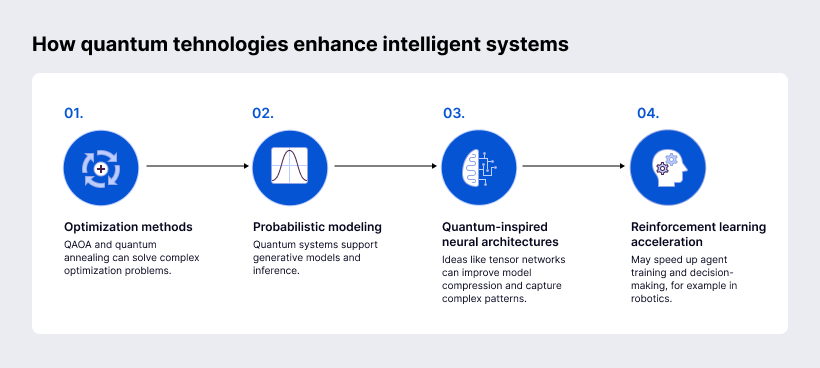
How quantum technologies enhance intelligent systems
Quantum technologies may improve intelligent systems through specialized optimization, probabilistic modeling, and novel data representations. These approaches could accelerate certain computations, although most practical benefits remain experimental.
Quantum optimization methods
Another way is through the Quantum Approximate Optimization Algorithm (QAOA), which uses quantum circuits combined with classical optimization.
Quantum annealing can provide yet another technique to find the lowest energy states.
Both techniques are considered for solving combinatorial optimization problems, but their effectiveness depends on the hardware available and the problem complexity.
Probabilistic modeling
Probability distributions are inherent to quantum systems, thus their potential in generative models and inference.
Quantum circuits are studied as means for artificial data generation and modeling of complicated systems. Yet, training challenges and high measurement cost pose major problems.
Quantum-inspired neural architectures
Quantum-influenced AI utilizes ideas such as tensor network and other mathematical formulations within traditional development.
Such approaches may enhance model compression and represent complex correlations without the use of quantum computers. Yet they may not necessarily confer any advantage at all.
Reinforcement learning acceleration
This area looks into methods for improving agent training, decision-making and policy evaluations.
Possible uses include robotics and autonomous systems. While there is theoretical potential for speedup under certain conditions, no such benefits have been proven yet on practical hardware.
How intelligent systems support quantum research
AI already plays a practical role in quantum engineering, helping researchers improve hardware reliability, analyze measurements, and automate complex experiments.
AI is currently used practically in quantum engineering to help scientists increase hardware performance and analyze their measurement results.
| Quantum research area | How AI is applied | Practical value |
|---|---|---|
| Error decoding | Neural networks analyze error-syndrome data and predict which corrections should be applied to logical qubits. | More accurate detection of complex and correlated quantum errors. |
| Noise mitigation | Learning-based models infer how noise affects quantum circuits and determine compensation strategies from training data. | Cleaner estimates from noisy hardware without requiring full fault-tolerant error correction. |
| Qubit calibration | Machine-learning methods learn relationships between device parameters, crosstalk, and qubit behavior to automate calibration. | Less manual tuning and a more scalable calibration process as processors grow. |
| Adaptive quantum control | Reinforcement-learning agents optimize control signals and adjust processor parameters in response to hardware behavior and drift. | More stable gates and greater resilience to changing operating conditions. |
| Device characterization | Physics-informed machine-learning models learn quantum-system dynamics and hardware parameters from experimental measurements. | Faster identification of device behavior and better information for subsequent control and optimization. |
Error correction and noise mitigation
Such machines are very vulnerable to outside influences, resulting in computational mistakes.
AI assists in detecting error patterns, optimizing decoding, and noise mitigation. Using machine learning, one can predict hardware operation, thus improving performance.
Hardware calibration and control
For quantum machines, there is a need for accurate adjustment of pulse timing, frequency, and amplitude.
Using AI-based systems to optimize hardware operation with the help of experimental data, one can minimize human effort. Such methods as reinforcement learning and Bayesian optimization can be essential in automatic calibration of quantum processors.
Get AI software built for your business by SaM Solutions — and start seeing results.
What are the current challenges and limitations of quantum AI?
There are numerous constraints for quantum AI to be commercially used; such constraints include hardware, talent, and costs.


“Quantum AI is unlikely to transform every industry at once. Its earliest meaningful applications will probably emerge in areas where classical computing faces particularly difficult challenges, such as molecular simulation, materials research, and specialized optimization. For most businesses, conventional AI will remain the foundation, with quantum capabilities introduced only where they demonstrate clear advantages.”
Andrey Kopanev — .NET developer, AI enthusiast
The future of AI and quantum computing
AI and quantum computing will likely converge in hybrid architectures combining classical and quantum processors. Future progress depends on reliable hardware, scalable algorithms, and proven commercial value in specialized applications.
Some of the most significant research goals include error correction, better algorithms, hybrid software, and automation of hardware control systems. For instance, IBM has laid out the timeline for its fault tolerant system, Starling, which is scheduled to launch in 2029. These timelines are goals in the development process and not promises of commercially available performance. Another research goal will be achieving advantage for real-world problems. Validation and performance comparison will be crucial for years to come.
Commercialization is expected to be initially targeted towards niche research and highly valuable tasks. Drug firms, material producers, financial institutions, and energy companies can be considered some of the likely beneficiaries. But most companies will still depend on conventional AI infrastructure for their regular operations. The pragmatic way forward is to benchmark the algorithms against classical ones, determine their business value, and avoid premature commitment to immature technologies.
With the development of fault-tolerant computers to the point where they become sufficiently powerful, they can revolutionize computational chemistry, material science, and some aspects of optimization. AI can contribute to achieving such goals through automatic programming, allocation of resources, and experimentation processes. As a consequence, there can emerge a heterogeneous system where CPU, GPU, computer, and AI work together. Quantum technology does not replace classical computation but expands the capabilities of computational systems.
What does SaM Solutions offer?
SaM Solutions assists companies in forming effective AI strategies and building software architectures that are able to evolve in light of new technological advances.
Having over 30 years of software engineering experience, SaM Solutions helps companies in AI consulting, custom AI software development, system modernization, cloud implementation, and proof-of-concept implementation.
The skills of the firm can assist companies in forming the technical infrastructure to test new approaches to technology.
Relevant services include AI integration, machine learning solutions, data engineering, cloud architecture, and application development focused on performance and scalability.
As for the companies researching quantum AI, a reasonable starting point would be detecting computational limitations, setting classical benchmarks, and assessing whether experimental approaches warrant additional investment.
FAQ
Which cloud platform offers tools to experiment with quantum computing and build quantum AI algorithms?
Both Amazon Braket from AWS and IBM Quantum provide simulators, computers, and hybrid quantum-classical workflows. Amazon Braket also has an option to develop and run algorithms on computers from different vendors.
How can organizations build a roadmap for adopting quantum computing while already scaling AI applications across their business?
Can AI and quantum computing impact cybersecurity regulations?