Spec-Driven Development with the BMAD Method: A Practical Guide


Key Takeaways
- BMAD turns informal AI prompts into structured requirements, specifications, architecture decisions, and implementation tasks.
- Specialized agents improve context management by separating responsibilities across analysis, product, UX, architecture, development, testing, and review.
- Human oversight remains essential for validating requirements, approving high-impact decisions, and evaluating final results.
AI coding tools can accelerate software delivery, but speed alone does not guarantee that generated code reflects business requirements, architectural constraints, or product intent.
This guide explains how the BMAD Method supports spec-driven development, which artifacts and workflow phases it uses, how agent orchestration maintains context and quality, and when the approach makes sense for enterprise and product teams.
What Is Spec-Driven Development with the BMAD Method?
BMAD is an acronym for “Build More Architect Dreams.” Spec-driven development with BMAD is an AI-assisted approach in which structured requirements guide implementation. The main goal is not to leave an AI coding agent to infer the product from a series of prompts. To turn business intent into controlled software delivery, BMAD combines:
- Specifications
- Specialized agents
- Defined workflows
- Human checkpoints
Definition and core principles
The BMAD Method treats documented intent as the foundation for AI-native development. Depending on project complexity, you can define capabilities, success conditions, constraints, non-goals, architecture decisions, and acceptance criteria.
This reduces the number of assumptions an AI agent must make. A vague instruction such as “add secure authentication” still leaves decisions about login methods, sessions, recovery flows, and access rules unresolved. BMAD moves those decisions into explicit requirements, where experts can review them before code is generated.
BMAD is also proportional: a small, well-defined change may require only a lightweight specification, while larger initiatives may need a PRD, UX documentation, architecture, and story breakdown.
From informal prompts to structured requirements
BMAD turns informal requests into implementation-ready requirements. A developer may start with a sentence, issue, or rough feature idea, but ambiguous work is clarified before the AI proceeds.
For example, “Add subscription cancellation to the customer portal” raises immediate questions:
- When does cancellation take effect?
- What happens to prepaid access?
- Can users reactivate later?
A structured specification makes those decisions explicit instead of allowing the coding agent to invent them.
The role of context engineering
Context engineering is central to BMAD because AI output depends on the information available to the model. BMAD organizes requirements, architecture rules, repository conventions, and implementation constraints into focused context for each task.
The goal is not to give the AI every project document. It is to provide the smallest coherent set of information required for the current decision.
How Does the BMAD Method Work?
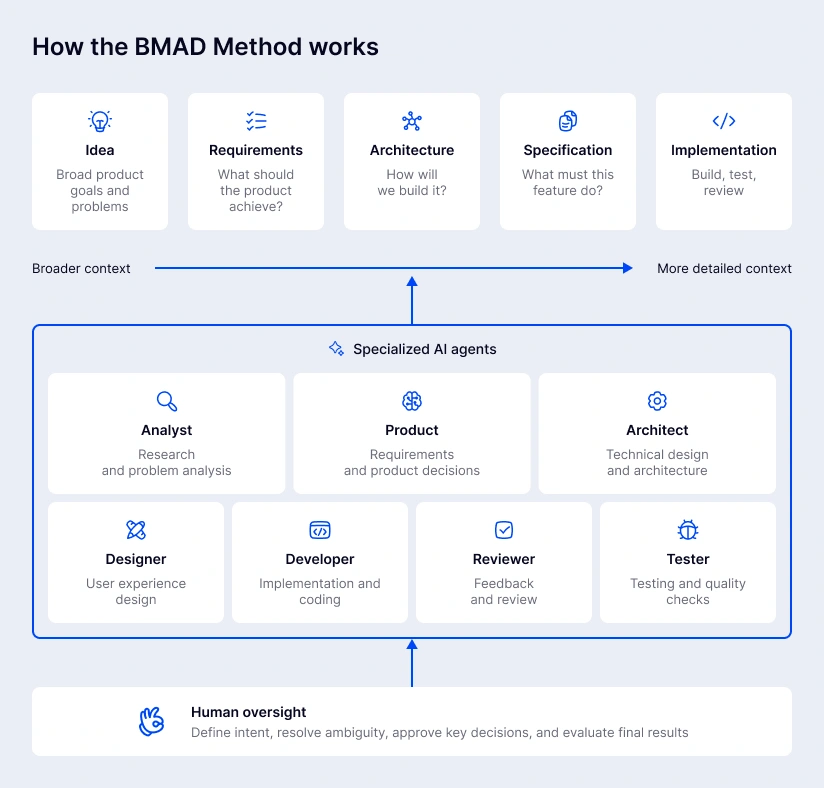
BMAD progressively refines intent, assigns tasks to AI agents, and involves humans where judgment is most important. The workflow can expand for complex projects or remain lightweight for smaller changes.
Progressive context creation
BMAD creates context in layers. Broad product goals can become requirements, architecture decisions, specifications, and finally implementation stories.
Each layer answers a narrower set of questions. A product requirements document (PRD) defines what the product should achieve, architecture establishes shared technical decisions, and a specification describes what a particular feature must do. Smaller tasks can skip unnecessary stages and move directly to implementation.
Specialized AI agents
BMAD doesn’t rely on one general-purpose assistant for every development activity; it divides work among specialized AI roles. These roles typically cover analysis, product management, architecture, UX design, development, testing, and review.
Specialization creates clearer responsibility boundaries. Product decisions are less likely to be reinterpreted during coding, while architecture and acceptance criteria remain visible throughout implementation.
Structured workflows and human oversight
AI-generated decisions are not treated as automatically correct, so BMAD combines automation with human oversight. Humans remain involved in defining intent, resolving ambiguity, approving high-impact plans, and evaluating final results.
What Are the Four Phases of the BMAD Workflow?
The BMAD workflow structures AI-assisted software development into four phases: Analysis, Planning, Solutioning, and Implementation. But for small, well-understood changes, BMAD also supports a Quick Flow that can bypass the first three phases and move directly into a streamlined development cycle.
| Phase | Goal | Key activities | Typical outputs |
|---|---|---|---|
| 1. Analysis | Understand the problem and validate the idea | Brainstorming, research, concept validation, product discovery | Research findings, product brief, PRFAQ |
| 2. Planning | Define what should be built and for whom | Requirements discovery, PRD creation, UX planning, specification | PRD, UX artifacts, specification |
| 3. Solutioning | Decide how the product should be built | Architecture design, epic and story breakdown, readiness checks | Architecture decisions, epics, stories, readiness assessment |
| 4. Implementation | Turn approved plans into working software | Coding, testing, review, corrections, retrospectives | Production code, tests, review results, completed stories |
Phase 1: Analysis
The analysis phase establishes whether the team understands the problem well enough to start formal planning. BMAD can use brainstorming, research, product briefs, and customer-focused PRFAQs to examine user needs, business opportunities, technical questions, and competing approaches. Analysis is optional because not every project starts with uncertainty.
Phase 2: Planning
The planning phase converts validated intent into explicit requirements. BMAD defines what the product or feature should accomplish, who it serves, which capabilities matter, and which constraints implementation must respect.
Depending on the project, planning may produce a PRD, UX documentation, or a focused specification.
Phase 3: Solutioning
The solutioning phase determines how the approved requirements will be implemented. Architecture decisions make choices about system structure and technical patterns explicit; epics and stories translate larger requirements into manageable development units.
BMAD can also perform an implementation-readiness check before development starts. The check helps identify gaps or inconsistencies between requirements, architecture, and planned work while changes are still relatively inexpensive to make.
Phase 4: Implementation
The implementation phase turns the accumulated context into working software. AI agents execute bounded units of work, create or modify code, run tests, review results, and correct problems against the requirements and technical decisions established earlier.
BMAD does not treat implementation as unrestricted autonomous coding. Human review remains important for intent, high-impact decisions, and final acceptance, while AI handles more of the execution inside defined boundaries.
Which Artifacts Does the BMAD Method Produce?
The BMAD Method produces a set of structured artifacts that carry business intent from discovery into implementation. The exact set depends on project complexity: smaller initiatives may rely mainly on SPEC.md, while larger projects can add a product brief, PRD, UX documentation, architecture, epics, stories, and sprint tracking.
Product brief and product requirements document
The product brief captures the core product concept before the development of detailed requirements. BMAD typically uses it to document the vision, problem, target users, and key assumptions in a concise form; the standard output is brief.md with an accompanying addendum.md.
The Product Requirements Document (PRD) goes further: it defines what the product should achieve and why. It organizes capabilities, functional requirements, and non-functional requirements without prescribing implementation details.
User experience documentation
BMAD creates UX documentation when product behavior and user interactions need to be defined before implementation. The bmad-ux workflow produces DESIGN.md and EXPERIENCE.md, which describe how the product should look and behave from the user’s perspective.
SPEC.md contract
SPEC.md is the implementation contract that connects planning with development. BMAD uses bmad-spec to condense an idea or larger planning documents into five elements: Why, Capabilities with success conditions, Constraints, Non-goals, and a Success signal.
Architecture documentation
BMAD’s architecture documentation records technical decisions that independently developed parts of a system must share. The bmad-architecture workflow typically produces ARCHITECTURE-SPINE.md, covering the architectural choices needed to keep implementation consistent across epics and agents.
Epics, user stories, and sprint status
BMAD converts larger requirements into epics and user stories that can be implemented and reviewed as manageable units. Stories include acceptance criteria so developers and AI agents have an explicit basis for determining whether the work is complete.
Tracking depends on the planning path. A spec-backed epic can use an ordered stories.yaml, while larger PRD-based projects use epic files together with sprint-status.yaml. BMAD sprint planning also checks implementation readiness before development begins and tracks story status during delivery.
Project context
Project context captures repository-specific rules that AI agents need to follow consistently. The bmad-project-context workflow creates or maintains a compact, verified block in the repository’s AGENTS.md, covering information such as coding conventions, governance requirements, restricted areas, and project-specific instructions.
BMAD intentionally keeps this context concise. Information that an agent can already discover from source files or configuration does not need to be repeated; the artifact should contain rules that materially change agent behavior.
How Can You Implement Spec-Driven Development with the BMAD Method Step by Step?
Implementing BMAD spec-driven development means moving from an initial idea to a validated specification, architecture, delivery plan, and controlled implementation. The process can be shortened for small tasks or expanded for enterprise projects.
Install and initialize the framework
Install BMAD in the project directory with npx bmad-method install, select the required modules, and connect the framework to your AI development environment. The installer creates the BMAD configuration and output structure used by subsequent workflows.
Select the appropriate planning depth
Choose the smallest planning path that safely fits the project. A simple change may go directly to bmad-spec, while larger initiatives may require a PRD, UX documentation, architecture, and detailed story planning.
Analyze the product idea
Use brainstorming, research, a product brief, or PRFAQ to clarify the problem, target users, business value, and major assumptions. This step reduces uncertainty before formal requirements are created.
Create and validate the PRD
For complex or multi-epic products, use bmad-prd to define what should be built and why. BMAD can also validate the PRD to identify missing, inconsistent, or unclear requirements before development continues.
Build the technical contract
Run bmad-spec to convert the approved intent into SPEC.md, the contract that implementation reads. It defines capabilities, success conditions, constraints, non-goals, and the overall success signal.
Define the system architecture
Use bmad-architecture to document technical decisions that must remain consistent across the system. The resulting architecture spine establishes shared boundaries, patterns, and implementation rules.
Break the scope into epics and stories
Divide the specification into independently implementable epics and user stories with clear acceptance criteria. BMAD can generate ordered story plans so development proceeds in manageable, reviewable units.
Check implementation readiness
Before coding begins, verify that requirements, architecture, and stories are sufficiently aligned. bmad-sprint-planning can identify readiness concerns and create the sprint status used to track execution.
Plan, build, and review
Implement each bounded unit with the appropriate BMAD build workflow, then test and review the result against the specification and acceptance criteria. Human oversight remains focused on unresolved decisions, high-risk changes, and final acceptance.
How Do BMAD Agents Maintain Context and Software Quality?
BMAD maintains context and software quality through specialized agents, shared project artifacts, validation gates, and structured review cycles.
Responsibilities of specialized agents
BMAD assigns different responsibilities to agents for analysis, product management, architecture, UX, development, and review. This separation reduces role confusion and helps each agent operate within a clearly defined scope.
Agent handoffs and shared context
Agents pass work through shared artifacts rather than relying only on conversational memory. Documents such as the PRD, SPEC.md, architecture files, stories, and AGENTS.md preserve the decisions that downstream agents need to follow.
Requirements validation
BMAD validates requirements before implementation to identify missing, contradictory, or ambiguous decisions. This helps prevent development agents from filling important product gaps with assumptions.
Implementation readiness checks
Before coding starts, BMAD evaluates whether the planned work is implementable without inventing undocumented decisions. The readiness gate checks traceability, dependencies, architecture and UX coverage, and conflicts between planning artifacts.
Acceptance criteria and code reviews
Acceptance criteria give developers and reviewers a concrete definition of completion. BMAD also uses structured review and triage to identify defects related to the current change without derailing the workflow with unrelated issues.
Course correction and retrospectives
When requirements, scope, or implementation assumptions change, BMAD supports course correction rather than forcing teams to continue with outdated plans. Retrospectives then capture lessons from completed work, helping improve subsequent planning and delivery cycles.
What Are the Benefits and Limitations of the BMAD Approach?
The BMAD Method improves control over AI-assisted development by making requirements, context, and review criteria explicit. Its main trade-off is additional process: the more structure a team introduces, the more effort it must invest in maintaining useful documentation and workflows.


How Does BMAD Compare with Other Software Delivery Approaches?
BMAD differs from vibe coding, traditional agile, and ad hoc AI coding mainly in how it manages requirements and context. Its defining feature is a structured chain from intent and specifications to implementation and review, while still allowing small changes to bypass unnecessary planning.
| Criterion | BMAD | Vibe coding | Traditional agile | Ad hoc AI coding |
|---|---|---|---|---|
| Requirements | Explicit and structured | Often minimal | Maintained through backlog and collaboration | Usually prompt-based |
| Planning depth | Scales with project complexity | Very low | Iterative | Inconsistent |
| AI role | Specialized, workflow-driven | Generates most code from conversational instructions | Optional | General-purpose coding assistant |
| Context management | Shared artifacts and project context | Mostly conversation-driven | Team knowledge and agile artifacts | Chat history, prompts, attached files |
| Human oversight | Defined checkpoints and reviews | Often limited during generation | Continuous team involvement | Depends on the developer |
| Best suited for | Structured AI-assisted delivery | Prototypes and experiments | Iterative team delivery | Small or isolated AI-assisted tasks |
BMAD versus vibe coding
BMAD prioritizes explicit intent and review, while vibe coding prioritizes speed and experimentation. Vibe coding, a term introduced by Andrej Karpathy in 2025, describes a highly conversational style in which developers let an LLM generate changes without necessarily examining or understanding every implementation detail.
That flexibility can be useful for prototypes and low-risk experiments. BMAD is better suited to work where requirements, maintainability, architectural consistency, and traceability matter because AI operates within defined specifications and project context rather than relying primarily on iterative prompting.
BMAD versus traditional agile
BMAD and agile address different layers of software delivery and can complement each other. Traditional agile emphasizes customer collaboration, frequent delivery, adaptability, and working software, rather than prescribing how AI agents should receive and preserve development context.
BMAD adds an AI-oriented execution layer through specifications, architecture artifacts, agent workflows, implementation readiness checks, and structured reviews. An agile team can therefore use BMAD inside its existing delivery model rather than replacing sprints, stakeholder collaboration, or iterative planning.
BMAD versus ad hoc AI coding workflows
BMAD replaces isolated prompt-and-response coding with reusable context and repeatable workflows. In an ad hoc AI workflow, developers may describe a task, review the generated code, add corrections, and repeat the process without maintaining a formal connection between business requirements, architecture decisions, and implementation.
BMAD preserves those connections through artifacts such as SPEC.md, project context, architecture documentation, and stories. This requires more preparation, but it gives larger teams a clearer basis for reviewing whether AI-generated software matches the original requirements rather than simply whether the code appears to work.
When Should Teams Use the BMAD Method?
BMAD is most valuable when software work involves ambiguity, architectural complexity, high risk, or coordination across people and teams. The framework can also support small changes, but BMAD recommends matching planning depth to the scope instead of applying the full workflow to every task.
| Project scenario | Recommended planning depth | BMAD suitability |
|---|---|---|
| Complex greenfield products | Full product, UX, architecture, and implementation planning | High |
| Enterprise applications | Full planning with governance and testing controls | High |
| Multi-team projects | Shared requirements, architecture, epics, and project context | High |
| High-risk features | Detailed specification, risk-focused planning, and review | High |
| Small fixes and simple prototypes | Direct build or lightweight specification | Moderate |
Complex greenfield products
BMAD is well suited to new products with uncertain requirements and significant technical scope. Product discovery, PRDs, architecture, and specifications help teams resolve key decisions before AI agents begin implementation.
Enterprise applications
Enterprise projects benefit from BMAD when they require stronger governance, traceability, architectural consistency, or extensive testing. BMAD also provides an enterprise-oriented testing path for complex or regulated environments.
Multi-team projects
BMAD helps multiple teams work from shared requirements and architectural decisions. Common artifacts reduce the risk that separate developers or AI agents interpret the same product goal differently.
High-risk features
Features with security, compliance, cross-system, or high business impact justify deeper planning. BMAD explicitly recommends more preparation when work has high risk, unclear requirements, broad architectural reach, or cross-system effects.
Small fixes and simple prototypes
Small, clearly bounded tasks rarely require the full BMAD workflow. BMAD allows straightforward changes to enter implementation directly, while slightly larger tasks can use a lightweight specification before coding.
The practical rule is to scale BMAD planning with project risk and complexity. More structure is useful when mistakes are expensive; for low-risk work, the shortest safe path is usually the better choice.
What Are the Best Practices for Successful BMAD Adoption?
Successful BMAD adoption depends on disciplined requirements, proportional planning, and consistent review. Teams should use BMAD to reduce ambiguity and improve delivery control, not to create documentation for its own sake.
Begin with a clearly defined problem
Start with a specific user or business problem rather than a broad request to “build a solution.” Clear intent gives downstream agents a stable basis for requirements, architecture, and implementation.
Keep requirements testable
Write requirements so completion can be verified through acceptance criteria, observable behavior, or measurable outcomes. Testable requirements reduce interpretation gaps between planning and development.
Record technical constraints early
Document architecture rules, approved technologies, security requirements, coding conventions, and restricted areas before implementation. BMAD project context can preserve these rules so agents apply them consistently across workflows.
Match planning depth to project risk
Use more planning for complex, high-impact, or cross-system work and less for small, well-understood changes. BMAD supports both structured multi-phase planning and a Quick Flow for simpler tasks.
Review every agent-generated artifact
Treat AI-generated PRDs, specifications, architecture decisions, stories, and code as drafts that require validation. Human review helps catch incorrect assumptions before they propagate to later stages.
Measure requirement coverage and rework
Track how many requirements are represented in stories, acceptance criteria, and completed functionality, as well as how often work must be revised because requirements were unclear. BMAD’s readiness checks specifically examine whether planned work traces back to recorded intent.
Track delivery predictability and defect rates
Monitor sprint completion, escaped defects, review findings, and changes made after implementation begins. BMAD provides sprint status, code review, course-correction, and retrospective workflows that can support this continuous improvement cycle.
Summing Up
The BMAD Method brings more structure and control to AI-assisted software development as it connects requirements, architecture, implementation, and review through shared artifacts and defined workflows. Its main value is reducing the amount of critical product and technical judgment left to ad hoc prompting.
BMAD is especially relevant for complex, high-risk, and multi-team projects where traceability and consistency matter.
FAQ
Is BMAD free and open source?
Yes. The BMAD Method is free and open source under the MIT License, which allows organizations to use, modify, and distribute the software subject to the license terms.
Which AI coding assistants are compatible with BMAD?
Can BMAD workflows support distributed development teams?
Can BMAD be introduced into an existing legacy project?