Devin Fusion: How Multi-Agent AI Is Transforming Software Development


Key Facts
- Devin Fusion uses a multi-agent architecture that combines a powerful lead agent for complex decisions with a lower-cost sidekick for coding, testing, and routine tasks.
- Cognition’s benchmarks show that Devin Fusion can reduce software engineering costs by 23–46% while maintaining comparable performance.
- Devin Fusion improves agent collaboration by maintaining separate contexts, sharing essential information, and dynamically delegating tasks based on complexity.
- Devin Fusion supports different AI models, allowing development teams to balance reasoning capabilities, execution speed, and computational costs.
- Human oversight remains essential because developers must validate AI-generated code and make critical decisions about architecture, security, and software quality.
Software development is moving beyond single AI coding assistants toward systems where specialized agents handle different engineering tasks. Cognition’s Devin Fusion is an example of this shift.
What is Devin Fusion? It’s a multi-model architecture that combines a powerful lead agent for planning and complex decisions with a lower-cost sidekick for coding, testing, and other routine tasks.
Unlike systems with independent agents working without coordination, Devin Fusion technology keeps key decisions centralized. This helps prevent conflicting changes while improving efficiency and reducing costs.
What is Devin Fusion and why does it use multiple AI agents?
Devin Fusion is a multi-agent system, not a new AI model. It combines a powerful lead agent with a lower-cost sidekick to maintain high-level intelligence while reducing development costs.
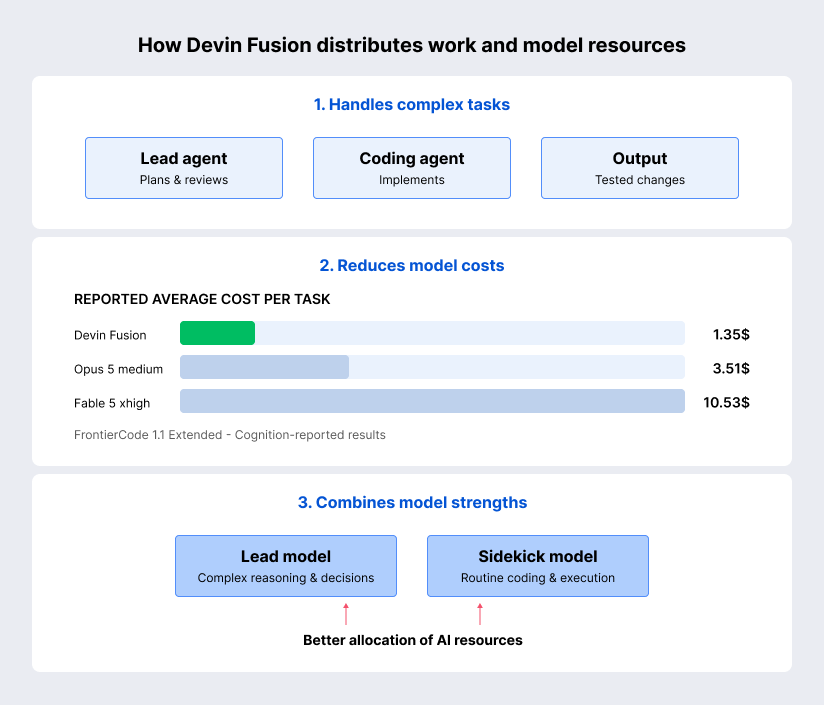
The lead handles complex decisions, architecture, and problem-solving, while the sidekick performs routine coding, testing, and migration. This approach reserves expensive computing resources for tasks that require deeper reasoning.
The difference between a single AI agent and a multi-agent system
| Dimension | Single-agent coding system | Devin Fusion-style multi-agent system |
|---|---|---|
| Reasoning | One agent plans and executes the complete task | A lead agent owns high-level reasoning while another agent can execute delegated work |
| Context | One evolving conversation and tool history | Lead and sidekick maintain separate, persistent contexts |
| Model usage | Usually one selected model carries the session | Different models can be matched to planning/review and execution |
| Delegation | Work remains inside one reasoning loop | Lead sends the sidekick a scoped brief with constraints and success criteria |
| Review | The same agent may review its own implementation | Lead evaluates sidekick results and can take the task back |
| Cost model | Expensive model may be used for routine steps | Premium compute can be concentrated on high-judgment steps |
| Main risk | Context growth and inefficient use of a powerful model | Coordination errors or loss of intent during delegation |
From the perspective of cognition, the method of using AI agents does not guarantee success when the number is increased. Coordination and reviewing are key to multi-agent design.
How do AI agents collaborate inside Devin Fusion?
Fusion’s structure of collaboration is similar to that of a senior engineer managing a teammate. That is, the senior engineer controls the entire process, while the junior engineer executes specific tasks.
The lead agent: understanding goals and coordinating work
The lead is responsible for planning, difficult decision-making, delegation of tasks, and final review. It changes the allocation of duties in light of difficulties encountered.
The coding agent: executing technical tasks
The sidekick can inspect code, implement changes, and run tests. Cognition’s benchmarks show cost reductions of 62% for test execution and 32% for routine code removal. However, complex tasks requiring judgment are better handled by stronger models.
Specialized agents and future multi-agent workflows
Devin CLI supports specialized subagents for repository analysis, testing, and other tasks. Future development environments may bring coding, security, and review agents together under centralized coordination, improving efficiency and collaboration.
“The real advantage of multi-agent AI isn’t having more agents working on the same problem. It’s knowing which tasks to delegate, what context each agent needs, and when to bring the results back for review. Without effective coordination, adding agents can create more complexity than value.”
Andrey Kopanev — .NET developer, AI enthusiast
How does Devin Fusion manage communication between AI agents?
Communication is a major challenge in multi-agent development. The excessive sharing of information leads to increased costs, whereas a lack of it leads to mistakes. This problem is solved through fusion, where the contexts of the agents are separated, and only the important information is shared.
Why multi-agent AI systems improve software development
The most convincing argument in favor of multi-agent systems is not the idea that two agents are necessarily better than one. Instead, the argument lies in the fact that software development consists of multiple activities, and a properly designed system will be able to manage those resources more effectively.
Handling complex engineering tasks
Repository-level engineering involves more than generating code. The AI agents have to perform dependency analysis, modify the modules, execute tests, correct any errors, and verify the outputs. This task is accomplished through a multi-agent system approach.
One agent can investigate code while another implements changes, keeping their contexts manageable. Cognition notes that this approach can improve coding performance, although additional agents also increase inference costs.
Reducing unnecessary model usage
Fusion also aims to reduce development costs by assigning routine tasks to cheaper AI agents while reserving powerful models for complex decisions.
In Cognition’s FrontierCode 1.1 Extended benchmark, Fusion scored 63.1 at $1.35 per task, compared with 63.6 at $3.51 for Opus 5 medium and 64.9 at $10.53 for Fable 5 xhigh. The above results imply that Fusion can achieve the same level of performance at a much reduced cost.
Combining different AI model strengths
With Fusion, one can incorporate AI models according to their strengths, speeds, and cost factors. The Devin CLI provides for multiple sources of models, both commercial and open source.
In September 2026, Cognition recommended Fable 5.1 to be the leader AI model, while SWE-2 is the sidekick. But the choice can vary depending on model performance and availability.
Devin Fusion architecture: models, agents, and workflow
Fusion is a system that differentiates decision responsibility from decision capability at an architectural level. The crucial part of this system is not the running of two separate models but rather the control of information flow between these two models.
| Component | Primary responsibility | Typical behavior | Why it matters |
|---|---|---|---|
| Frontier lead | Planning and judgment | Interprets the request, investigates ambiguity, creates the plan | Keeps difficult decisions with the strongest model |
| Sidekick | Cost-efficient execution | Explores code, performs edits, runs tests, reports results | Reduces premium-model usage |
| Delegation brief | Agent-to-agent handoff | Communicates task, constraints, and success criteria | Transfers intent without copying complete histories |
| Persistent contexts | Working memory | Lead and sidekick maintain separate cached histories | Preserves focus and improves cache efficiency |
| Dynamic routing | Escalation mechanism | Detects when work should move to another model | Prevents an early routing decision from becoming permanent |
| Review loop | Quality control | Lead checks sidekick output and can reclaim the task | Keeps final responsibility centralized |
| Tool environment | Engineering execution | Repository access, shell commands, testing and related tools | Lets both participants act rather than only generate text |
Unlike basic multi-agent systems, Fusion keeps high-level decisions with a lead agent while delegating specific tasks. This helps prevent conflicting changes and keeps development consistent across the codebase.
Devin Fusion performance: what benchmarks show
Cognition’s benchmarks show that Devin Fusion can reduce software engineering costs by 23–46% while maintaining comparable performance. For example, on DeepSWE 1.1, Fusion achieved a score of 63.1 at $7.88 per task, compared with 64.3 at $14.63 for the standalone model—a 46% cost reduction. However, results vary depending on the benchmark, model configuration, and task complexity.
| Benchmark | Fable 5.1 alone: score/cost | Fusion Fable 5.1 + SWE-2: score/cost | Reported cost change |
|---|---|---|---|
| DeepSWE 1.1 | 64.3 / $14.63 | 63.1 / $7.88 | −46% |
| Terminal-Bench 4 | 57.6 / $17.46 | 56.1 / $13.37 | −23% |
| SWE-Atlas QnA | 64.8 / $7.57 | 65.9 / $5.00 | −34% |
| Vals Code Migration | 54.6 / $70.97 | 57.3 / $42.00 | −41% |
| FrontierCode 1.1 Extended | 63.6 / $2.68 | 63.5 / $1.67 | −38% |
Fusion doesn’t outperform the standalone lead model on every benchmark, but it delivers comparable results at a significantly lower cost. In Cognition’s tests, it even scored slightly higher on SWE-Atlas QnA and Vals migration tasks.
Independent results from Artificial Analysis show a similar picture. The Fable 5.1 + SWE-2 Fusion configuration scored 62 overall, including 63% on DeepSWE and 66% on SWE-Atlas-QnA. Newer configurations perform even better, showing that Fusion’s capabilities evolve as its underlying models improve.
“The goal of multi-agent architecture isn’t to use the most powerful AI model for every task. It’s to achieve the required level of quality at a reasonable cost. By assigning routine work to smaller models and reserving advanced reasoning for complex decisions, development teams can make AI-assisted engineering more economically sustainable.”
Andrey Kopanev — .NET developer, AI enthusiast
Challenges of multi-agent AI development
Multi-agent AI development introduces three major challenges: coordinating autonomous agents, preventing errors from spreading between them, and keeping humans in control of critical decisions. As more agents collaborate, maintaining consistent context, validating outputs, and assigning clear responsibilities become increasingly important.
“As AI agents take on more implementation work, the developer’s role will shift toward defining requirements, making architectural decisions, and validating results. AI can accelerate coding, but it cannot take responsibility for whether a solution is secure, maintainable, or aligned with business goals. That responsibility remains with engineers.”
Andrey Kopanev — .NET developer, AI enthusiast
What Devin Fusion means for the future of AI software engineering
Devin Fusion demonstrates how AI programming is evolving from individualistic to orchestral models. The future development environment will depend on orchestration in assigning roles, providing context, choosing tools, and deciding on the need for human intervention.
This could impact the role of developers in their jobs. Rather than micromanaging each step of the coding process, engineers would be involved in requirement definition, architecture analysis, and validation of the output generated by AI.
Despite these innovations, human knowledge would still play an indispensable role. As more and more implementation tasks are delegated to AI, technical judgment, debugging, and verification will become critical in producing quality software.
Conclusion
Devin Fusion shows how AI-assisted development is moving beyond the “one model, one prompt” approach. Its approach does not depend on a particular model, but rather delegates tasks to agents of varying intelligence, capability, and computational expense.
The more capable, expensive lead agent plans and reviews code, whereas the less expensive one simply writes the code. This allows the system to be efficient and robust through handovers and review cycles.
Initial tests show that the approach is more suitable for specific tasks, while decision-making continues to demand better models and human intervention. Devin Fusion opens up a new era in software development where the reliance on AI models gives way to effective team management.
FAQ
Can Devin Fusion integrate with existing development tools?
Yes. Devin has compatibility with GitHub, GitLab, Bitbucket, Azure DevOps, Slack, Microsoft Teams, Jira, and Linear. It also offers MCP integration, APIs, automation, and CI/CD processes.
What programming languages does Devin Fusion support?
How secure is Devin Fusion for enterprise projects?
How can teams evaluate Devin Fusion before adopting it?