


AI Agents in Retail and Ecommerce: Transforming the Shopping Experience


(If you prefer video content, please watch the concise video summary of this article below)
Key Facts
- Over a decade, retail has moved from basic automation to generative AI and hyper-personalization.
- Why use AI agents in retail: They boost efficiency, cut costs, personalize customer journeys, and turn raw data into real-time decisions for pricing, stock, and marketing.
- Key types of AI agents in retail: Conversational bots, voice-activated assistants, visual search agents, predictive analytics tools, and inventory management agents.
- Top use cases: Personalized recommendations, automated customer support, pricing optimization, fraud detection, smart supply chain management.
- To implement AI agents, start with clear objectives, ensure clean data and integration readiness, pilot small, scale fast, and continuously retrain models for accuracy.
- Future trends: Hyper-personalization, AI-driven augmented reality (AR) shopping, autonomous checkout systems, AI and IoT convergence.
- Challenges and risks: Data privacy and bias, legacy-system integration, high initial costs, and cybersecurity vulnerabilities remain key barriers to artificial intelligence adoption in retail and ecommerce.
The era of universal shopping experiences is gone. Today, retail and ecommerce businesses are under the strong impact of artificial intelligence. The way people interact with products (both shopping online or visiting a store) has changed for life. AI agents in retail and ecommerce are powering some of the most impressive shifts in the industry.
87% of stores are already using smart features in some way. By 2032, the world is expected to spend $45.7 billion on AI for retail. It’s clear that AI-powered customer experience and ecommerce automation have moved from being something unprecedented to being something necessary.
Following the article on AI agents in healthcare, this blog post is about why AI agents are changing the way retail works and how businesses interact with customers. You’ll learn about the most common types of smart digital agents used today, the best ways to use them, how to set them up, what to look forward to in the future, and the problems to watch out for.
Get AI software built for your business by SaM Solutions — and start seeing results.
The Evolution of AI in Retail and Ecommerce
The retail industry has always adapted to technological advancements (barcodes, point-of-sale (POS) systems, digital marketplaces). However, the integration of AI agents for retail marks a new chapter, one driven by autonomy, data intelligence, and continuous optimization.
Retail has been using artificial intelligence for a long time. Amazon was one of the first companies to use simple AI algorithms to suggest products to online shoppers more than 20 years ago. These systems were pretty basic back then, but they set the stage for a new era of data-driven retail.
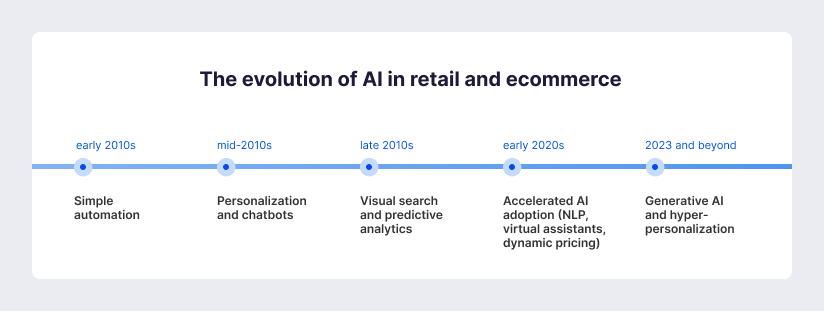
In the early 2010s, AI development for retail was still in its early stages. Most of the tools were simple and rule-based. For example, there were automated emails and simple chatbots that could answer a few questions that were already set up. They didn’t allow for much interaction and weren’t able to do anything more complicated than straightforward tasks.
In the mid-2010s, as machine learning techniques advanced, AI personalization truly took off. Ecommerce companies started using it to make sense of browsing and purchase behavior.
Amazon’s recommendation engine quickly became a key part of sales strategy, boosting online sales and customer engagement through suggesting relevant products.
Around the same time, retailers also started experimenting with AI chatbots for customer service. By 2016, companies like Sephora were using chatbots on Facebook Messenger to offer makeup advice and product suggestions, giving shoppers round-the-clock assistance and interactive engagement.
AI technologies matured in the late 2010s, and their applications in retail expanded and diversified. Visual search came along, letting customers upload a picture of an item and find similar products.
Walmart and other big stores implemented predictive analytics to manage their inventory and supply chain. They used algorithms to predict demand and find the best stock levels. This helped cut down on problems with out-of-stock items and too much inventory, which made things run more smoothly and saved money.
In the early 2020s, due to the COVID-19 pandemic, retailers were pushed to adopt AI faster than ever before. As more and more people shopped online, businesses used artificial intelligence to handle more customer service requests.
Virtual assistants got a lot smarter and more useful thanks to improvements in natural language processing. H&M, for example, launched an AI-powered chatbot that gave personalized fashion advice and answered customer questions. This was a useful tool when in-store help wasn’t possible.
Dynamic pricing tools became more popular at the same time. These tools change the prices of products in real time based on demand, inventory levels, and market trends (a strategy that was borrowed from the airline industry and quickly became standard in ecommerce).
By 2023 and beyond, AI in retail entered a new phase with generative AI and hyper-personalization. Advanced AI models (like large language models and image generators) opened up possibilities for creating content, crafting marketing copy, and delivering an even more tailored customer experience.
Retailers such as Ralph Lauren began using generative AI for personalized marketing campaigns and virtual try-ons. The influence of AI at the strategic level is evident: 93% of retail organizations report that generative AI is now a boardroom topic of discussion, and over 60% have dedicated teams and budgets to integrate artificial intelligence into future products and services.
Why AI Agents Are Revolutionizing Retail
The global market for AI in retail is projected to grow from $4.84 billion in 2021 to over $31 billion by 2028.
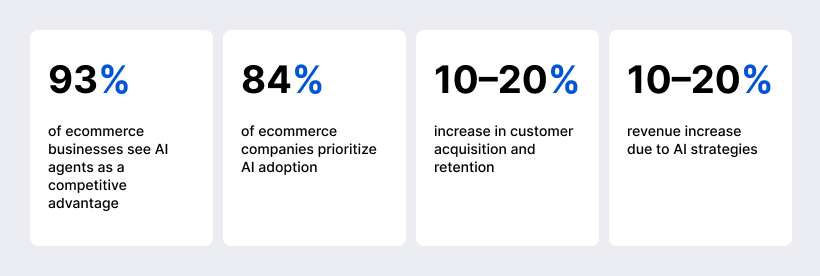
- 93% of ecommerce businesses see AI agents as a competitive advantage, according to SellersCommerce.
- 84% of ecommerce companies made AI adoption a top priority to enhance efficiency and customer satisfaction.
- A report by McKinsey found that companies leveraging AI across sales and marketing functions saw a 10–20% increase in customer acquisition and retention.
- On average, businesses implementing AI strategies generate about 10–12% more revenue.


Key Types of AI Agents in Retail
Brick-and-mortar stores and ecommerce websites can integrate different types of digital agents into their operations.
Conversational AI agents (chatbots and virtual assistants)
Modern retailers are deploying conversational AI agents (typically chatbots on websites, messaging apps, or in-store kiosks) to handle customer inquiries and assist shoppers in real time. These chatbots can:
- answer FAQs about products
- check order statuses
- guide users through returns 24/7
Voice-activated shopping assistants
Hands-free shopping becomes possible through spoken commands. Integrated into smart speakers (Amazon’s Alexa, Google Assistant, Apple’s Siri) and smartphones, such agents let consumers search and shop by voice, for example, saying “Order my usual coffee pods” or “Find me a size M black jacket.” The appeal is convenience and speed: busy customers can add items to a cart while cooking or driving and don’t have to navigate a screen.
Voice assistants leverage AI to recognize natural language and even learn user preferences, so they can present personalized suggestions (e.g. reordering a frequent purchase or recommending a complementary item).
A particularly creative example was Nike’s collaboration with Google Assistant: during an NBA game halftime, fans could simply speak to buy limited-edition sneakers, and the shoes impressively sold out in just 6 minutes via voice orders.
AI-powered visual search agents
Shoppers can now search using images instead of keywords. With visual search, a customer can snap a photo of an item (or upload a picture of a look they love) and the agent will identify similar products available for purchase.
Luxury retailer Neiman Marcus, for instance, introduced a mobile visual search feature called “Snap. Find. Shop.” allowing customers to take a picture of, say, a handbag or shoe, and find similar items in Neiman’s inventory. The result was increased customer engagement and higher app usage, as shoppers found it fun and convenient. Their CMO likened it to a “Shazam for shopping.”
Predictive analytics agents
Predictive systems analyze vast amounts of retail data (customer behavior, transactions, market trends, etc.) and predict future patterns or outcomes. These AI agents are like strategists working behind the scenes to answer questions such as:
- What products is this customer most likely to buy next?
- How much of item X should we stock for the holiday season?
- Which shoppers are at risk of not returning, and how can we re-engage them?
By leveraging machine learning on historical data, predictive analytics tools can generate insights that help retailers make proactive decisions. The major applications are personalized recommendations, targeted marketing, and promotions.
Autonomous inventory management agents
Inventory management is a critical retail operation now being revolutionized by autonomous AI agents (both software and robotic solutions) that manage stock with minimal human presence. These agents ensure that the right products are in the right place at the right time.
On the physical front, retailers are deploying autonomous robots and drones to handle inventory tracking in stores and warehouses. A great example is Tally by Simbe Robotics — a tall, slim robot that roams store aisles on its own, scanning shelves with cameras and sensors. Tally can instantly detect out-of-stock items, mispriced products, or disorganized shelves and report that data back to the inventory system.
Top Use Cases of AI Agents in Retail and Ecommerce
9 out of 10 retailers are already using or evaluating AI in their operations, and over half have deployed it across numerous use cases.
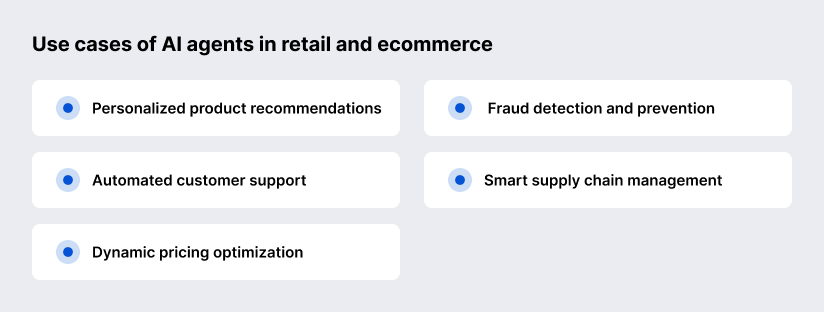
Personalized product recommendations
One of the most visible impacts of AI in retail is personalized product recommendations. AI agents analyze customers’ browsing behavior, purchase history, and preferences to suggest relevant products in real time. This kind of AI-powered customer experience drives more engagement and sales.
Amazon’s recommendation engine, for example, is responsible for about 35% of its total revenue.
Automated customer support
Customer service is another area being transformed through ecommerce automation with AI. Chatbots and virtual agents now handle routine inquiries 24/7 across websites, messaging apps, and voice channels. This means shoppers can get instant answers about orders, returns, or product info at any hour, without waiting on hold.
62% of consumers say they prefer interacting with bots over waiting for a human agent when they have simple questions.
Dynamic pricing optimization
Pricing is a critical lever in retail, and AI agents are making it more dynamic and strategic. Dynamic pricing tools use AI to adjust product prices in real time based on factors like demand, inventory levels, and competitor pricing.
Fraud detection and prevention
Fraudulent orders and transactions cost the retail industry billions each year, but AI agents are now on the digital front lines to combat these threats. Smart fraud detection systems monitor transaction data in real time, flagging anomalies and suspicious patterns that might indicate credit card fraud, account takeover, or return abuse.
As a result, merchants can block fraudulent purchases instantaneously, before the sale is completed, preventing chargebacks and direct losses. At the same time, smart agents can learn to avoid “false positives,” meaning legitimate customers aren’t wrongly turned away.
Amazon and Alibaba use in-house AI systems to scan millions of transactions daily for signs of fraud. Walmart has even patented a machine-learning based fraud detection system trained on past transaction data to detect unusual payment patterns the moment they occur.
Smart supply chain management
In inventory management and demand forecasting, AI systems can analyze historical sales, seasonality, and external data (like search trends or weather) to predict demand with far greater accuracy. This helps retailers maintain optimal stock levels, avoiding both stockouts and overstock situations.
According to industry research, AI-based demand forecasting can reduce forecasting errors by 20–50%, which in turn cuts lost sales from out-of-stock items by up to 65%.
AI agents also streamline the logistics side of the supply chain. They automatically trigger reorders with suppliers, optimize warehouse layouts, and find the most efficient delivery routes.
Implementing AI Agents: Best Practices
Deploying AI agents successfully requires strategic planning and alignment with business goals. To avoid costly missteps, business leaders should choose to partner with an experienced AI software development company (like SaM Solutions) and follow a step-by-step implementation roadmap.
Identify business needs and objectives
The biggest initial mistake is diving into AI without defining the problem it should solve. So you should start with a clear business-driven objective for your AI agent.
Involve stakeholders across departments (marketing, operations, IT, etc.) to discover pain points and refine objectives. An AI project must have quantifiable KPIs for success (e.g., “increase online sales by 15% via personalized recommendations” or “cut response time to customer inquiries in half”).
Note! Avoid vague goals like “improve customer experience” without metrics.
Select the right AI framework
With objectives in hand, evaluate the best technological approach to meet them. The AI landscape is crowded with options, but not every solution is right for your business.
Large language models (LLMs) come in three flavors:
- Open-source tools offer flexibility but require in-house expertise for maintenance
- Third-party models are ready-made but can be costly
- Custom solutions can be tailored to your needs but demand significant expertise
Note! Avoid chasing hype. Not all LLMs are designed for the same purpose. Some are optimized for writing code or processing images, while others specialize in specific programming languages like Python. Certain models don’t support external tools at all and are best suited for basic conversational tasks. To get the most value, you should choose an LLM that aligns with your existing tech stack and can solve your specific business problem.
SaM Solutions’ AI team, experienced with ChatGPT, Claude, LLaMA 2, LLaMA 3, Phi-3, Phi-4, Gemma 2, Gemma 3, and some other models, can guide you to the right choice.
The next step is deciding which tools the selected model should use. This is managed through a Model Context Protocol (MCP) — a standard that defines how the AI agent interacts with different data sources. You can either build a custom MCP or use a ready-made one. For example, HubSpot offers a proprietary MCP that gives clients access to all of its platform features.
Weigh different options in light of your budget, timeline, and talent. If you lack internal skills, consider bringing in a specialist partner to help select and implement AI technologies in your business.
Collect and process data
Data is the fuel for any AI agent, so invest time in gathering and preparing the right data. Identify what data sources are relevant to your chosen use case (customer purchase histories, website interactions, CRM records, inventory levels, etc.) and consolidate them for analysis. Data quality is critical: poor or incoherent data will lead to flawed outcomes, rendering even a promising AI use case unworkable.
Integrate with existing systems
Don’t treat the AI agent as a standalone silo. Plan from the outset how your agent will integrate with your current systems and workflows. In retail and ecommerce, an AI agent must connect with a website, CRM, ERP, or inventory management system to be effective.
Use APIs and modular architecture so the AI agent can plug in to existing workflows without overhauling everything. It’s also crucial to address scalability: ensure the integration can handle large transaction volumes and peak shopping periods without performance issues.
Continuous monitoring and improvement
Launching your AI agent is the beginning of continuous improvement. After deployment, closely monitor the AI agent’s performance and impact on your key metrics. Track business KPIs related to the agent’s function (e.g., cart abandonment rate, customer satisfaction scores, fulfillment speed).
Establish a feedback loop where data from the AI agent’s interactions is fed back into retraining or fine-tuning the model. If the agent’s performance falls short, be ready to update algorithms, retrain on new data, or adjust parameters. Post-launch maintenance and support also means watching for technical issues and fixing them promptly.
Future Trends in AI Agents for Retail
The retail and ecommerce industry is on the cusp of an AI-driven transformation. What was once experimental is rapidly becoming essential.
Hyper-personalization with AI
AI-driven hyper-personalization takes the classic “customers who bought this also bought…” to an entirely new level. It means every interaction can be intelligently tailored in real time. The near future of retail will see brands treating each customer as a “segment of one,” using AI to deliver the kind of personal attention once reserved for VIPs, but now at internet scale.
AI-driven augmented reality (AR) shopping
Augmented reality (AR) is emerging as a powerful tool in retail, and AI is the behind-the-scenes enabler making these AR experiences truly smart. Retail is no longer just about showing products, it’s about immersing customers in experiences.
AR lets shoppers visualize and interact with products in their own context (seeing how a couch would look in their living room or virtually trying on a pair of sunglasses) and make more confident buying decisions, reducing the guesswork that often comes with online shopping.
The next 5–10 years will take AI-driven AR shopping even further. The global AR-in-retail market is projected to surge from $19.9 billion in 2024 to $64.6 billion by 2030. We can expect more advanced uses of AR both online and in-store, including virtual fitting rooms and smart mirrors.
Autonomous checkout systems
The rise of autonomous checkout systems (aka cashierless stores) is one of the clearest signs that the future of retail is here.
In early pilots, Amazon’s own AI-powered supermarket in Seattle demonstrated the model: customers simply scan into the store, grab what they need and walk out, while machine learning algorithms, cameras, and shelf sensors track every item taken and charge the customer’s account automatically.
AI and IoT convergence in retail
The convergence of artificial intelligence (AI) with the Internet of Things (IoT) is giving rise to AIoT — the new concept that creates a connected store of the future. In retail, AIoT means that all the gadgets and sensors now proliferating in stores and supply chains can be leveraged in a much more intelligent way.
IoT devices are already widespread: shelf sensors, RFID tags, smart cameras, digital price displays, beacons, and connected appliances in warehouses. Layering AI on top of this network allows for real-time data analysis and decision making.
Challenges and Risks of Deploying AI Agents in Retail
Business leaders should be mindful of several key challenges when implementing intelligent retail solutions in real-world operations.


Why Choose SaM Solutions for Successful AI Development?
SaM Solutions has a proven track record of ecommerce projects and artificial intelligence implementations.
Whether you need to build AI agents that personalize shopping experiences, optimize inventory, or facilitate transactions through intelligent automation, our team is ready to assist. From strategy to deployment, we support you in building scalable, secure, and efficient systems that unlock real business value.
Conclusion
AI agents in retail and ecommerce have become essential for staying competitive. By completing tasks faster, more accurately, and with greater personalization, AI agents empower businesses to deliver the kind of seamless experience modern shoppers expect. With the right strategy and a trusted technology partner, your retail business can turn AI into a long-term advantage.
FAQ
AI agents handle repetitive, time-consuming tasks so your team can focus on what really matters, helping customers and improving the in-store experience. Instead of replacing people, they make everyday work smoother, more efficient, and often more rewarding.





![15 Best AI Tools for Java Developers in 2026 [with Internal Survey Results]](https://sam-solutions.com/wp-content/uploads/fly-images/18712/title@2x-6-366x235-c.webp)


