What Is Composable Commerce? The Complete Guide for 2026


(If you prefer video content, please watch the concise video summary of this article below)
Key Facts
- Composable commerce is a modular, API-first ecommerce architecture that allows businesses to assemble their commerce stack from independent, best-in-class components instead of using a single monolithic platform.
- It is built on MACH principles — microservices, API-first, cloud-native, headless.
- Adoption is accelerating: by 2026, at least 70% of organizations are expected to rely on composable DXP and commerce architectures.
- Composable commerce prioritizes agility and personalization, making it easier to adapt to new markets, channels, and customer expectations without replatforming.
- It reduces long-term vendor lock-in and technical debt, while improving resilience, developer productivity, and time to market.
- Implementation is typically phased, allowing companies to replace critical capabilities first and scale over time with controlled risk.
The ecommerce software market is dominated by versatile platforms offering lots of customization options and industry-specific modules. However, these commerce platforms are no longer sufficient for businesses to keep up with evolving consumer expectations and respond to rapid changes in the industry.Composable commerce, an innovative approach to continuously optimizing customer interactions, seems to be the solution to modern trading challenges. What is composable commerce? Is it just a buzzword, or does it have a promising future? Let’s find out.
SaM Solutions offers a wide range of platform-based and from-scratch ecommerce development services that help you reach your digital sales objectives.
Composable Commerce Explained: A Simple Definition
Composable commerce is a modern ecommerce architecture that lets businesses build and evolve their digital commerce stack by combining independent, best-in-class components, such as product catalogs, checkout, search, CMS, payment services, etc., connected through APIs.
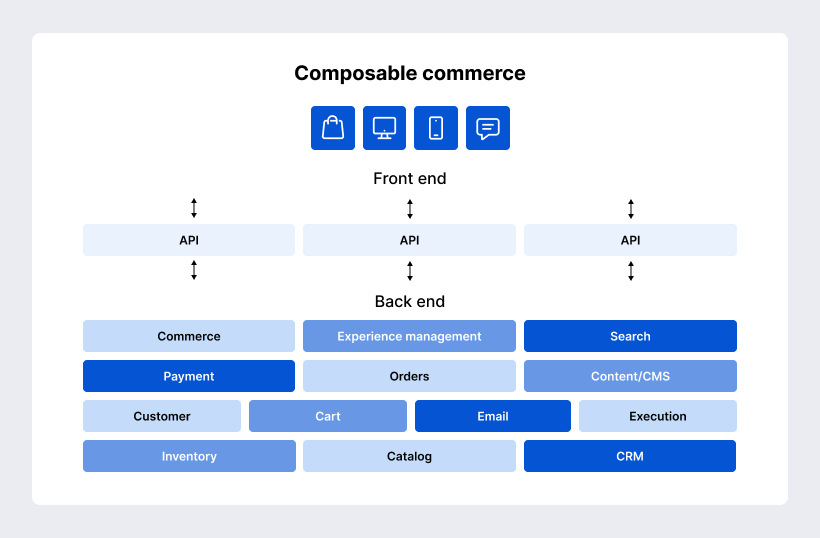
Why is this approach becoming popular? Despite the abundance of complex ecommerce solutions available, no single vendor can offer an impeccable platform for all intents and purposes. Today’s business environments and customer demands are changing too fast. That’s why at some point your company may encounter a situation where existing tools fail to meet your business requirements. Resolving these issues through integrations, migrations, and other means can be both time-consuming and costly.
Composable commerce, a dynamic concept that has been shaping the ecommerce landscape since 2020, has proven to be a catalyst for enhanced business agility.
Here is what the MACH Alliance says:
- By 2026, a minimum of 70% of organizations will be required to adopt composable DXP solutions rather than traditional monolithic DXP platforms, up from around 50% in 2023.
- As a consequence, one capability is becoming mandatory: a composable architecture for modular and API-first approaches built from clearly defined, task-focused, and independently deployable packaged business capabilities (PBCs) that can be combined and evolved as business needs change.
Core principles of a composable approach
- Modular architecture. The system is built from independent components that can be added, removed, or replaced when needed.
- Loosely coupled services. Each capability operates autonomously, reduces dependencies, and minimizes the risk of system-wide failures.
- API-first design. All components communicate through standardized APIs to enable seamless integrations and omnichannel experiences.
- Independent deployment and scaling. Services can be updated and scaled individually, which allows faster releases and better performance management.
- Cloud-native foundation. Built for cloud environments to support elasticity, resilience, and continuous delivery.
- Business-aligned capabilities. Functional modules are designed around specific business needs, making it easier to adapt the platform as strategies and markets change.
Composable Commerce vs. Traditional Commerce: Key Differences
For years, traditional commerce platforms promised simplicity: one system, one vendor, everything included. In practice, that simplicity often came at a cost. Monolithic architectures bundle all commerce capabilities into a single, tightly coupled system. Any change, whether a new checkout flow, a different CMS, or a regional payment method, can trigger long development cycles, higher risk, and growing technical debt.
Composable commerce flips that model. Instead of forcing businesses into a fixed stack, it breaks commerce down into modular services that can be assembled, replaced, and scaled independently. Such a flexible foundation keeps pace with changing markets, customer expectations, and technology trends.
| Aspect | Traditional commerce | Composable commerce |
|---|---|---|
| Architecture | Monolithic, tightly coupled | Modular, API-first |
| Innovation speed | Slow, release-heavy | Fast, incremental |
| Scalability | Limited, platform-wide scaling | Independent service scaling |
| Flexibility | Limited customization | High adaptability |
| Vendor lock-in | High | Low |
| Time to market | Longer | Shorter |
In a nutshell, traditional commerce prioritizes control and predictability, while composable commerce prioritizes agility, resilience, and long-term growth — qualities that increasingly define competitive digital businesses.

Understanding MACH Architecture
The acronym MACH refers to a tech architecture that forms the basis of composable commerce. This approach emphasizes building and deploying software that is highly adaptable, scalable, and efficient in operation. MACH incorporates four terms: microservices, API-first, cloud-native, headless.
Microservices
The MACH architecture utilizes microservices as building blocks. Microservices are small components that work together to create a comprehensive application, yet remain autonomous in nature. Due to this, companies are empowered to develop and deploy software systems faster, and their maintenance is simplified.
Packaged Business Capabilities (PBCs) are also a part of the MACH architecture. A PBC consists of several pre-built and pre-integrated microservices, operates as a single entity, and provides a specific set of functionalities. A shopping cart can be an example of PBC as it includes microservices for the catalog, payment processing, and checkout functions.
API-first
MACH architecture is API-first, meaning that all services and functions are accessed through APIs (Application Programming Interfaces). This allows for seamless integration with other systems and makes it possible to build custom solutions by combining different components.
Cloud-native SaaS
MACH architecture is designed to run natively in the cloud, which provides many benefits such as scalability, cost-effectiveness, and high availability.
Headless
MACH architecture is headless, meaning that the front end and back end are decoupled. This allows for more flexibility and control over the customer experience.
Composable Commerce vs. Headless Commerce
While both headless and composable commerce modernize digital commerce architectures, they serve different scopes and strategic goals. Headless commerce decouples the user interface from the back end, giving organizations the freedom to innovate front-end experiences independently of back-end systems.
Composable commerce builds on this idea but goes further — it breaks down the entire ecommerce stack into modular, interchangeable components across front end and back end, enabling true best-performing assembly of services.
| Aspect | Headless commerce | Composable commerce |
|---|---|---|
| Scope | Decouples front end from back end | Decouples entire commerce stack |
| Customization | Focus on front-end flexibility | Full flexibility across all services |
| Scalability | Scales UI independently | Scales every component independently |
| Vendor lock-in | Back end often single provider | Minimal lock-in, choose diverse services |
| Agility | Faster front-end updates | Fast innovation across stack |
In a nutshell, headless is about freedom at the front end; composable is about freedom across the whole commerce ecosystem.
Why Businesses Are Choosing Composable Commerce
The essence of composable technology is to empower organizations to respond swiftly and effortlessly to shifting business requirements and customer expectations, without the limitations of rigid and monolithic ecommerce systems.
The need for agility and speed
Markets change faster than traditional commerce platforms can keep up. New channels emerge, customer behavior shifts, and business models evolve. With composable commerce, companies can choose the best components from different software providers and combine them into unique applications that will meet their specific needs. Later on, they can recombine such apps by adding new components, removing unnecessary ones, or replacing the existing features with more advanced options.
This way, merchants get a new type of digital commerce platform where they tailor its functionality to fit their business needs, rather than adjust their established processes to align with the limitations of a single system.
Demand for personalization at scale
Personalization has moved from a competitive advantage to a baseline expectation. With composable commerce, businesses can easily replace standard functionality.
For example, when your business achieves a certain level, you can take it up a notch by replacing a traditional search functionality with an AI-based solution. This way, you can create highly personalized commerce experiences for your customers.
Key Benefits of Composable Commerce
The real composable commerce advantages aren’t hidden in architecture diagrams, they show up in how quickly businesses can react, adapt, and grow. For many organizations, composable commerce isn’t a tech upgrade. It’s a mindset shift.


Potential Challenges and Considerations
Composable commerce offers clear advantages, but it also introduces new responsibilities that organizations need to plan for from the start.
Integration complexity
Connecting multiple independent services takes more effort than deploying a single platform. Without a clear and agile integration strategy, teams may face compatibility issues, inconsistent data flows, or synchronization delays across systems. Strong API governance and integration standards are essential to keep complexity under control.
Initial investment
Implementing a composable solution may require higher upfront investment. Costs can include specialized tools, cloud infrastructure, and skilled architects and developers. While the long-term value is strong, organizations must be prepared for the initial build and ongoing optimization.
Vendor management and security
Working with multiple vendors increases operational overhead. Each service must meet security, compliance, and reliability standards. Managing data across systems also raises security and privacy concerns, making centralized monitoring, access control, and clear vendor governance critical.
How Composable Commerce Works: A Step-by-Step View
You don’t have to replace everything at once. The ultimate goal is to assemble the right capabilities in the right order to support your specific business objectives.
Defining business capabilities
The process starts by identifying core business functions such as product discovery, pricing, checkout, content, or personalization, and defining what each must deliver. The team takes a hard look at how the business actually runs. What drives revenue? Where are customers dropping off? Capabilities like search, pricing, checkout, or content are clearly defined, not as features, but as business outcomes.
Selecting best-of-breed components (PBCs)
Next comes choice. You don’t settle for whatever a single vendor offers. You pick the strongest tools for each job: search engines that actually convert, CMS platforms that scale, pricing engines that handle complexity, and so on. Each packaged business capability (PBC) earns its place.
API orchestration and integration
This is where the stack comes alive. APIs act as the connective tissue, allowing services to talk to each other in real time. Middleware plays a critical role by orchestrating APIs and synchronizing data across commerce, content, and back-end systems. When orchestration is done right, data flows cleanly and systems stay loosely coupled instead of tangled.
Is Composable Commerce Right for Your Business?
Composable commerce isn’t a silver bullet, and it’s not meant to be. For some organizations, it’s a strategic accelerator. For others, it can be unnecessary complexity. The key is knowing where your business stands today and where it needs to go next.
Signs you are ready for composable
You’re likely ready for composable commerce if your current platform feels more like a constraint than a foundation.
- Releases take too long.
- Integrations are painful.
- Adding new channels, markets, or personalization features turns into a negotiation with the platform rather than a business decision.
Composable commerce also makes sense when your organization has (or is currently building) strong internal tech capabilities. Product teams, developers, and architects are already thinking in services, APIs, and continuous delivery. In that environment, composable isn’t risky, it’s enabling.
When to stick with a traditional platform
If your business is stable, your requirements are simple, and speed of initial launch matters more than long-term flexibility, a traditional platform can still do the job. Smaller teams without dedicated engineering or integration expertise may struggle to justify the added overhead.
In short, if you don’t need frequent change or aren’t ready to manage it, a monolithic platform may be the safer, more pragmatic choice for now.
How to Implement Composable Commerce
Implementing composable commerce technology is not a single rollout. It presupposes making smart, staged decisions. Done right, it’s a controlled evolution, not a risky leap.
Planning your composable journey
Start with clarity, not tools. Look at where your current commerce platform slows you down: time to market, personalization limits, integration pain, or scaling issues. From there, define which business capabilities truly need flexibility first: search, checkout, CMS, pricing, or integrations.
Most successful companies don’t go “fully composable” overnight. They phase it in, replacing the most restrictive components first while keeping the rest stable. This reduces risk, protects ongoing revenue, and builds internal confidence step by step.
Choosing a composable commerce platform
Once the strategy is clear, platform choice becomes a business decision, not just a technical one. Look for solutions that are API-first, cloud-native, and designed around packaged business capabilities (PBCs).
A good example is the Emporix platform. The key for success is working with an experienced partner like SaM Solutions who understands both commerce architecture and real-world business constraints, because composable commerce only delivers value when technology and strategy move in sync.
Real-World Composable Commerce Success Stories
Implementing composable commerce in retail means powering real transformation for brands. Here are standout examples:
- John Lewis & Partners — the iconic UK retailer moved away from a monolithic platform to a composable stack, enabling faster launches of omnichannel experiences and more personalized customer journeys that reinforce loyalty and digital growth.
- River Island — the fashion brand embraced composable commerce to support cross-channel retail experiences, streamline integrations, and accelerate experimentation across touchpoints, which is a win in a fast-moving industry.
The Future of Composable Commerce
Composable commerce is quickly becoming the new normal. Businesses are tired of platforms that promise stability but cause issues.
What’s coming next is practical flexibility. New AI features, smarter personalization, or emerging channels won’t require full replatforming. They’ll simply be added, tested, and refined. Commerce systems will grow the way businesses do: step by step, without disruption.
Put simply, composable commerce fits the way modern companies actually work. And that’s why it’s here to stay.
Composable Commerce by SaM Solutions
SaM Solutions is a reputable software provider with a proven track record of delivering high-quality, scalable, and secure ecommerce solutions. We have extensive experience working with platforms such as Sitecore OrderCloud, Adobe Commerce (formerly Magento), SAP Commerce Cloud, and more.
Our team combines deep technical expertise with a solid understanding of real business needs. By staying up to date with the latest technology advancements, we help companies migrate to composable commerce smoothly, while ensuring stability, performance, and business continuity throughout the process.
To Wrap Up
The key meaning of composable commerce is to build freedom into your ecommerce strategy. By moving away from all-in-one platforms and embracing modular components, businesses gain the ability to adapt faster and stay aligned with changing customer expectations.
FAQ
How long does it take to implement composable commerce?
Most composable commerce programs take about 3–6 months to launch a first production-ready MVP when using modern SaaS components and a phased migration. A full, highly customized build can stretch toward 6–18 months and beyond, especially if you replace many legacy systems, build custom microservices, or operate in multiple countries and channels.
How much does composable commerce cost?
How does identity impact composable commerce?