Shopify vs BigCommerce: Detailed 2026 Comparison


(If you prefer video content, please watch the concise video summary of this article below)
Key Facts
- The Shopify versus BigCommerce debate in 2026 reflects two different commerce paradigms: speed and extensibility within an ecosystem, versus inherent enterprise functionality and architecture.
- Shopify leads in terms of scale and depth of ecosystem, with 16,000+ apps and serving millions of businesses in 175+ countries.
- BigCommerce, on the other hand, focuses on enterprise and complex commerce scenarios with inherent B2B functionality, multiple storefront support, and no platform transaction fees.
- The cost model is also different, with Shopify involving app fees and potential transaction fees, versus revenue-based plan upgrades for BigCommerce.
- The choice between Shopify or BigCommerce ultimately depends on how you operate: fast, app-driven growth and speed-to-market (Shopify), or structured, scalable, and composable commerce built for complex operations (BigCommerce).
In 2026, “choosing a platform” is less about picking a website builder and more about committing to an operating model: how you launch campaigns, manage catalogs, run B2B programs, plug into marketplaces, and control checkout, data, security, and integrations.
The Shopify vs BigCommerce decision often comes down to speed-to-market and ecosystem depth versus built-in enterprise-grade capabilities and architectural freedom — but the real answer depends on your go-to-market strategy, margin structure, and degree of complexity (B2B, multi-store, international, headless, POS, and custom integrations).
Shopify Platform Overview and Strategic Positioning
Shopify’s positioning is best understood as a unified commerce operating system with fully managed hosting as part of its SaaS model. It combines online store, checkout, payments options, and POS — plus a very large ecosystem of apps for everything else. It’s widely used across the web and is prominent among ecommerce systems tracked by industry usage surveys.
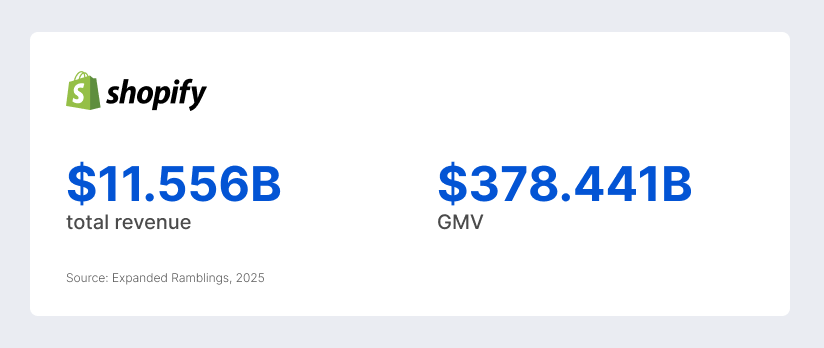
Shopify reported $11.556B total revenue and $378.441B GMV for 2025, reflecting its scale as a commerce infrastructure provider.
Its investor communications describe the platform as supporting “millions of businesses” across “175+ countries,” and also name recognizable enterprise brands using the platform.
From an ecosystem standpoint, the platform explicitly markets the scale of its app marketplace as a core advantage (for example, “over 16,000 apps,” with a review/release process described on the marketplace page).
This matters strategically: Shopify often encourages merchants to compose capabilities through apps and partners rather than build everything custom.
Request SaM Solutions’ ecommerce development services to grow your client base and boost profitability of your online sales.
BigCommerce Platform Overview and Market Focus
BigCommerce can be best described as an ecommerce platform that is enterprise-ready and is based on the concept of ‘open SaaS,’ which is the combination of infrastructure with flexibility enabled through APIs. At its core, the platform is centered around the idea of having a centralized admin section to control catalogs, orders, customers, and storefronts, with the ability to support both traditional and headless approaches through the likes of Stencil and Catalyst, as well as the support for REST and GraphQL APIs.
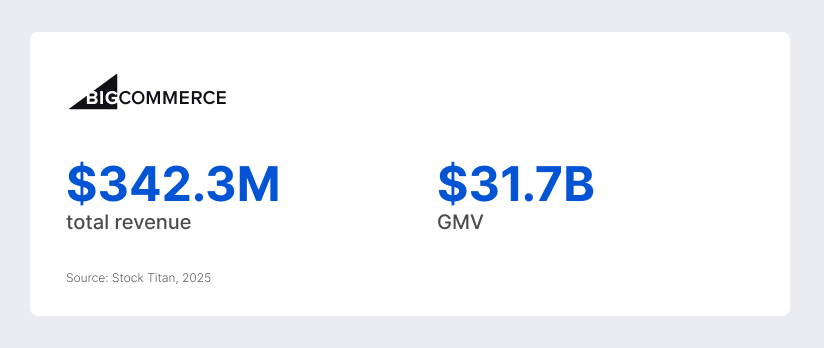
BigCommerce’s market narrative is distinct: it emphasizes “open SaaS” and enterprise-grade capabilities for both B2C and B2B, with multi-storefront and headless options as first-class patterns. Its corporate parent rebranded as Commerce.com, Inc., framing growth around AI-powered “agentic commerce” and ecosystem solutions. Commerce/BigCommerce reported $342.3M total revenue and $31.7B GMV for fiscal year 2025, plus an ARR of $359.1M and 6,648 enterprise accounts as of December 31, 2025 — signals of its heavier weighting toward enterprise customers and subscription economics.
Shopify Capabilities in Detail
Shopify’s capabilities shine when you want a cohesive admin experience, fast launch, and a deep catalog of third-party (and increasingly native) functionality — from marketing automations to AI — without running infrastructure yourself.


BigCommerce Capabilities in Detail
BigCommerce’s strengths center on native capability depth, flexible architectures (including headless), and a pricing philosophy that avoids platform-level transaction fees — while still enforcing growth tier thresholds based on annual online sales.
Shopify vs. BigCommerce: A General Comparison
The following table is a side-by-side comparison of some of the key differences between Shopify and BigCommerce, which will enable you to quickly compare which of these options is best for your business model and needs.
| Dimension | Shopify (2026) | BigCommerce (2026) | What typically wins |
|---|---|---|---|
| Ease of use | Unified admin + fast launch positioning | Product-tour-driven “build/manage with ease” message; strong admin focus | Shopify often for speed-to-launch; BigCommerce often for complex catalogs/ops |
| Built in features vs apps | “Covers the basics…for everything else, there’s apps” (16k+) | Many mid-market features included in plans (segmentation, faceted search, etc.) | Shopify for ecosystem breadth; BigCommerce for native feature depth |
| Customization & flexibility | Theme customization with Liquid + headless via Hydrogen/APIs | Stencil themes + Catalyst (Next.js) headless | Headless-first teams often like BigCommerce; Shopify is strong if you want Hydrogen |
| SEO & technical control | robots.txt.liquid editing allowed; URL structure largely fixed | SEO tooling: microdata, redirects, URL rewrites, robots control messaging | BigCommerce typically for tighter SEO control without workarounds |
| Payments & fees | Third-party transaction fees if not using Shopify Payments | No platform transaction fees; 55+ providers | BigCommerce often wins on fee predictability with 3rd-party gateways |
| Total cost | Base plan + apps + possible 3rd-party transaction fees | Base plan + possible forced upgrades at revenue thresholds | Depends on your margins + payment routing + growth curve |
| Automation | Marketing automations route into Shopify Flow | Automation more integration-led; strong API orientation | Shopify for “workflow builder” convenience; BigCommerce for API-driven ops |
| Headless & APIs | Hydrogen + Storefront API; AI-assistant storefront hooks announced | Catalyst + GraphQL Storefront API; composable focus | Either works; pick based on dev stack preference and governance |
| Multi-store & multichannel | Plus supports 9 expansion stores (10 total) | Multi-Storefront management is a flagship capability | BigCommerce often for many storefronts under one roof; Shopify Plus for expansion-store model |
| B2B features | Growing native B2B features; payment terms docs exist | B2B Edition and plan-level price lists, segmentation | BigCommerce frequently chosen for built-in B2B depth; Shopify for unified B2B+DTC when on Plus |
| Enterprise scalability | Plus adds expansion stores, priority support, unlimited staff | Enterprise adds unlimited API calls, multi-storefront, enterprise services | Both scale; decision usually turns on architecture + ops model |
| International selling | Managed Markets sells to 150+ countries; Global-e handles complexities | Multi-storefront and multi-currency selling messaging; enterprise has multi-currency transact/settle | Shopify for “merchant-of-record style” add-on; BigCommerce for multi-store operational segmentation |
| Promotions & pricing | Discounts: codes + automatic discounts; gift card handling documented | Coupons/discounts/gift cards are listed in enterprise feature set | Roughly comparable; differences are in edge cases and admin workflows |
| Integration ecosystem | 16k+ apps; partner payout economics disclosed | “Hundreds of apps” + strong partner orientation | Shopify usually wins on breadth; BigCommerce is strong for core enterprise tools |
| Technology partnerships | Ecosystem-driven composability narrative | Catalyst ecosystem includes modern partners and tooling references | Depends on your existing martech/tech stack |
| Point of sale | Native POS integration; sync promise described on pricing page | POS integration product page; “never charges additional transaction fees” | Shopify often wins for a single-vendor POS+ecom; BigCommerce wins if you want POS freedom |
| Customer segmentation | Flow supports segments/tags; segmentation strongly app-extendable | Customer groups/segmentation is a plan feature | BigCommerce for built-in segmentation; Shopify for segmentation + ecosystem depth |
Enterprise Comparison: Shopify Plus vs BigCommerce Enterprise
The following table illustrates the main differences between Shopify Plus and BigCommerce Enterprise in the areas that are most important for a large-scale ecommerce operation.
| Category | Shopify Plus | BigCommerce Enterprise |
|---|---|---|
| Product management | Unified admin for products, inventory, and omnichannel sync (including POS); extensible via apps | Strong native catalog management with segmentation, price lists, and multi-storefront product control |
| Multi-store model | Up to 10 stores (1 main + 9 expansion) under contract, with eligibility rules | Multi-Storefront marketed as multi-brand/geo/segment capability from one dashboard |
| Admin experience | Highly cohesive and user-friendly admin optimized for speed and ease of use across teams | Admin designed for complex operations, with more built-in controls for multi-store, B2B, and segmentation workflows |
| Performance | Optimized SaaS infrastructure with fast deployment; performance can depend on apps and theme complexity | Headless-ready architecture (Catalyst, APIs) with strong performance potential and modern frontend frameworks |
| API / extensibility | Strong API + headless support; Hydrogen + AI storefront roadmap | Enterprise plan references unlimited API calls and headless/composable roadmap via Catalyst |
| Fees | Third-party transaction fees depend on payment setup; Shopify documents fee mechanics | No platform transaction fees; BigCommerce states 0% transaction fees |
| B2B posture | B2B features expanding; payment terms and B2B workflows documented | B2B Edition positioning + native segmentation/price lists support |
| Security and compliance | Shopify is PCI DSS Level 1; compliance reports available | Trust center lists ISO certifications and NIST alignment; SOC reports messaging exists |
Real World Examples and Use Cases
Real-world fit is easier to understand when you separate platform choice by operating model: high-velocity DTC campaigns, omnichannel retail, multi-brand portfolios, or B2B catalogs with customer-specific pricing and purchasing workflows.
Shopify’s investor materials cite enterprise adoption by naming brands such as Aldo, BarkBox, Carrier, SKIMS, Supreme, and Vuori. The key takeaway is less about the logos and more about the pattern: Shopify is positioning itself as capable of supporting both independent businesses and large brands on a single commerce foundation.
BigCommerce’s official communications cite brands such as Ben & Jerry’s, Molton Brown, S.C. Johnson, Skullcandy, Solo Stove, Ted Baker, and Vodafone as examples of companies using the platform. BigCommerce also highlights multi-storefront adoption in its product announcements, including a case example featuring Bullitt Group leveraging Multi-Storefront for localized experiences.
Shopify is often a strong fit when you want to launch fast, run frequent campaigns, and rely on a large marketplace of specialized extensions (reviews, subscriptions, loyalty, CRO tooling, personalization, etc.). Shopify explicitly frames apps as the path to customization beyond core features. BigCommerce tends to be compelling for B2C retailers with larger catalogs and higher operational complexity that benefit from built-in capabilities like faceted search, stored cards, segmentation, and multi-storefront governance.
For B2B, the differences are clearer:
- Shopify is building tighter native B2B operations inside the platform, with documented workflows like payment terms and published enterprise updates focused on unifying B2B processes.
- BigCommerce markets B2B Edition and plan-level tools (price lists, customer groups/segmentation) that directly support customer-specific pricing and catalogs behind logins — classic wholesale requirements.
If your business runs both DTC and B2B, the deciding factor is often whether you want one admin and one operational model (Shopify’s push) or separate storefront experiences and governance under one “open SaaS” roof (BigCommerce’s multi-storefront narrative).
Why Choose SaM Solutions for Ecommerce Development?
Execution usually matters more than the platform: platform selection is only the start, and outcomes depend on information architecture, catalog strategy, integrations, analytics, and performance governance. This is where an experienced implementation partner can reduce both risk and time-to-value.
At SaM Solutions, we offer full-cycle implementation services for both platform-based and custom-built solutions according to the requirements of the business. Our experts specialize in the development of high-performance web and mobile-based ecommerce applications.
One thing that differentiates us from is our ability to create connected ecommerce ecosystems rather than standalone stores. This is possible through the integration of platforms with ERP, CRM, CMS, payment systems, etc., which helps businesses automate the processes, synchronize the data, and make the operations more efficient.
Another important thing is our experience with multiple platforms, including the best-in-class platforms such as SAP Commerce, Adobe Commerce, Magento, Sitecore, Salesforce, and Shopify. This helps businesses choose the right platform according to the requirements of the business strategy rather than the limitations imposed by the vendor.
In terms of the implementation process, SaM Solutions provide end-to-end services that cover the entire lifecycle of the project, from discovery to deployment. This means that we are not just helping businesses launch an online store; rather, we are helping them create a scalable ecommerce engine with the potential for performance, integration, and maximum value.
With SaM Solutions’ ecommerce developers, you build a digital retail ecosystem that becomes your business’ key sales channel.
Conclusion
So, which is better: BigCommerce or Shopify? Shopify is a strong default when your priority is speed, operational cohesion, and ecosystem breadth — especially if your roadmap leans on rapid experimentation, app-based extensibility, and unified POS + online operations.
BigCommerce is often the stronger choice when you need built-in mid-market/enterprise capabilities, no platform transaction fees, and a platform posture that naturally supports multi-storefront, segmentation-driven experiences, and composable/headless architectures.
FAQ
Is Shopify or BigCommerce better suited for subscription-based ecommerce models?
Shopify supports subscriptions as a purchase option, documents subscription behavior in its help center, and provides APIs (selling plan APIs and subscription contract APIs) for building subscription apps. Shopify also positions subscription selling as possible online and in-store via Shopify Subscriptions or compatible third-party subscription apps. BigCommerce’s model is more clearly “app-led” for subscriptions: BigCommerce’s support content for recurring billing points merchants to subscription apps in its app marketplace (including ReCharge), and the marketplace has a dedicated recurring billing/subscriptions category.
How do Shopify and BigCommerce handle data portability and vendor lock-in risks?
How do AI-powered personalization tools integrate with Shopify and BigCommerce ecosystems?