


AI Shopping Agents: The Ultimate Guide to the Future of Automated Ecommerce


(If you prefer video content, please watch the concise video summary of this article below)
Key Facts
- Massive economic impact ahead: Agentic commerce could orchestrate up to $1 trillion in B2C retail revenue across the US by 2030, with global projections reaching $3–5 trillion, signaling a structural shift in how ecommerce value is created.
- From assistance to autonomy: AI shopping agents go beyond chatbots and recommendation engines, using LLMs, RAG, and standardized protocols to discover, compare, negotiate, and execute purchases with minimal human intervention.
- Infrastructure determines visibility: In an autonomous ecommerce ecosystem, structured product data, API-first architecture, and interoperability protocols (MCP, ACP, AP2) matter more than traditional interface design.
- Competitive advantage is architectural: Retailers that redesign their data, governance, and commerce systems for agent-driven interactions will capture algorithmic preference, while those that delay risk becoming invisible to AI-mediated buying journeys.
Commerce is entering a phase where software not just assists the buyer but can act on their behalf. This has become possible with AI shopping agents that are transforming the process of product discovery, comparison, and purchasing.
For about two decades, digital retail focused on optimization: better recommendations, smoother checkout, higher conversion. Today the imperative is to make catalogues and policies readable by machines. So, instead of optimizing the path for a human shopper, businesses must prepare for AI agents shopping across platforms. This is the rise of agentic commerce, where intelligent programs act as digital purchasing representatives for consumers and enterprises.
The scale of this shift is striking: McKinsey’s analysis suggests that agentic commerce could orchestrate nearly $1 trillion in the US B2C retail revenue by 2030 and between $3 trillion and $5 trillion worldwide.
For retailers, this means that buyer journeys will gradually start and end with an algorithm, not a website. As more consumers delegate routine purchases to digital assistants, brand storytelling becomes structured data and competitive advantage moves to those businesses ready to serve autonomous agents as well as human customers.
Request SaM Solutions’ ecommerce development services to grow your client base and boost profitability of your online sales.
Defining the AI Shopping Agent Revolution
Ecommerce automation has existed for years through recommendation engines, comparison bots, and marketing algorithms. Today’s systems go further. Powered by large language models (LLMs) and advanced orchestration frameworks, AI agents for retail and ecommerce can complete purchasing tasks with minimal human input. The shift from AI-powered shopping assistants to fully autonomous shopping agents marks the beginning of autonomous or agentic commerce.
In this model, specialized AI agents for shopping anticipate needs, navigate options, negotiate deals, and execute transactions on behalf of shoppers. Such solutions collapse the traditional multi-step online purchase journey into a single, fluid conversation: they handle discovery, comparison and checkout within the same interface, often bypassing retailer websites entirely.
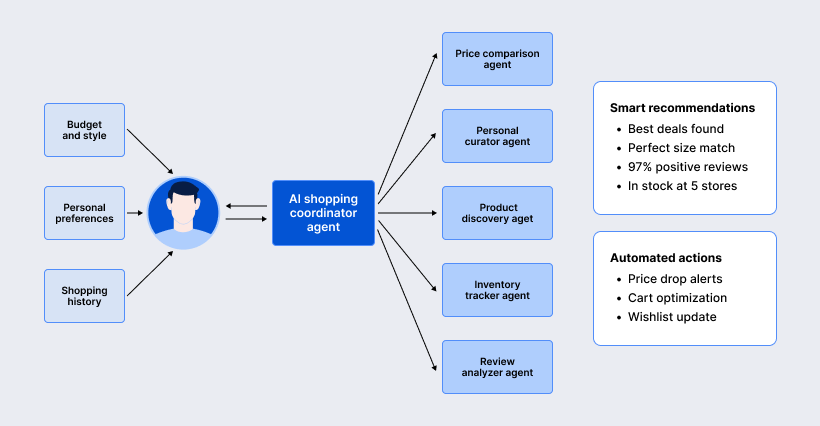
To understand the magnitude of this change, we must distinguish between assistance and autonomy.
From chatbots to autonomous agents
Traditional ecommerce chatbots were reactive tools. They answered FAQs, tracked orders, and sometimes guided users through a product comparison. Their logic was predefined, rule-based, and narrow in scope.
Modern AI agents operate differently. They are proactive, context-aware, and goal-oriented. Instead of waiting for prompts, they can:
- Interpret broad objectives (“Find the best ergonomic office chair under $800 with fast delivery”)
- Compare multiple retailers in real time
- Evaluate product specifications, reviews, loyalty incentives, and return policies
- Execute purchasing decisions automatically
Core capabilities of AI shopping assistants
To qualify as true AI shopping agents, not simply advanced bots, systems must demonstrate a set of core capabilities that enable autonomy and real business impact. Below is a concise capability breakdown.
| Capability | Description | Business impact |
|---|---|---|
| Intent understanding | Interprets natural language goals and constraints | Reduces search friction |
| Real-time data retrieval | Accesses APIs and live product feeds | Improves pricing accuracy |
| Structured comparison | Evaluates features, reviews, and policies | Increases informed purchasing |
| Decision optimization | Applies algorithms to balance trade-offs | Enhances conversion quality |
| Transaction execution | Completes purchasing via secure APIs | Enables frictionless checkout |
| Continuous learning | Adapts based on outcomes and feedback | Improves long-term performance |
How AI Shopping Agents Operate
Let’s look under the hood to see what exact technologies make shopping without human participation possible.
The technology behind AI agents
At the core of autonomous shopping systems are large language models (LLMs) and machine‑learning engines that can understand intent, retrieve product data and orchestrate multi‑step tasks. Because intelligent programs must interact with retailers, payment providers and other agents, standards have emerged to provide a common language for commerce.
McKinsey highlights three complementary protocols that allow agents to access structured product and policy data, negotiate with brand agents, and execute secure payments:
- Model Context Protocol (MCP)
- Agent‑to‑Agent (A2A)
- Agent Payments Protocol (AP2)
Google’s more recent Universal Commerce Protocol (UCP) builds on these standards to enable agents to operate across multiple surfaces (search, chat interfaces, voice assistants) and to integrate with business catalogues, loyalty programmes and payment rails. These protocols create interoperability and trust; without them, intelligent assistants would struggle to transact outside a single ecosystem.
On top of the protocol layer sits the orchestration framework: LLMs are paired with retrieval‑augmented generation (RAG) and decision‑making algorithms. The MCP ensures that product data, availability, and pricing are consistently accessible to any agent. The A2A standard supports direct negotiation between third‑party shopping agents and brand agents for inventory and pricing, while AP2 provides a secure payment layer.
Data-driven personalization in action
Personalization also evolves in this model. Instead of suggesting products based on browsing history, AI agents in retail can ingest a broader array of signals.
- Long‑term consumption patterns: agents can recognize patterns, e.g., when a household typically runs out of coffee pods or office supplies and proactively reorder them at optimal prices.
- Budget constraints: they respect spending limits, balancing cost against quality and timing.
- Brand preferences: they learn favourite brands and switch suppliers only when there is a compelling reason (price, sustainability, loyalty benefits).
- Loyalty program optimization: agents evaluate reward programmes and apply the one that maximizes points or cashback.
- Environmental impact preferences: given the right data, they weigh carbon footprint or packaging sustainability in their recommendations.
A consumer’s AI purchasing system may automatically reorder consumables at optimal pricing intervals. A B2B autonomous ecommerce system may negotiate volume discounts across vendors. In both cases, personalization becomes proactive automation.Importantly, frictionless interaction is no longer limited to one storefront. Autonomous shopping agents operate across marketplaces, direct-to-consumer platforms, and supplier ecosystems. Commerce becomes interoperable.
Implications for Consumers and Retailers
AI shopping agents are reshaping not only how purchases happen, but who controls the decision-making process in digital commerce.
The consumer experience transformed
For consumers, AI purchasing agents compress hours of browsing, comparison, and checkout into a single interaction. Discovery, evaluation, and purchasing converge into one conversational flow. No need to jump between tabs, read reviews, and hunt for coupon codes. Shoppers can delegate those tasks to an autonomous assistant that optimizes for price, delivery speed, loyalty rewards, and personal preferences simultaneously.
A smoother experience is the result:
- An agent can scan dozens of retailers in seconds, surface the most relevant options, and execute the transaction when conditions are met.
- Routine purchases (groceries, household supplies, office consumables) change from reactive buying to automated replenishment.
- Higher-consideration purchases benefit from structured comparison, transparent trade-offs, and reduced cognitive load.
However, this convenience comes with trade-offs. Consumers must decide how much authority to delegate. Trust, transparency, and control become critical factors. When AI agents in retail act on behalf of users, clarity around permissions, data usage, and override mechanisms is essential to maintain confidence in autonomous commerce.
New challenges and opportunities for retail
For retailers, the implications are more structural. AI shopping agents reduce the influence of traditional interface design, brand storytelling, and on-site merchandising. If purchasing decisions are mediated by algorithms, structured product data, API readiness, pricing logic, and availability signals become more important than visual layout.
This creates both risk and opportunity.
On the risk side:
- Brands that fail to expose machine-readable, accurate product data may become invisible to autonomous assistants.
- Price transparency increases as agents perform instant comparison across marketplaces.
- Loyalty strategies must evolve, as agents optimize benefits across multiple programs.
On the opportunity side:
- Retailers can deploy their own AI-powered shopping assistants to guide customers and retain direct engagement.
- Agent-ready APIs allow businesses to participate in new high-intent channels where AI agents initiate transactions.
- Advanced personalization and automation can improve conversion, reduce returns, and optimize inventory turnover.
Retailers now compete for more than just human attention in the developing field of automated commerce. They are vying for preference in the algorithm. The next competitive advantage will be defined by those who modify their governance models, commerce architecture, and data infrastructure to support autonomous ecommerce ecosystems.
Building an Agent-Ready Ecommerce Business
To compete in autonomous ecommerce, retailers must redesign their infrastructure for machines as much as for people.
The foundation of data and APIs
Agentic commerce depends on clean and structured data that machines can read. Product catalogs, pricing rules, inventory levels, delivery options, return policies, and loyalty logic must be consistently formatted and accessible in real time.
API-first architecture is essential: autonomous assistants cannot scrape webpages reliably at scale. They require domain-oriented endpoints that expose business operations (search, compare, reserve, purchase) through secure, standardized interfaces.
Technical protocols for agent communication
Modern AI shopping agents rely on interoperable standards such as Model Context Protocol (MCP) for discovery and tool invocation, and Agentic Commerce Protocol (ACP) or similar payment frameworks for secure checkout orchestration. These protocols ensure agents can retrieve context, initiate transactions, and complete purchases while merchants retain control over compliance, pricing, and fulfillment.
Key implementation steps
- Audit and unify data sources across ERP, CRM, PIM, and inventory systems.
- Design and expose core APIs aligned with agent-driven workflows.
- Pilot with controlled agent access under defined permissions.
- Establish performance metrics (conversion, latency, error rates).
- Iterate based on agent behavior and transaction insights.
Leading in the New Agent Economy
The shift to AI shopping agents demands strategic repositioning, not incremental optimization.
Strategic adaptation for retail leaders
Retail leaders must treat agents as a new customer segment. That means investing in machine-readable catalogs, API-first architecture, and governance frameworks that manage identity, permissions, and risk.
Pricing, loyalty, and merchandising strategies should be rethought for algorithmic evaluation, where comparison, transparency, and fulfillment speed often outweigh brand storytelling. Companies that proactively expose agent-ready endpoints and experiment with their own AI-powered shopping assistants can retain influence in the purchasing journey rather than becoming invisible intermediaries.
The future of AI in retail
AI in retail is moving toward fully autonomous commerce: A2A negotiation, dynamic bundling, predictive replenishment, and real-time optimization across supply chains. As trust grows, more transactions will shift from assisted to delegated. The winners will be those who design for automation at scale, where data, intelligence, and execution operate as one integrated system.
What SaM Solutions Offers
Turning agentic commerce into a competitive advantage demands architectural expertise, AI engineering depth, and platform-level integration.
SaM Solutions combines deep ecommerce expertise with advanced AI software development services to help retailers build agent-ready businesses. Our experts design and implement AI agents for ecommerce, integrate Retrieval-Augmented Generation (RAG) pipelines for context-aware decision-making, and enable secure agent interactions through standards such as Model Context Protocol (MCP).
We also provide AI consulting services, helping organizations define artificial intelligence roadmaps aligned with revenue, conversion, and operational efficiency goals.
Through our partnership with Emporix, a composable commerce platform, we help clients accelerate time to value. Together, we enable API-first, cloud-native infrastructures that allow AI agents to discover, transact, and optimize in real time.
To Wrap Up
AI shopping agents are turning to economic force, quietly redrawing the boundaries of digital commerce. As autonomous systems begin to mediate discovery, comparison, and purchasing, the balance of power shifts toward those prepared to serve both humans and machines. The retailers who rethink their architecture today won’t just survive the agent economy, they’ll define its rules.
FAQ
What are the primary security risks associated with granting an AI agent access to my payment information?
The main risks include:
- Payment fraud from compromised credentials that enable unauthorized purchases.
- Prompt injection attacks that alter the agent’s behavior to make fraudulent transactions.
- Model man-in-the-middle attacks intercepting sensitive data during processing.
To mitigate these, use layered authentication, encrypted payment tokens, auditable transaction logs, transaction limits, explainability frameworks for accountability, and human-in-the-loop approval for high-risk purchases.
How will AI shopping agents impact affiliate marketing and referral revenue models?
What specific programming languages are most commonly used to develop core AI agent frameworks?










![15 Best AI Tools for Java Developers in 2026 [with Internal Survey Results]](https://sam-solutions.com/wp-content/uploads/fly-images/18712/title@2x-6-366x235-c.webp)


