What Is AWS IoT?


(If you prefer video content, please watch the concise video summary of this article below)
In a Nutshell:
- AWS IoT is AWS’s broader family of Internet of Things services for industrial, consumer, commercial, and automotive workloads.
- AWS Internet of Things Core is the managed service that connects devices, brokers messages, maintains device state, and routes data to other AWS services.
- AWS IoT Core supports secure MQTT, MQTT over WebSocket Secure, HTTPS, and LoRaWAN, with authentication options including X.509 certificates, SigV4, and custom authorizers.
- AWS IoT Greengrass, Device Management, and Device Defender extend the platform to edge processing, fleet operations, and device security.
- As of June 1, 2026, AWS IoT Events has reached the end of support, and AWS IoT FleetWise is no longer open to new customers.
What is AWS IoT? AWS IoT is easiest to understand when you picture data moving from a physical thing to a business decision. This article breaks that journey into plain, practical steps.
If cloud software feels abstract, the Internet of Things makes it wonderfully concrete. A thermostat, a delivery van, a pump on a factory floor, or a smart door lock sends signals; AWS helps receive them, secure them, analyze them, and turn them into something useful, whether that is a dashboard, an alert, an automated workflow, or a better customer experience. AWS’s own IoT decision guide frames the portfolio exactly this way: as a stack that moves from devices and edge processing up into cloud ingestion, analytics, AI, and applications.
What Is AWS IoT and Why Does It Matter?
AWS Internet of Things is AWS’s collection of services for connecting, managing, securing, and learning from devices. It matters because it turns physical operations into software-driven insight, automation, and new digital products.
What is IoT in AWS? In simple terms, Amazon Web Services Internet of Things is the umbrella, not just one product. Under that umbrella, Amazon Web Services offers foundational services such as AWS IoT Core, AWS IoT Device Management, AWS IoT Device Defender, AWS IoT Greengrass, and AWS IoT ExpressLink, along with industry-focused services such as AWS IoT SiteWise, AWS IoT TwinMaker, and, for existing customers, AWS IoT FleetWise. Amazon Web Services positions this portfolio around secure connectivity, local processing at the edge, cloud integration, analytics, and AI/ML, which is why it matters to businesses trying to do more than just “get a sensor online.”
What makes the portfolio important is scale and fit. Amazon Web Services says Internet of Things Core is designed to support billions of devices and trillions of messages, while the broader Internet of Things portfolio adds fleet operations, security, digital twins, and industrial modeling so teams do not have to stitch together every building block from scratch. For many businesses, that means less plumbing work and more time spent solving the actual problem in front of them.
How AWS IoT Works
AWS Internet of Things works like a layered system that moves data from a device to a useful action. Each layer has a clear job, which is why the platform scales without becoming a mess.
The easiest mental model is a five-layer flow: devices generate signals, edge software handles local logic, IoT Core connects everything to the cloud, processing services shape the data, and business applications use the results. AWS’s own documentation describes this stack-oriented view directly.
This is where the real world enters the system: sensors, actuators, gateways, wearables, smart appliances, and industrial equipment. Amazon Web Services supports this layer with device SDKs and software such as FreeRTOS for small, low-power microcontroller-based devices.
The edge layer handles work close to the device, where speed and resilience matter most. Amazon Web Services IoT Greengrass lets devices act locally, run Lambda functions, containers, native processes, and ML inference, and keep working even when cloud connectivity is weak or intermittent.
This is the handoff point between devices and Amazon Web Services. AWS IoT Core provides the device gateway and message broker so devices can securely publish and subscribe over MQTT, WSS, HTTPS, and LoRaWAN without teams operating their own messaging infrastructure.
Once telemetry lands in Amazon Web Services, it needs sorting and meaning. AWS IoT Core Rules Engine can filter, transform, and route messages to services such as Lambda, DynamoDB, S3, Kinesis, SQS, SNS, and more, while services like SiteWise and TwinMaker add industrial context and visualization.
This is the layer people actually see. Mobile apps, web dashboards, digital twins, maintenance portals, analytics pipelines, and enterprise integrations consume the IoT data through Amazon Web Services APIs, SDKs, Grafana integrations, or custom applications built on top of the AWS stack.
AWS IoT Architecture
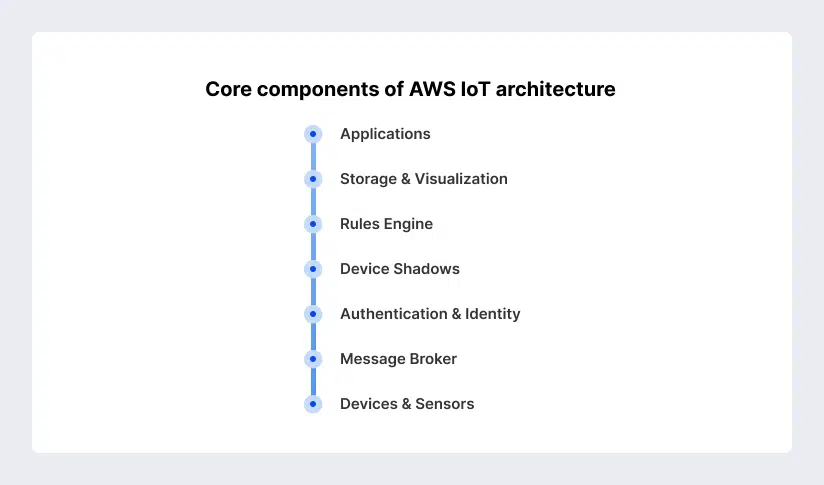
Amazon Web Services’ Internet of Things architecture is built around identity, messaging, device state, and data routing. Those pieces sound technical, but together they form a very practical pipeline from thing to action.
Devices are the physical endpoints that generate or receive information: a temperature probe, a smart lock, a vehicle ECU, or a production line PLC. Amazon Web Services documentation explicitly calls out sensors, actuators, embedded devices, wireless devices, and smart appliances as common IoT Core clients.
The device gateway is like the secure front desk, and the message broker is the traffic controller behind it. Amazon Web Services says the gateway supports scalable pub/sub communication, while the message broker securely moves messages with low latency using MQTT topic structures.
AWS Internet of Things does not want anonymous devices wandering around the building. It supports mutual authentication and encryption, plus X.509 certificates, SigV4, and custom authorizers; the registry then gives each device a stable identity and metadata record.
A device shadow is best understood as a cloud-side sticky note that remembers a device’s state. Amazon Web Services stores the latest reported state and the desired future state so apps and services can work with a device even when the device is offline.
The Rules Engine is the sorter, translator, and dispatcher. It evaluates inbound messages, can transform them with a SQL-like syntax, and sends them to downstream AWS or third-party destinations, sometimes in parallel, without you managing extra infrastructure.
After routing comes storage and visibility. AWS IoT SiteWise offers hot, warm, and customer-managed cold storage tiers for industrial data, while SiteWise Monitor and AWS IoT TwinMaker help teams visualize operations through web apps, dashboards, and 3D digital twin scenes.
Core AWS IoT Services
The core services cover the everyday needs of most Internet of Things programs: connectivity, operations, security, edge logic, and simpler hardware integration. Think of them as the toolkit you reach for before you specialize by industry.
Amazon Web Services groups these services around connection, management, monitoring, and edge execution. That is helpful because most Internet of Things projects fail less from a lack of data and more from poor operational discipline.
AWS IoT Core
AWS IoT Core is the foundation. It provides secure bidirectional communication, a device gateway, a message broker, device shadows, a registry, and a rules engine, so devices can talk to AWS services and to each other without server management.
AWS IoT Device Management
AWS Internet of Things Device Management focuses on the middle of an IoT device’s life: onboarding, grouping, indexing, remote commands, OTA jobs, software package tracking, and secure tunneling for troubleshooting. In plain English, it helps you run a fleet like a fleet instead of like a pile of one-off gadgets.
AWS IoT Device Defender
AWS Internet of Things Device Defender is the security guard for the fleet. It audits configurations against best practices, monitors device behavior for anomalies, raises alarms through CloudWatch and SNS, and provides mitigation actions when a device or policy looks risky.
AWS IoT Greengrass
AWS Internet of Things Greengrass extends Amazon Web Services to the edge. It lets devices run local software components, Lambda functions, containers, native processes, and ML inference so they can react quickly, reduce bandwidth use, and keep operating when the internet has a bad day.
AWS IoT ExpressLink
AWS IoT ExpressLink simplifies cloud connectivity for embedded products by moving much of the hard work into partner hardware modules. Those modules come pre-programmed to connect to AWS services and pre-loaded with security credentials, which helps OEMs ship connected products faster.
Industrial and Industry-Specific AWS IoT Services
The important thing to know is that not every industry service has the same lifecycle today. Two of the names below need a current-status context, which matters if you are planning a new platform in 2026.
AWS IoT SiteWise
AWS IoT SiteWise is built for industrial equipment data. It collects, stores, organizes, and monitors industrial telemetry at scale, lets you model assets and metrics such as OEE, supports edge collection through SiteWise Edge, and provides web-based operational views through SiteWise Monitor.
AWS IoT TwinMaker
AWS IoT TwinMaker is AWS’s operational digital twin service. It creates a knowledge graph around equipment, spaces, and processes, connects to time-series, video, and enterprise data, and can present the result through 3D scenes and Grafana-based dashboards.
AWS IoT FleetWise
AWS IoT FleetWise was designed to collect, standardize, and orchestrate vehicle data collection campaigns. However, Amazon Web Services now says the service is no longer open to new customers; existing customers can continue using it, but new projects should consider AWS’s connected mobility guidance instead.
AWS IoT Events
AWS Internet of Things Events historically monitored telemetry from devices and applications, recognized patterns across multiple inputs, and triggered actions. But this is now a legacy reference: AWS ended support on May 20, 2026, and directs customers to transition to alternate solutions.
Key Benefits OF AWS IoT
AWS IoT’s biggest advantage is not one feature. It is the way connectivity, operations, edge computing, security, and analytics fit together without forcing businesses to assemble everything themselves.
Secure device connectivity
AWS Internet of Things Core provides mutual authentication, encryption, multiple authentication methods, and topic-level authorization controls. That gives teams a solid security baseline before they even start building higher-level logic.
Scalable device fleet management
Device Management adds onboarding, groups, indexing, commands, OTA updates, software package visibility, and secure tunnels. In practice, that means growth is less painful when your pilot turns into a real deployment.
Edge computing capabilities
Greengrass lets teams keep decisions close to the machine. That reduces latency, cuts cloud traffic, and keeps operations moving during intermittent connectivity, which is especially valuable in factories, buildings, and remote sites.
Real-time data processing
IoT Core’s pub/sub model, device gateway, and rules engine are designed for low-latency message flow and immediate downstream actions. If a threshold is crossed, Amazon Web Services can transform, route, and react to that event right away.
Integration with AI, ML, and cloud services
Amazon Web Services explicitly positions Internet of Things alongside analytics, ML, and AI services. Greengrass can run local inference from cloud-trained models, SiteWise can integrate with anomaly detection workflows, and IoT Core rules can feed broader AWS data pipelines.
AWS IoT Use Cases and Examples
AWS Internet of Things is not one market; it is a pattern that repeats across industries. The same basic stack can power a factory line, a building, a vehicle platform, or a consumer device.
Smart manufacturing
Manufacturing is one of AWS IoT’s clearest fits. SiteWise can model equipment and compute metrics such as OEE, while TwinMaker can give plant teams a consolidated digital view to diagnose process and equipment anomalies more quickly.
Connected vehicles
For connected vehicles, Amazon Web Services historically offered FleetWise to collect and standardize vehicle data for quality, autonomy, infotainment, battery health, and maintenance workflows. In 2026, the safer framing for new buyers is connected mobility on AWS more broadly, because FleetWise is no longer open to new customers.
Smart buildings
Smart buildings are a natural IoT workload because they have lots of sensors and lots of repetitive decisions. Amazon Web Services highlights LoRaWAN for building sensors and TwinMaker for tenant experience, live temperature, occupancy, and air-quality context inside commercial spaces.
Asset tracking
Asset tracking often needs long battery life and broad coverage more than raw compute power. AWS IoT Core for LoRaWAN is positioned for tracking and monitoring assets, and AWS IoT Core Device Location can estimate position using GNSS, Wi-Fi, cellular, and IP-derived measurements without traditional GPS hardware.
Predictive maintenance
Predictive maintenance starts with equipment data, but it only becomes useful when it is contextualized. AWS IoT SiteWise can organize machine telemetry, compute industrial metrics, and feed anomaly-detection workflows, while LoRaWAN connectivity can support monitoring across large industrial facilities.
Consumer connected products
Consumer IoT is about product experience as much as telemetry. Amazon Web Services has dedicated connected-home guidance for home automation, security, and network management, and it emphasizes cloud-scale data processing, offline-capable edge logic, and firmware management for manufacturers building connected products.
AWS IoT vs. AWS IoT Core
AWS IoT and AWS IoT Core are related, but they are not interchangeable. AWS IoT is the broader portfolio; AWS IoT Core is the foundational service inside that portfolio.
| Aspect | AWS IOT | AWS IOT CORE |
| Scope | Umbrella family of IoT services | One managed connectivity and messaging service |
| Main job | Covers connectivity, edge, security, fleet operations, industrial services, and digital twins | Connects devices, brokers messages, manages state, and routes data |
| Typical components | Greengrass, Device Management, Device Defender, SiteWise, TwinMaker, ExpressLink, and more | Device Gateway, Message Broker, Registry, Device Shadow, Rules Engine |
| Best when | You are designing the full IoT solution stack | You specifically need secure device-to-cloud communication |
| Simple analogy | The whole workshop | The central switchboard inside the workshop |
The table above reflects AWS’s own positioning: AWS Internet of Things is the full service family, while AWS IoT Core is the foundational platform that provides secure connectivity, messaging, registry, device shadow, and rules-based routing.
When Should Businesses Use AWS IoT?
Businesses should use AWS Internet of Things when connected devices are becoming part of a real operating model, not just a lab experiment. It is strongest when you need secure connectivity, scalable operations, and tight links to Amazon Web Services analytics or edge services.
A good fit usually looks like this: you need to connect many devices; you care about identity and security from the start; you expect remote updates and fleet search; you want rules, storage, analytics, or digital twins; and your company already values AWS-native integration. Manufacturing, buildings, connected products, logistics, and infrastructure all line up well with that profile.
How to Get Started with AWS IoT
The cleanest way to start is to move from business need to device connection in small, deliberate steps. AWS’s tutorials and decision guidance support exactly that approach.
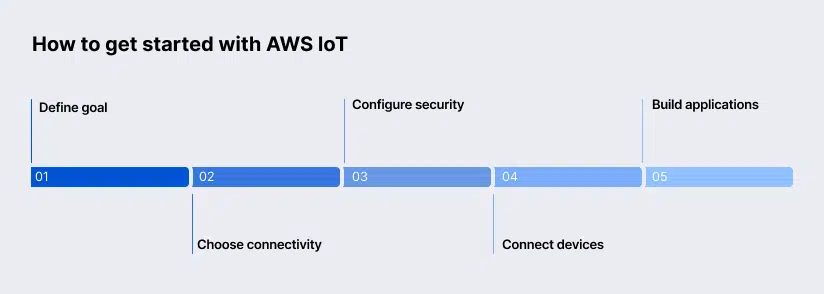
Define the business goal
Start with the outcome, not the hardware. AWS’s decision guide recommends beginning with the business problem and desired result, whether that is reducing downtime, improving service, lowering energy use, or creating a new connected product feature.
Choose the right device connectivity model
Then choose how devices should talk. AWS IoT Core supports MQTT, WSS, HTTPS, and LoRaWAN, so the right model depends on device resources, power budget, network conditions, and whether you need pub/sub behavior or simple publish-only traffic.
Set up security and device identity
Before you celebrate your first message, establish trust. Amazon Web Services requires registered certificates for certificate-based communication, supports X.509, SigV4, and custom authorizers, and uses policies plus the registry to control which devices may connect and what they may do.
Connect devices to AWS IoT Core
After identity comes connection. AWS’s quick-start path creates a thing object, associates security resources, connects a device, and lets you watch MQTT messages flow, which is a practical way to confirm your basic architecture works before adding more services.
Build data pipelines and applications
Once messages are flowing, add business meaning. Use rules to route data, device shadows to manage state, dashboards or digital twins to visualize it, and management or security services to make the deployment sustainable at fleet scale.
AWS IoT Services from SaM Solutions
SaM Solutions can support an AWS IoT initiative across device software, cloud integration, and analytics. We provide the following services: custom IoT development, end-to-end IoT implementation, embedded software engineering, firmware work, board support packages, drivers, testing, integrations, and data analytics services. Our embedded practice lists experience with ARM, x86, PowerPC, AVR, PIC, ESP32/ESP8266, as well as languages such as C, C++, Java, JavaScript, and Python, which maps well to the kinds of device and application layers commonly used in AWS IoT projects.
Conclusion
AWS Internet of Things is best understood as a well-organized toolbox for connected systems. AWS IoT Core handles the conversation with devices, while the wider AWS Internet of Things portfolio adds security, fleet operations, edge logic, industrial context, and visualization.
That matters because successful IoT programs are rarely about a sensor alone. They are about the full chain: trustworthy identities, reliable messaging, device state, safe updates, useful analytics, and applications that help people act faster and smarter. AWS’s IoT portfolio is compelling precisely because it addresses that full chain in one ecosystem.
FAQ
How much does AWS IoT cost for a small connected device project?
For a small project, AWS IoT can be surprisingly inexpensive. Amazon Web Services IoT Core has no minimum fee and includes a free tier with 2,250,000 connection minutes, 500,000 messages, 225,000 registry or Device Shadow operations, and 250,000 rules triggered plus 250,000 actions applied; Amazon Web Services says that the free tier can support a 50-device workload under its sample assumptions.
Is AWS IoT better than Azure IoT or Google Cloud IoT alternatives?
What programming languages are commonly used with AWS IoT?