Moving from US to EU Cloud Providers: Why It Matters for European Businesses Now and What to Consider Before Migrating


(If you prefer video content, please watch the concise video summary of this article below)
Key Takeaways
- EU regulations do not ban US hyperscalers, but they require businesses to assess data transfers, foreign jurisdiction, cybersecurity, provider concentration, and cloud exit readiness.
- European providers offer stronger regional control, but none fully matches the service range and global reach of AWS, Azure, or Google Cloud. Provider selection should be based on individual workload requirements.
- Full cloud repatriation is not always necessary. EU public cloud, sovereign cloud, private infrastructure, on-premises systems, and hybrid models can be combined according to data sensitivity and business needs.
- Migration should be phased, starting with clear goals, workload assessment, provider selection, and a pilot. Businesses must also plan for proprietary dependencies, migration costs, skills gaps, and future provider exits.
For years, European enterprises have relied on the US hyperscalers (Amazon Web Services, Microsoft Azure, and Google Cloud) to power their digital transformation. Choosing a cloud provider was primarily a technical and financial decision: companies compared computing power, managed services, global coverage, scalability, and price. But the ground beneath this infrastructure is shifting.
Driven by a wave of strict regulations, intensifying enforcement, and structural legal conflicts, European organizations are actively re-evaluating their dependency on US-headquartered cloud companies. Gartner forecasts that global sovereign cloud infrastructure spending will reach $80 billion in 2026, up 35.6% from 2025, with Europe recording 83% growth.
Today, businesses are asking broader questions:
- How much control do we retain over the infrastructure on which our operations depend?
- Who can access business data and which laws apply to it?
- How dependent operations are on a single supplier, and what happens if that relationship changes?
- How to ensure GDPR and CRA compliance?
- How to guarantee data security of European citizens?
This guide examines the reasons companies are reassessing their cloud strategies and moving from US to EU cloud providers, the available migration models, and the technical and commercial questions that should be answered before anything is moved.
Need a trusted partner for secure, cloud-native development?
The EU Regulatory Context
EU law does not prohibit European companies from using AWS, Microsoft Azure, or Google Cloud. It does, however, require closer scrutiny of where data is processed, which jurisdictions apply, how providers support critical operations, and whether the business can move its workloads when necessary.
GDPR and international data transfers
The GDPR governs the processing of personal data and places additional requirements on transfers outside the European Economic Area. Data may be transferred to eligible US companies under the EU–US Data Privacy Framework or through safeguards such as Standard Contractual Clauses.
Using a US cloud provider can therefore be lawful, but an EU data-center location alone does not guarantee sovereignty. Businesses must also consider provider ownership, administrative access, subprocessors, and encryption-key control.
The EU Data Act and cloud portability
The EU Data Act has applied since September 12, 2025. It aims to make switching between cloud providers easier by reducing contractual and technical barriers, improving data portability, and supporting the use of several providers in parallel.
The Act strengthens customers’ exit rights, but it does not make provider-specific applications automatically portable. Businesses still need to identify proprietary dependencies and prepare a technical migration plan.
DORA and ICT concentration risk
The Digital Operational Resilience Act (DORA) has applied since January 17, 2025 and primarily affects financial organizations. It requires them to manage risks connected with cloud and other ICT (Information and Communication Technology) providers, particularly where those providers support critical business functions.
Banks, insurers, payment providers, and other covered organizations must assess supplier concentration, contractual arrangements, continuity measures, and exit strategies. DORA does not ban hyperscalers, but it makes unmanaged dependence on one provider harder to justify.
NIS2 and supply-chain security
The NIS2 Directive strengthens cybersecurity requirements across 18 critical sectors, including energy, healthcare, transport, digital infrastructure, public administration, and manufacturing. It covers risk management, incident response, business continuity, and supply-chain security.
For European businesses, this means cloud-provider assessments should go beyond certifications and uptime guarantees. Security practices, subcontractors, recovery capabilities, and third-party dependencies also need to be examined.
CADA and the direction of EU cloud policy
The Cloud and AI Development Act, or CADA, was proposed by the European Commission in June 2026 and is not yet an applicable regulation. It is intended to expand European cloud and AI infrastructure while strengthening the EU’s technological sovereignty.
The proposal signals that ownership, jurisdiction, operational control, supply chains, and technology dependencies will play a larger role in future cloud assessments and public procurement.
The US CLOUD Act and foreign jurisdiction
The US CLOUD Act clarifies that providers subject to US jurisdiction may be required to produce data within their possession, custody, or control in response to valid US legal process, even when that data is stored abroad.
It does not give US authorities unrestricted access to European cloud environments. A lawful request is still required. The relevant point is that storing information in an EU data center does not necessarily remove the provider from US jurisdiction.
European companies should therefore evaluate the provider’s corporate structure, contractual entity, administrative access, encryption model, and ability to respond to foreign legal orders.
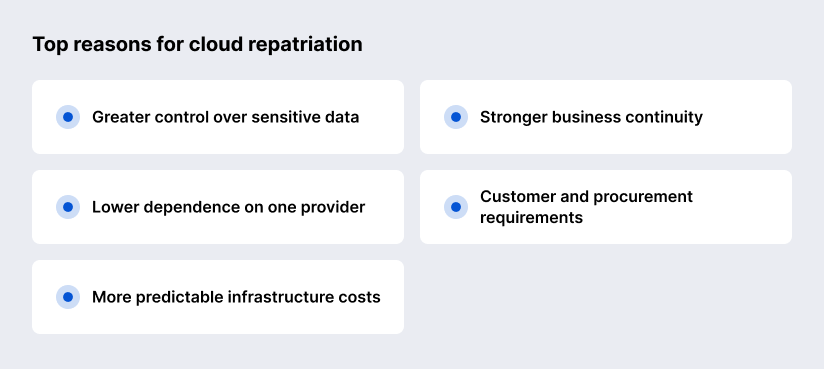
Top Reasons European Companies Are Considering Cloud Repatriation
Cloud repatriation is rarely driven by one regulation or a single security concern. In most cases, it reflects a broader reassessment of cost, control, resilience, and long-term dependence on US hyperscalers.
Greater control over sensitive data
Companies in finance, healthcare, manufacturing, government, and other data-intensive sectors want clearer control over where sensitive information is processed, who can access it, and which laws apply. Moving selected workloads to an EU, private, or local environment can reduce legal and operational uncertainty.
Lower dependence on one provider
Applications built around proprietary databases, serverless platforms, identity services, or analytics tools can become difficult and expensive to move. Repatriation gives businesses an opportunity to replace some of these dependencies with more portable technologies and establish a realistic exit strategy.
More predictable infrastructure costs
Public cloud is cost-effective for variable demand, but not every workload is variable. Stable applications with predictable resource needs may be cheaper to run on dedicated, private, or local infrastructure. Companies are also reviewing egress fees, premium support, long-term commitments, and the cost of underused resources.
Stronger business continuity
Relying on one provider creates a concentration risk. Outages, service changes, contractual disputes, or geopolitical developments can affect systems far beyond the IT department. A hybrid or multi-provider model gives companies more options when a platform becomes unavailable or no longer meets business requirements.
Customer and procurement requirements
Public-sector buyers and regulated customers increasingly ask where data is stored, who operates the infrastructure, and how services can continue if a provider relationship ends. European or sovereign cloud options can help suppliers meet stricter tender requirements and demonstrate greater control over critical systems.
For most businesses, these reasons do not justify moving every workload. They do justify identifying which systems are too sensitive, costly, or strategically important to remain deeply tied to a single external provider.
Top Alternatives to AWS, Azure, and Google Cloud in Europe
Europe has no single provider that matches the full service catalog, global reach, and partner ecosystem of AWS, Azure, or Google Cloud. European alternatives to US cloud providers tend to be stronger in narrower areas: infrastructure hosting, data sovereignty, Kubernetes, private cloud, transparent pricing, or regional support.
The EU-based cloud providers below are not ranked. You can choose depending on the workload, required services, geographic reach, compliance obligations, and how much platform management the company is prepared to handle.
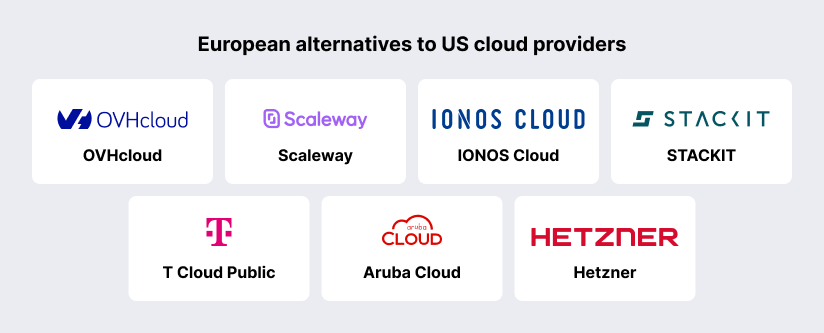


Airbus, a major European aerospace corporation, is migrating 70 most critical applications from AWS to Scaleway under a drive to increase digital sovereignty.


Migration Options: EU Cloud, Private Cloud, On-Premises, or Hybrid?
The target environment (public, sovereign, private, hybrid cloud, multi-cloud, or on-premises infrastructure) should be selected separately for each workload.
Full migration to an EU public cloud
This approach preserves the public-cloud operating model while changing the provider. It is suitable for organizations that need on-demand infrastructure, managed services, and scalability but want stronger European legal, contractual, or operational control.
The main challenge is replacing services that do not have direct equivalents on the new platform.
Sovereign cloud
Sovereign-cloud environments introduce stricter requirements concerning provider control, administration, personnel, encryption, jurisdiction, supply chains, and technical independence. They may be appropriate for government, defense, critical infrastructure, healthcare, financial services, or strategically sensitive corporate systems.
The word “sovereign” is not sufficiently precise on its own. Buyers must understand exactly which sovereignty level the service provides and where dependencies remain.
Private cloud
A private cloud can run in a company’s own data center, a colocation facility, or a managed provider environment.
Technologies such as Kubernetes and OpenStack can deliver automated resource provisioning and cloud-like operations while providing greater infrastructure control. The company must nevertheless account for platform maintenance, upgrades, capacity, security, resilience, and specialized engineering skills.
On-premises or dedicated infrastructure
Traditional infrastructure can be appropriate for stable workloads with predictable demand, high data volumes, specialized hardware, low-latency requirements, or strict physical-control needs. It is less suitable where demand changes rapidly or where the organization lacks the people and processes required to operate resilient infrastructure.
Multi-cloud
Multi-cloud architectures use services from more than one public provider. They can reduce reliance on a single supplier, but they do not automatically make applications portable. Two isolated provider-specific environments may create twice the operational complexity without providing realistic failover.
Hybrid cloud
Hybrid cloud combines public cloud, European cloud, private infrastructure, edge systems, or on-premises environments. For many enterprises, it offers the most practical balance between sovereignty and business continuity.
How to Migrate from AWS, Azure, or Google Cloud to an EU Cloud Provider
A cloud migration should begin with a clear understanding of why the company is changing providers, which systems should move, and what the new environment must deliver.
Define the migration goals
Start by identifying the main reason for the move. The objective may be stronger data control, lower legal exposure, reduced vendor dependence, more predictable costs, or better alignment with customer and regulatory expectations.
Clear goals make it easier to judge whether a full migration is necessary or whether a hybrid model would be more practical.
Review the current cloud environment
Create an overview of the applications, databases, storage, integrations, users, and business processes running on the current platform.
This review should show which systems are critical, which contain sensitive data, and which depend heavily on services specific to AWS, Azure, or Google Cloud. These dependencies often determine the cost and difficulty of the migration.
Classify workloads by priority
Not every system should move at the same time. Group workloads according to business importance, data sensitivity, technical complexity, and acceptable downtime.
Low-risk applications can be used as early migration candidates. Critical systems should be moved only after the target environment and migration process have been tested.
Select the target provider and migration model
Compare EU providers based on service coverage, data-center locations, security, support, pricing, reliability, and exit conditions.
At this stage, decide whether the company will move everything to one EU provider or use a broader model that combines EU cloud, private infrastructure, local hosting, and selected hyperscaler services.
Prepare the target environment
Before transferring applications, establish the new cloud environment, including access controls, networking, security policies, monitoring, backups, and recovery procedures.
The target platform should be ready to support real business operations before the first production workload is moved.
Run a pilot migration
Move one representative but non-critical workload first. The pilot should test application compatibility, performance, data transfer, security, support quality, and the effort required from internal teams.
The results can reveal hidden dependencies and help improve the plan before larger systems are affected.
Migrate in controlled phases
Move applications in several waves rather than through one large cutover. Systems that depend on each other should usually be migrated together.
For each phase, define responsibilities, testing steps, communication procedures, downtime limits, and a rollback option. This reduces the risk of prolonged disruption.
Validate and optimize the new environment
After each migration wave, confirm that applications work correctly, data is complete, performance is acceptable, and security controls operate as expected.
Costs and resource use should also be reviewed. A direct copy of the old setup may carry over inefficiencies that the migration was supposed to remove.
Decommission the former environment
The old cloud resources should be closed only after the new environment has operated reliably and all required data has been verified.
Remove obsolete accounts, revoke access, cancel unused services, review remaining contracts, and confirm that sensitive data and backups are handled according to company policy.
Reduce the risk of future lock-in
The migration should leave the company in a stronger position than before. Applications, data, documentation, deployment processes, and backups should be organized so that another provider change remains possible.
This does not require every system to be completely provider-neutral. It does require the company to understand its dependencies and maintain a realistic exit path.
The Biggest Risks of Moving to an EU Cloud Provider
A US to EU cloud migration can reduce some risks while introducing others.
Underestimating proprietary dependencies
The most difficult migrations often involve managed databases, serverless functions, analytics systems, provider-specific identity services, event platforms, or AI tools. Rewriting these components may take more time than transferring the application itself.
Selecting a provider based only on geography
An EU data center does not answer every question concerning control, ownership, support access, subcontractors, supply chains, encryption, and portability. Likewise, an EU-headquartered provider may still rely on technologies or operational dependencies that matter to a highly sensitive workload.
Assuming Kubernetes solves everything
Kubernetes improves workload portability, but only for components running inside the Kubernetes layer. Data, networking, identity, secrets, load balancers, storage, observability, and external managed services may still require substantial migration work. Provider-specific Kubernetes extensions can also recreate lock-in.
Migration costs may include:
- Application refactoring
- Parallel environments
- Data transfer
- New licenses
- Testing
- External specialists
- Training
- New monitoring and security tools
- Contract termination
- Temporary productivity loss
A migration budget should include contingency for undocumented dependencies.
Operational capability gaps
Moving to a smaller provider, private cloud, or local infrastructure may transfer more responsibility to the internal team. The organization may need new capabilities in Kubernetes, networking, infrastructure as code, security, databases, observability, and incident response.
Replacing one dependency with another
Moving every application to one smaller European provider can create a new concentration risk. The company should assess regional redundancy, provider stability, technical openness, export options, partner capacity, and the ability to move again.
Key Decision Criteria Before Migrating
Before initiating a migration, your leadership team should address these four core questions:
- How sensitive is our data? Classify your data. If you handle highly regulated financial data, critical healthcare metrics, or state contracts, a sovereign EU provider is highly compelling.
- What are the refactoring costs? If you are deeply tied to proprietary hyperscaler databases, calculate the development resources required to decouple your software and move to open-source alternatives.
- What are our uptime and latency requirements? Ensure the European cloud providers you evaluate have physical data centers situated close to your core users with robust service-level agreements (SLAs).
- Do we have the internal skills? Managing a hybrid, multi-cloud, or localized infrastructure setup requires specialized DevOps and cloud architecture expertise. Do you have the talent in-house, or do you need a partner?
How SaM Solutions Can Help
Navigating the complexities of cloud sovereignty, code refactoring, and modern platform engineering requires deep, proven expertise. As a global software development company with over 30 years of experience and a strong geographical presence across the EU and US, SaM Solutions helps businesses successfully execute zero-downtime, compliant migrations.
Our specialized cloud and DevOps services cover every stage of your modernization journey.
- Sovereignty and readiness assessment: We audit your existing cloud infrastructure, map data flows, identify proprietary US cloud dependencies, and build a tailored migration roadmap.
- Cloud architecture and refactoring: Our certified engineers decouple your applications from proprietary APIs, redesigning them into modern, cloud-native microservices.
- Kubernetes and containerization: We containerize your legacy applications and deploy them using Kubernetes, ensuring complete portability across any European cloud provider.
- DevOps and infrastructure automation: We implement custom Infrastructure as Code (IaC) via Terraform and build secure GitOps CI/CD pipelines to ensure your operations are stable, repeatable, and vendor-agnostic.
Conclusion: Cloud Sovereignty Is a Workload Strategy
European businesses do not need to choose between blindly remaining on a US hyperscaler and immediately moving every system to an EU provider. The better approach is to understand the organization’s data, workloads, dependencies, legal exposure, continuity requirements, and long-term costs.
For some workloads, an AWS, Azure, or Google Cloud environment will remain the best option. For others, an EU cloud, sovereign environment, private platform, or local infrastructure may offer greater control and resilience. In many cases, a hybrid cloud provides the safest transition.
The most important step is to preserve the ability to decide. Applications should be designed so that a provider change is a manageable business project, not an emergency transformation triggered by circumstances outside the company’s control.
FAQ
Is hybrid cloud a better choice than complete migration to an EU provider?
For many established organizations, yes. A hybrid strategy lets the company move sensitive or regulated systems to European, sovereign, private, or local infrastructure while retaining workloads that benefit from the global reach or specialized services of AWS, Azure, or Google Cloud. It can reduce immediate migration risk and spread investment over several phases. However, hybrid cloud also introduces additional networking, security, integration, monitoring, and governance complexity.
When is on-premises infrastructure better than an EU public cloud?
What should be included in a cloud exit strategy?
Can AI workloads be moved from US hyperscalers to European infrastructure?