Python for Cybersecurity: Use Cases, Tools, and Practical Workflows


(If you prefer video content, please watch the concise video summary of this article below)
Key Facts
- Python helps security teams move faster. It supports log analysis, alert enrichment, IOC extraction, penetration testing, malware triage, digital forensics, and repetitive task automation.
- It is not mandatory for every cybersecurity role. Still, Python is one of the most practical languages for teams that want to turn raw security data into repeatable workflows and faster decisions.
- Python works best as part of a broader security stack. It can connect SIEM, EDR, cloud platforms, threat intelligence feeds, scanners, and ticketing systems, but it does not replace enterprise-grade security tools.
- Poorly engineered Python scripts can create risk. Security automation needs error handling, logging, secure credential management, dependency control, and clear validation before any action is taken.
Python is the definitive lingua franca for modern secure operations. It can be considered as the connective tissue that bridges disparate security tooling, automates response mechanisms, and facilitates rapid prototyping of custom defensive frameworks.
Experts use Python for cybersecurity to investigate incidents faster, automate routine checks, enrich threat data, analyze logs, support penetration testing, and connect security tools that were never designed to work together. For business leaders, the value is not the language itself. The value is shorter response time, better visibility, fewer manual errors, and more scalable security operations.
The business case is easy to understand.
- IBM’s 2025 Cost of a Data Breach Report put the global average cost of a breach at about $4.4 million.
- Verizon’s 2026 DBIR also reported that 31% of breaches now start with software vulnerabilities.
That changes the role of cybersecurity. It is no longer enough to buy tools and wait for alerts. Companies need security engineering capacity: people and systems that can collect evidence, interpret signals, test assumptions, and automate response steps.
This is where Python fits naturally. It is readable enough for analysts, powerful enough for engineers, and flexible enough to integrate with SIEM platforms, cloud APIs, threat intelligence feeds, ticketing systems, scanners, and custom internal tools.
So, do you need Python for cybersecurity? Not for every role and not for every task. But if a company wants to move from reactive security to repeatable, data-driven security operations, Python becomes one of the most practical skills and technology choices available.
SaM Solutions renders professional Python development services, from consulting to end-to-end project implementation.
What Makes Python Useful for Cybersecurity
Python turns fragmented security data into repeatable workflows. It helps teams move from one-off manual effort to consistent investigation, validation, automation, and reporting.
Security teams rarely work with clean data. They work with logs, alerts, packet captures, JSON files, CSV exports, emails, hashes, IP addresses, API responses, cloud audit trails, endpoint events, and incomplete evidence. Python gives them a common language for handling these materials.
| Benefit | How it helps security teams | Example |
|---|---|---|
| Readable syntax | Analysts and engineers can review, adapt, and maintain scripts without deep software engineering experience. | A SOC analyst modifies a log parser to support a new firewall format. |
| Strong library ecosystem | Pre-built modules for network analysis, cryptographic functions, and data parsing remove the need to build security tools from scratch. | Using the scapy library to rapidly craft and dissect custom packets to audit industrial control systems (ICS). |
| Fast prototyping | Teams can test ideas quickly before investing in full-scale platforms. | A team validates a phishing-domain detection workflow before integrating it into a SIEM. |
| API-friendly design | Python connects well with cloud platforms, SIEMs, EDR tools, vulnerability scanners, and ticketing systems. | A script enriches alerts with asset ownership data and opens Jira tickets. |
| Data processing | Python handles large volumes of structured and semi-structured data. | Analysts group failed login events by user, source, location, and time window. |
| Automation | Repetitive checks can run on a schedule with consistent outputs. | Daily extraction of suspicious IPs from logs and comparison against threat feeds. |
| Cross-platform support | Scripts can run across Linux, Windows, macOS, containers, and cloud environments. | A DFIR team runs the same evidence collection helper across multiple systems. |
The question “does cybersecurity require Python” deserves a careful answer: cybersecurity does not require one universal programming language, but Python can be the fastest route from raw security data to actionable security insight.
What Are the Core Python Use Cases in Cybersecurity?
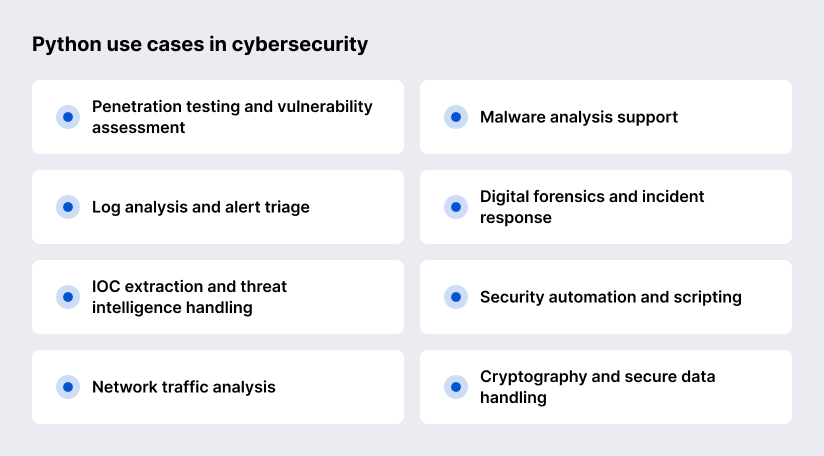
Enterprise engineering teams leverage Python across every facet of modern security operations: penetration testing and vulnerability assessment, log analysis and alert triage, IOC extraction and threat intelligence handling, network traffic analysis, malware analysis support, digital forensics and incident response, security automation and scripting, cryptography and secure data handling.
Penetration testing and vulnerability assessment
In proactive security paradigms, Python used in cybersecurity enables internal security engineers to look beyond standardized, automated vulnerability scanners. While off-the-shelf commercial scanners are good at identifying known software versions and missing patches, they may fail to capture multi-step logical vulnerabilities unique to a business’s custom applications.
Python allows penetration testers to quickly build specialized exploits, automate web application fuzzing, and orchestrate targeted password-spraying attacks against identity providers. By simulating precise threat actor behaviors with tailored scripts, enterprises can uncover systemic configuration flaws before malicious entities exploit them.
Log analysis and alert triage
Modern enterprise networks generate terabytes of log data every single day from firewalls, DNS servers, database engines, and user authentication portals. Traditional SIEM systems frequently become bogged down under this immense data volume, resulting in significant alert fatigue for analyst teams.
With Python, security teams turn noisy logs into structured evidence. It can parse timestamps, group related events, identify suspicious sequences, remove duplicates, and highlight patterns that are easy to miss in raw exports.
IOC extraction and threat intelligence handling
Python is well suited for extracting indicators of compromise from reports, emails, logs, and alerts. These indicators can include IP addresses, domains, URLs, file hashes, email addresses, registry keys, and mutex names.
Threat intelligence is rarely delivered in one perfect format. Some feeds come through APIs. Others arrive as PDFs, CSV files, STIX/TAXII objects, emails, or analyst notes. Python can standardize these inputs and prepare them for SIEM rules, blocklists, enrichment pipelines, or incident reports.
Network traffic analysis
Python can help teams inspect traffic patterns, parse packet captures, and analyze metadata from network monitoring tools.
For example, analysts can use Python to examine a PCAP file, identify unusual ports, group conversations by source and destination, or detect repeated connections to an external host. In cloud environments, Python can also process VPC flow logs and highlight unexpected east-west traffic.
The important point is scope. Python can support network investigation and prototyping, but it is not a substitute for high-throughput packet inspection engines in large enterprise networks.
Malware analysis support
Malware analysis with Python means automating repetitive research tasks, not replacing specialized reverse engineering tools. Analysts use it to calculate hashes, extract strings, unpack simple formats, query sandboxes, compare samples, and organize findings.
A malware analyst may need to process 500 suspicious files from an endpoint investigation. Python can calculate SHA-256 hashes, identify file types, extract metadata, compare results with known malware databases, and prepare a first-pass triage list.
Digital forensics and incident response
Python is valuable in digital forensics and incident response because it helps teams collect, process, and correlate evidence. During an incident, speed matters, but so does consistency.
A DFIR team can use Python to build helpers that extract browser history, parse event logs, analyze file timestamps, process endpoint telemetry, or create timelines. These scripts must be carefully controlled, tested, and documented because forensic workflows require defensible outputs.
In executive terms, Python can help answer critical incident questions sooner: when did the attacker enter, what systems were touched, what data may have been accessed, and which accounts require containment?
Security automation and scripting
Security automation is one of Python’s strongest areas. Teams reduce manual work across alert enrichment, ticket creation, reporting, asset checks, access reviews, and evidence collection.
A common workflow looks like this: receive alert, enrich with asset owner and business criticality, check whether the IP is known to be malicious, create a ticket, notify the responsible team, and log every action. Python can orchestrate these steps through APIs.
Cryptography and secure data handling
Python can support cryptographic tasks such as hashing, token generation, certificate handling, encryption workflows, and secure data processing. However, cryptography is a sensitive area where experts should use established libraries and reviewed patterns.
Python is useful for verifying file integrity, hashing evidence, protecting secrets in automation workflows, or building secure internal utilities. But you should not invent custom encryption algorithms or casually combine cryptographic primitives.
What Are the Essential Python Libraries and Tools for Cybersecurity?
The Python cybersecurity stack includes libraries for networking, data parsing and log processing, web and application security, and cryptography.
| Library/tool | Technical purpose | Specific cybersecurity application |
|---|---|---|
| Requests | HTTP requests and API interaction | Query threat intelligence APIs, SIEM APIs, scanners, and cloud services. |
| urllib3 | HTTP client functionality | Build controlled integrations with web services and internal APIs. |
| Scapy | Packet crafting and packet analysis | Analyze packets, inspect protocols, and support authorized network testing. |
| Impacket | Network protocol work | Support Windows protocol research and controlled security testing. |
| pandas | Data analysis and transformation | Analyze logs, alerts, CSV exports, and investigation datasets. |
| re | Regular expressions | Extract IOCs, usernames, timestamps, hashes, and suspicious strings. |
| json / csv | Data parsing | Normalize outputs from security tools and cloud platforms. |
| Beautiful Soup | HTML/XML parsing | Extract structured data from reports, portals, and internal pages. |
| lxml | Fast XML/HTML processing | Process large XML security exports and structured reports. |
| cryptography | Cryptographic operations | Encryption, hashing, certificate handling, and secure token workflows. |
| hashlib | Hashing | Calculate file hashes for malware triage and forensic evidence tracking. |
Libraries for network security
Network security workflows use Python to inspect packets, query services, parse flow logs, or automate authorized checks. Libraries such as Scapy, socket, ipaddress, and Impacket are common in this area.
Network security specialists might use Python to compare open ports against approved baselines, identify unusual external destinations, or process firewall logs. This doesn’t mean replacing enterprise-grade monitoring but creating targeted utilities when commercial tools do not answer a specific question quickly enough.
Libraries for data parsing and log processing
Parsing is where Python earns much of its cybersecurity value. Logs are frequently inconsistent, incomplete, or spread across multiple platforms, and Python helps bring them into one workable format.
The standard library covers many needs: json, csv, datetime, pathlib, gzip, and re. For larger analytics, pandas helps group, filter, join, and summarize data. A typical example is joining VPN logs with identity events and endpoint alerts to reconstruct user activity during a suspected account compromise.
Libraries for web and application security
Securing modern web applications and APIs requires continuous programmatic interaction, which is effectively managed via the requests, urllib3, and BeautifulSoup libraries. The requests package simplifies the generation of complex HTTP/HTTPS requests, allowing security teams to easily test web endpoints for cross-site scripting (XSS), SQL injection, or broken object-level authentication.
When analyzing the responses, BeautifulSoup and lxml allow for rapid structural traversal of HTML and XML DOM trees. This combination is widely used to scrape OSINT (Open Source Intelligence) sources or to parse incoming web application firewall (WAF) rule sets to ensure application perimeters remain fortified.
Libraries for cryptography
Python’s cryptographic work should rely on established libraries, especially cryptography and hashlib. These tools help teams calculate hashes, verify integrity, handle certificates, and protect sensitive values.
The risk is misuse. Cryptography errors may look harmless in code but serious in production. That is why secure design, peer review, secrets management, and compliance requirements must guide any Python-based cryptographic workflow.
What Hands-on Python Workflows Do Security Teams Use?
Hands-on Python in cybersecurity means producing useful outputs from real security inputs. The most practical workflows turn logs, indicators, alerts, and repetitive security tasks into decisions.
Turning logs into investigation timelines
Python can convert scattered log entries into a timeline that shows what happened and when. This is essential during incident response because isolated events rarely explain the full attack path.
A practical timeline workflow may collect authentication logs, endpoint alerts, DNS queries, proxy records, and cloud audit events. Python normalizes timestamps, sorts events, removes duplicates, groups them by user or host, and outputs a clear sequence for analysts.
Matching indicators across security data
Python helps teams match indicators against internal data sources. A suspicious IP address means little until the team knows whether any endpoint is connected to it.
A typical workflow starts with a list of IOCs from a threat report. Python validates the list, removes duplicates, checks internal DNS and proxy logs, and returns matches with timestamps, users, hosts, and business units. This workflow is especially useful for companies with many tools but limited integration.
Enriching alerts with external context
Alert enrichment adds business and threat context to raw security events. Python can query APIs, asset inventories, vulnerability databases, identity systems, and threat intelligence feeds to make alerts more meaningful.
For example, an alert about a suspicious login becomes more useful when it includes the user department, device owner, geolocation, recent password reset status, MFA status, and whether the source IP appears in known abuse feeds.
Automating repetitive security tasks
Python can be used to automate recurring tasks that consume analyst time but still require consistency. Examples include collecting daily vulnerability reports, checking expired certificates, formatting executive metrics, archiving evidence, or generating remediation tickets.
The best automation has guardrails. It logs actions, handles errors, validates inputs, avoids destructive defaults, and allows human review where needed.
That distinction matters. Poor automation can multiply mistakes. Good automation reduces fatigue and improves control.
What Are the Most Common Mistakes When Using Python in Security Projects?
The basic mistakes come from treating scripts as temporary even after they become business-critical: no proper error handling, ignored secure coding practices, hardcoded credentials, unverified third-party libraries, automation without validation and logging, or using Python instead of performance-critical tools.
Writing scripts without proper error handling
Security scripts run against unstable data sources, unavailable APIs, incomplete logs, or inconsistent formats. Without error handling, they fail silently or produce misleading results.
A good script should report what it processed, what it skipped, what failed, and why. This is especially important in incident response, where missing data can lead to false confidence.
Ignoring secure coding practices
Python scripts used in security operations should follow secure coding principles. That includes input validation, safe file handling, dependency management, least privilege, and protection against injection-style mistakes.
OWASP guidance is relevant here even when the script is internal. Internal tools can still expose data, mishandle credentials, or become an attacker’s shortcut if compromised.
Hardcoding credentials and sensitive data
Hardcoded credentials remain one of the easiest mistakes to make and one of the hardest to clean up. API keys, tokens, passwords, and private keys should not live inside scripts or repositories.
Python workflows should use secret managers, environment variables, vault integrations, managed identities, or other approved mechanisms. Access should be limited, rotated, logged, and reviewed.
Relying too much on unverified third-party libraries
Python’s ecosystem is a strength, but it also introduces supply chain risk. PyPI hosts a large number of projects, and not all of them are maintained, reviewed, or safe for enterprise use.
Security teams should pin versions, scan dependencies, review maintainers, check licenses, monitor vulnerabilities, and avoid unknown packages for sensitive workflows. Convenience is not a control.
Automating tasks without validation and logging
Automation without validation can turn a small error into a large incident. A script that disables accounts, blocks IPs, deletes files, or changes firewall rules must have safeguards.
Validation should happen before action. Logging should happen during action. Review should be available after action. This is especially important for workflows connected to production systems.
Using Python where performance-critical tools are required
Python is excellent for orchestration, analysis, and automation, but not ideal for every performance-critical workload. High-volume packet inspection, real-time endpoint detection, and low-level reverse engineering may require compiled languages or specialized platforms.
Smart teams use Python where it fits and integrate it with faster tools where needed. The goal is not language purity. The goal is reliable security outcomes.
When Python Is Not Enough for Cybersecurity Tasks
You can’t do with Python only when the problem requires enterprise-scale monitoring, real-time detection of threats, deep reverse engineering, formal compliance controls, or complex orchestration across many critical systems.
Large-scale enterprise security monitoring
Enterprise monitoring requires durable pipelines, scalable storage, access control, retention policies, high availability, and search performance. Python can help process and enrich data, but it should not replace a SIEM, data lake, or managed detection platform.
A Python prototype may prove that certain log patterns are valuable. After that, the logic may need to move into a production-grade detection platform.
Real-time threat detection and response
Real-time response requires speed, reliability, and careful control. Python can trigger workflows and call APIs, but the core detection and response engine must be resilient.
For example, automatically isolating endpoints or blocking network traffic requires validation, auditability, rollback plans, and approval rules. Python may orchestrate part of the workflow, but governance determines whether the response is safe.
High-performance malware reverse engineering
Malware reverse engineering requires specialized tools, assembly-level analysis, debuggers, sandboxes, emulators, and memory analysis platforms. Python can automate supporting tasks, but it does not replace expert reverse engineering.
In practice, Python helps analysts handle samples, extract indicators, compare artifacts, and integrate results into reports or detection systems.
Advanced vulnerability scanning and exploitation
Python can support authorized vulnerability testing, but advanced scanning and exploitation require mature tools, controlled methodology, and strong legal boundaries. For enterprises, testing must be scoped, approved, documented, and repeatable.
A Python script may validate a specific condition. A full vulnerability management program needs asset inventory, scanner coverage, remediation tracking, risk ranking, exception handling, and executive reporting.
Compliance-driven security operations
Compliance-driven security requires evidence, policies, approvals, traceability, and audit-ready reporting. Python can collect and prepare evidence, but compliance is not solved by scripts.
For example, Python can verify whether encryption settings are enabled across cloud accounts. But the organization still needs control ownership, review cadence, documentation, and remediation procedures.
Complex security orchestration across multiple systems
Large organizations often need security orchestration across SIEM, SOAR, EDR, IAM, cloud platforms, vulnerability scanners, service desks, and data platforms. Python can connect these systems, but long-term orchestration needs architecture.
A reliable solution should include access control, observability, testing, versioning, deployment pipelines, documentation, and support ownership. Without that, automation becomes fragile.
What Does SaM Solutions Offer?
SaM Solutions helps companies build secure Python-based solutions and cybersecurity workflows that fit real enterprise environments. Whether the goal is log analysis, alert enrichment, vulnerability workflow automation, secure integrations, or custom security software, the right approach combines Python development expertise with cybersecurity discipline.
That combination matters. In modern cybersecurity, speed is important. But controlled, repeatable, well-engineered speed is what protects the business.
Final Thoughts
Is Python important for cybersecurity? Well, this programming language is not a silver bullet for cybersecurity. It is a practical engineering tool that helps security teams work faster, investigate better, and automate with more consistency.
For executives, the lesson is direct: Python can reduce friction inside security operations, but its value depends on how well it is engineered. Scripts should not remain hidden, undocumented, or dependent on one person. They should be reviewed, secured, tested, and integrated into the broader cybersecurity architecture.
FAQ
Do you need Python for cybersecurity?
You do not need Python for every cybersecurity role, but it is highly useful. Security teams use it to automate repetitive tasks, analyze logs, process threat data, test systems, and connect tools through APIs.
How can Python be used in cybersecurity?
What Python skills are required for cybersecurity roles?
Is Python used more by ethical hackers or cybersecurity analysts?