What Is Spec-Driven Development? A Complete Guide


(Prefer videos? Watch a brief summary of this article below.)
Key Facts
- An agreed specification guides planning, code, testing, and review.
- SDD works with human developers, AI coding agents, or both.
- Good specs define outcomes, boundaries, edge cases, constraints, and measurable acceptance criteria.
- Teams can apply SDD to one risky feature or an entire product.
Software projects often go wrong because people imagine different finished products. Spec-driven development turns an idea into a shared, testable description before implementation — rather like giving a builder a plan instead of saying, “make the house comfortable.” As AI can spread either a sound requirement or a false assumption across many files, the specification gives product owners, developers, testers, and AI tools one reference point.
What Is Spec-Driven Development?
What is spec-driven development? Spec-driven development (SDD) uses a structured specification to guide planning, implementation, testing, and validation. The SDD definition treats the spec as an active delivery artifact. The meaning of SDD is to agree on success, record it, and compare the software with that agreement.
A spec can cover behavior, data, interfaces, constraints, quality, and failures. “Users can reset a password” becomes buildable when identity checks, token expiry, rate limits, errors, and acceptance tests are defined.
Why Is Spec-Driven Development Important for AI-Assisted Software Engineering?
Spec-driven development matters in AI-assisted engineering because AI fills missing context with plausible assumptions. A spec narrows that guessing space through requirements, architecture rules, security limits, and acceptance conditions. It cannot make automation infallible, but it makes generated output easier to review, test, and correct.
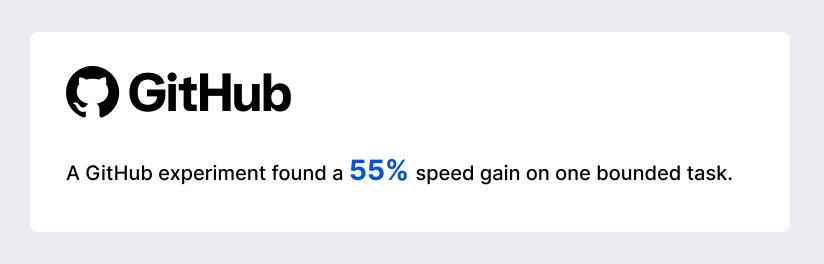
Evidence shows why guardrails matter. A GitHub experiment found a 55% speed gain on one bounded task, while a METR randomized study found experienced contributors took 19% longer across 246 tasks in familiar repositories using early-2025 AI tools. Teams should measure accepted, maintainable outcomes — not generated lines.
How Does Spec-Driven Development Work?
Spec-driven development works via six connected stages: teams define requirements and expected outcomes, create a structured specification, and build the technical plan. They then break the plan into implementation tasks, generate and implement code, and validate the implementation against the specification. This sequence keeps delivery tied to the original intent.
Start with a measurable result, such as reducing abandoned checkouts through simpler guest payment. Outcomes guide scope and prevent misplaced polish.
Translate the outcome into behavior, boundaries, inputs, outputs, and acceptance conditions. This gives stakeholders one operational picture to approve.
Map behavior to components, interfaces, data, dependencies, and security controls, showing how the feature fits the architecture.
Divide the plan into ordered tasks with explicit results and dependencies. Reviewable units give agents a manageable context.
Developers or agents follow repository and security rules. Generated changes require the same ownership and review as handwritten code.
Compare actual behavior with every criterion, constraint, and edge case. Automated tests supply repeatable evidence; human review checks usability, system fit, and unintended effects.
Get AI software built for your business by SaM Solutions — and start seeing results.
What Makes a Good Software Specification?
A good software specification describes functional requirements, acceptance criteria, technical constraints, and architecture and dependencies. It also covers edge cases and failure scenarios as well as security and quality requirements. Together, these elements define expected behavior, system boundaries, and proof of success without dictating every low-level choice.
Functional requirements
Functional requirements state observable behavior, such as creating or canceling an order. Each capability should serve a named need.
Acceptance criteria
Acceptance criteria create pass-or-fail checks. “An expired token cannot change the password” is testable; “handle it properly” is not.
Technical constraints
Technical constraints record non-negotiable limits such as cloud region, browser support, response time, or data residency. Early visibility prevents unusable designs.
Architecture and dependencies
Architecture and dependencies identify components, APIs, data owners, external services, and versions, exposing integration work and hidden coupling.
Edge cases and failure scenarios
Edge cases define recovery when reality breaks the happy path — for example, payment succeeds but confirmation times out. Planned failure behavior protects users and data.
Security and quality requirements
Security and quality requirements make authentication, authorization, encryption, accessibility, performance, resilience, and observability measurable rather than vague appeals to best practice.
What Are the Main Spec-Driven Development Approaches?
SDD has four main approaches: spec-first development, which guides initial delivery; spec-anchored development, which evolves with code; spec-as-source development, which generates related artifacts; and hybrid approaches, which vary the specification’s authority according to risk.
| Approach | Role of the specification | Best fit | Main trade-off |
| Spec-first | Guides initial delivery | Bounded features | May become outdated |
| Spec-anchored | Evolves with code | Long-lived products | Requires governance |
| Spec-as-source | Generates related artifacts | Automatable domains | Demands mature tooling |
| Hybrid | Authority varies by feature | Mixed-risk portfolios | Rules must stay explicit |
Spec-first development
Spec-first development creates an agreed spec before implementation without requiring lifelong maintenance, offering low-friction clarity for a current change.
Spec-anchored development
Spec-anchored development evolves the specification with software, providing traceability but requiring ownership and reviewed updates.
Spec-as-source development
Spec-as-source development derives code, tests, or configuration from the main human-edited spec; deterministic, reviewable generators are essential.
Hybrid approaches
Hybrid approaches match rigor to risk — for example, spec-anchored payment rules, generated API contracts, and lightweight notes for minor UI changes.
How Does Spec-Driven Development Compare with Other Software Engineering Practices?
SDD becomes clearer through four comparisons. SDD vs. traditional requirements documentation contrasts active and reference artifacts; SDD vs. test-driven development compares product intent with code feedback; SDD vs. behavior-driven development compares broad specifications with examples; and SDD vs. vibe coding contrasts constraints with conversational exploration.
SDD vs. traditional requirements documentation
| Aspect | SDD | Traditional documentation |
| Delivery role | Drives plans, tasks, tests, review | Explains scope or records decisions |
| Change handling | Versioned with implementation | Often updated separately |
| Evidence | Traced to acceptance conditions | Assessed through project process |
SDD connects requirements to delivery and validation. Use it when documentation must guide execution, not merely communicate intent.
SDD vs. test-driven development
| Aspect | SDD | TDD |
| Starting point | Desired system outcome | Failing automated test |
| Scope | Feature and system | Small behavior or unit |
| Primary value | Alignment and traceability | Design feedback and regression protection |
SDD defines what matters and why; TDD turns selected behavior into executable feedback. Used together, they connect intent with code-level evidence.
SDD vs. behavior-driven development
| Aspect | SDD | BDD |
| Main artifact | Structured specification | Behavior examples, often Given–When–Then |
| Breadth | Behavior, architecture, constraints | Observable behavior |
| Relationship | Can contain BDD scenarios | Supplies acceptance examples |
BDD examples can sit inside SDD, clarifying behavior while the wider specification covers dependencies, security, data, and architecture.
SDD vs. vibe coding
| Aspect | SDD | Vibe coding |
| Direction | Agreed, versioned specification | Iterative natural-language prompts |
| Review basis | Explicit criteria | Observed output and conversation |
| Best fit | Production collaboration | Exploration and disposable prototypes |
Vibe coding favors momentum; SDD favors control. Convert promising experiments into reviewed specifications before production use.
How Does AI Change Spec-Driven Development?
AI changes SDD through AI coding agents, context engineering, agentic workflows, automated code generation, and human review and validation. Agents execute work, context engineering supplies relevant information, agentic workflows coordinate handoffs, code generation accelerates implementation, and human review confirms that the result is correct and useful.
- AI coding agents. AI coding agents can inspect repositories, edit files, and run tests. A bounded spec supplies a finish line; permissions limit a mistaken interpretation’s consequences.
- Context engineering. Context engineering selects relevant specs, conventions, interfaces, examples, and current state. Curated, non-conflicting material usually helps more than indiscriminate volume.
- Agentic workflows. Agentic workflows distribute planning, implementation, testing, or review. Explicit inputs, outputs, authority, and handoffs prevent parallel activity from becoming parallel confusion.
- Automated code generation. Automated code generation accelerates well-bounded work. Measure accepted changes, defects, review time, and maintainability instead of celebrating raw generation volume.
- Human review and validation. Human review remains essential because a spec can be incomplete and code can satisfy its words while violating its purpose. Domain judgment closes that gap.
What Are the Benefits of Spec-Driven Development?
The main benefits of spec-driven development are clearer requirements and shared understanding, more reliable AI-generated code, better consistency across teams and projects, earlier detection of errors and requirement gaps, improved traceability and documentation, and faster review and validation. These benefits result from making intent explicit.
- Clearer requirements and shared understanding. A reviewed spec gives product, engineering, QA, security, and operations one vocabulary, surfacing disagreement before it becomes conflicting software.
- More reliable AI-generated code. Explicit behavior reduces what AI must invent. Reviewers can compare output with known criteria instead of an ambiguous prompt.
- Better consistency across teams and projects. Reusable templates encourage consistent information, improving handovers without forcing identical architecture or implementation choices.
- Earlier detection of errors and requirement gaps. Specification review exposes contradictions early. Resolving “instant but manually approved” refunds avoids rework across interfaces, services, and tests.
- Improved traceability and documentation. Links among requirements, tasks, tests, and releases preserve intent and evidence, easing maintenance and audits.
- Faster review and validation. Visible outcomes and boundaries focus reviews. A targeted diff plus acceptance criteria replaces the vague request, “please check.”
What Are the Limitations and Challenges of Spec-Driven Development?
SDD’s main limitations are upfront time and effort, over-specification and unnecessary complexity, outdated or incomplete specifications, and ambiguous requirements and context gaps. The approach becomes counterproductive when detail exceeds the change’s needs, ownership is unclear, or the specification is neglected.
- Upfront time and effort. Writing a spec delays the first code change. The investment pays where misunderstanding is expensive; tiny, reversible changes need only lightweight detail.
- Over-specification and unnecessary complexity. Excess detail can freeze decisions engineers should make later. Specify outcomes, interfaces, risks, and constraints; leave low-risk internal choices open.
- Outdated or incomplete specifications. An obsolete spec creates false confidence. Assign an owner, update specs with code, and archive documents that no longer claim authority.
- Ambiguous requirements and context gaps. Formatting cannot rescue unclear thinking. Examples, measurable thresholds, and stakeholder questions must define words such as “fast,” “secure,” and “user-friendly.”
When Should You Use Spec-Driven Development?
SDD is most useful for complex software projects, AI-assisted and agentic coding workflows, large and distributed engineering teams, regulated and compliance-sensitive systems, projects with multiple integrations and dependencies, and long-lived software requiring continuous evolution. Smaller, reversible experiments usually need only lightweight specifications.
Complex software projects
Complex projects contain interacting rules no contributor can safely remember. A specification divides them into inspectable decisions and supplies a common map.
AI-assisted and agentic coding workflows
AI agents act quickly and literally. A spec defines scope, permissions, expected artifacts, and stopping conditions, enabling useful autonomy without surrendering control.
Large and distributed engineering teams
Distributed teams cannot rely on hallway context. Versioned specifications preserve decisions across locations and time zones and support asynchronous review.
Regulated and compliance-sensitive systems
Regulated systems need evidence that controls were designed, implemented, and tested. SDD supports auditability but does not replace legal or compliance review.
Projects with multiple integrations and dependencies
Integration work fails at boundaries such as ownership, formats, timing, and error handling. A spec exposes contracts before teams build incompatible assumptions.
Long-lived software requiring continuous evolution
Long-lived products outlast their original authors. Anchored specifications preserve intent and show whether new requests extend, contradict, or retire existing behavior.
How Can You Introduce Spec-Driven Development into an Existing Codebase?
Teams can introduce SDD into an existing codebase incrementally: assess the current codebase and documentation, identify high-value areas for initial adoption, create specifications for existing functionality, and connect specifications to tests and acceptance criteria. Then introduce SDD into new features and changes and expand the approach incrementally across the codebase.
Map trustworthy documentation, critical workflows, tests, architecture decisions, and known gaps. The assessment shows where apparently small changes carry hidden risk.
Choose an area with frequent change, costly defects, several contributors, or AI use. One bounded success provides evidence without imposing SDD everywhere.
Document observed behavior from code, tests, logs, journeys, and domain experts. Mark uncertainty so assumptions do not quietly become facts.
Link important rules to an automated test, manual check, or monitoring signal. This turns documentation into verifiable knowledge and reveals evidence gaps.
Require a right-sized spec for the next selected change and review it first. Keep the pilot within normal issue, pull-request, and CI practices.
Expand where the pilot reduces defects, review time, or confusion. Refine templates, train contributors, and follow measured value rather than mandates.

What Tools Support Spec-Driven Development?
SDD tools include GitHub Spec Kit, Kiro, OpenSpec, and general AI coding agents and IDEs. The first three provide structured workflows; general-purpose tools can follow team templates. Choose according to codebase maturity, governance needs, and the intended specification lifecycle.
GitHub Spec Kit
GitHub Spec Kit is an open-source Spec → Plan → Tasks → Implement toolkit. Markdown artifacts feed each phase, offering a structured, tool-flexible workflow.
Kiro
Kiro can produce requirements, technical design, and implementation tasks. Requirements-first, design-first, and quick-spec paths provide different review depth.
OpenSpec
OpenSpec adds a lightweight specification layer for AI assistants. Its repository-based artifacts suit teams adopting SDD gradually in existing projects.
AI coding agents and IDEs
General agents and IDEs support SDD through templates, repository rules, and validation commands. Evaluate context control, permissions, audit history, and testing integration.
What Are the Best Practices for Spec-Driven Development?
Teams should keep specifications clear and outcome-focused, define measurable acceptance criteria, treat specifications as living artifacts, and keep specifications and code synchronized. These practices keep the specification useful during delivery and maintenance instead of allowing it to become ceremonial paperwork.
Name the user, behavior, conditions, boundaries, and reason. Remove wording that changes no decision, task, or validation step.
Replace adjectives with thresholds and examples. “The API responds within 500 milliseconds at agreed load” guides work better than “fast.”
Review a spec whenever behavior, constraints, or architecture changes. Version it with delivery work and make ownership visible.
Use pull-request checks, trace links, contract tests, or generated artifacts to detect drift. Resolve every code–spec disagreement explicitly.
What Is the Future of Spec-Driven Development?
SDD’s future will feature more autonomous AI coding agents, specifications as executable sources of truth, multi-agent software engineering workflows, and automated specification generation and validation. These capabilities will automate more work while making permissions, evidence, and human accountability increasingly important.
More autonomous AI coding agents
Agents will handle longer sequences from analysis to pull-request revision. Safe autonomy needs bounded goals, least-privilege access, checkpoints, and testable completion.
Specifications as executable sources of truth
Teams will generate contracts, tests, documentation, infrastructure rules, or code from structured specs. Deterministic, inspectable output will earn the most trust.
Multi-agent software engineering workflows
Specialized agents may plan, implement, test, secure, and review. Shared specs, clear handoffs, and independent validation will coordinate their work.
Automated specification generation and validation
AI will draft specs from conversations, tickets, code, and production behavior, then flag gaps. Stakeholders must still approve what software ought to do.
What does SaM Solutions offer?
SaM Solutions can introduce spec-driven delivery within custom development, AI-assisted engineering, modernization, and QA — from discovery and architecture through testing, governance, integration, and maintenance. With 30+ years in software engineering and 1,000+ delivered projects, SaM Solutions can match SDD rigor to product risk.
Ready to implement AI into your digital strategy? Let SaM Solutions guide your journey.
Conclusion
Spec-driven development turns intent into a shared, testable delivery guide. It suits AI agents, complex rules, multiple teams, integrations, regulated systems, and long-lived products. Record important outcomes and boundaries, connect them to implementation and evidence, and keep people accountable. Start with one consequential feature; expand when measured results justify the discipline.
FAQ
Is spec-driven development good?
Yes, when ambiguity or rework would be expensive, and the spec fits the task. For tiny, reversible changes, keep it light. Measure defects, review time, and rework.
Can spec-driven development be used without AI coding tools?
Who should own and maintain specifications in an SDD team?
Can spec-driven development reduce software maintenance costs?