Cost of Training LLM from Scratch in 2026


(Prefer videos? Watch a brief summary of this article below.)
Key Facts
- The cost of training LLM models depends on model size, training-token volume, GPU type, data quality, engineering effort, and whether the estimate covers only the final compute run or the entire development program.
- The available 2026 figures should be used for early-stage planning, not as a final quotation, because hardware availability, cloud discounts, training efficiency, dataset requirements, and the number of experimental runs can change the result.
- To calculate the cost of LLM training, the most important inputs are training-token volume, GPU type, cluster utilization, training duration, and cloud or hardware pricing.
- A compute-only calculation provides a useful baseline, but it should never be mistaken for the complete project budget.
The cost of training large language models from scratch in 2026 can be anywhere from tens of thousands of dollars for a narrowly scoped small model to well over $100 million for a large-scale system.
For reference, public estimates place GPT-4 training compute at approximately $78–100 million and Gemini Ultra 1.0 at about $191–192 million, compared with $670–900 for the original Transformer in 2017.
These figures are not directly comparable because AI companies rarely disclose complete budgets, but they show how sharply the economics of LLM development have changed.
Leverage AI to transform your business with custom solutions from SaM Solutions’ expert developers.
How Much Does It Cost to Train an LLM From Scratch in 2026?
Based on open sources, the cost of training an LLM from scratch currently ranges from $50,000 to $500,000 for a small model, $1 million to $6 million for a 70-billion-parameter-class model, and more than $200 million for large-scale training.
Typical 2026 budget ranges
| Model category | Typical parameter scale | Indicative training compute cost in 2026 | Typical development profile |
|---|---|---|---|
| Small experimental LLM | 1–3B parameters | $50,000–150,000 | Limited domain, research prototype, or language-specific model trained on a carefully curated corpus |
| Small production-oriented LLM (Qwen3.5-4B, Gemma4:12b) | 4–13B parameters | $150,000–500,000 | Domain-focused model requiring stronger data preparation, evaluation, and multiple training iterations |
| Enterprise mid-size LLM (Qwen3.8-27B) | 26–70B parameters | $1–6M | Large domain model requiring distributed training, substantial datasets, robust MLOps, and extensive validation |
| Large open-weight model (Qwen3.8-125B) | 100B+ total parameters | Several million to tens of millions | Large-scale pre-training and significant post-training work |
Publicly documented models illustrate just how much the economics can differ.
| Model | Size / architecture | Reported or estimated training cost | What the figure represents | Source |
|---|---|---|---|---|
| GPT-3 | 175B parameters | ~$4.3M | Estimated training compute cost | Stanford AI Index 2024 |
| Llama 2 | 70B parameters | ~$3.9M | Estimated training compute cost | Stanford AI Index 2024 |
| GPT-4 | Architecture undisclosed | ~$79M | Estimated compute cost | Stanford AI Index 2025 |
| Gemini 1.0 Ultra | Architecture undisclosed | ~$192M | Estimated compute cost | Stanford AI Index 2025 |
| Llama 3.1-405B | 405B parameters | ~$170M | Cloud-equivalent estimated training compute | Stanford AI Index 2025 |
| DeepSeek-V3 | 671B MoE, 37B active parameters per token | $5.576M | Official training run based on 2.788M H800 GPU-hours at $2/hour; prior R&D excluded | DeepSeek-V3 Technical Report |
The table shows why parameter count alone cannot determine an LLM training budget. DeepSeek-V3 reportedly contained 671 billion total parameters but had a published compute estimate of approximately $5.6 million, while GPT-4 and Gemini Ultra estimates reached tens or hundreds of millions of dollars.
What counts as training an LLM from scratch?
Training an LLM from scratch means creating the model’s base capabilities by initializing new model weights and pre-training them on a large corpus. Remember, it is not starting with an already trained foundation model.
The project normally includes:
- Defining or selecting the architecture
- Building the tokenizer and training dataset
- Filtering and deduplicating data
- Running distributed pre-training
- Validating checkpoints
- Evaluating the resulting base model
- Post-training/fine-tuning the model
Why published cost estimates vary so widely
A figure described as a “$50 million training cost,” for example, may represent only the accelerator time consumed by the final successful run, while another estimate may include experimental runs, data preparation, engineers, infrastructure, energy, and hardware depreciation.
How to Calculate LLM Training Costs
You need to estimate the compute required for the model, convert that compute into GPU-hours, apply the effective price per GPU-hour, and then add data, engineering, infrastructure, experimentation, and contingency costs.
The core LLM training cost formula
The simplest LLM training cost formula is GPU-hours multiplied by the effective cost per GPU-hour. A fuller project calculation looks like this:
| Total training budget = Compute + Data + Engineering + Storage/Networking + Experiments + Post-training/Evaluation + Contingency |
For cloud infrastructure, compute can be estimated as:
| Compute cost = Number of GPUs × Training hours × Cost per GPU-hour |
For example, a cluster of 512 GPUs running continuously for 30 days consumes 368,640 GPU-hours. At an effective rate of $2 per GPU-hour, the final run alone would cost about $737,000, before data preparation, salaries, experiments, storage, or post-training are included.
When the required training compute is known in FLOPs (Floating point operations per second) rather than hours, the formula becomes:
| Compute cost = Training FLOPs ÷ (GPU peak FLOP/s × utilization × 3,600) × cost per GPU-hour |
GPU hours, cluster size, and utilization
- GPU hours equal the number of GPUs reserved multiplied by the hours for which the training job runs.
- Cluster size changes calendar time more directly than it changes total compute spend. Doubling the number of GPUs can shorten a well-parallelized run, but it may not halve the bill if network communication, memory limits, failures, or data-loading bottlenecks reduce scaling efficiency.
- Model FLOPs utilization (MFU) measures how much of a GPU’s theoretical processing capacity is converted into useful model-training work. For example, improving MFU from 30% to 60% can halve training time for the same workload, which can have an effect comparable to doubling the GPU fleet.
Parameters, tokens, and training FLOPs
For a dense transformer, training compute can be approximated from two core variables: the number of model parameters and the number of training tokens. A widely used heuristic is:
| Training FLOPs ≈ 6 × Parameters × Training tokens |
Failed runs, experiments, and budget contingency
The final training run is only part of the cost. GPU spend also covers experiments, data trials, debugging, evaluation, and post-training.
Set aside contingency based on project risk. Proven architectures need less reserve than new models, proprietary datasets, or unfamiliar language requirements.
What Are the Main Expenses Involved in LLM Training?
LLM training costs include compute, data, specialist labor, infrastructure, energy, and model assurance. A reliable budget must include all six categories, not only the GPU bill.
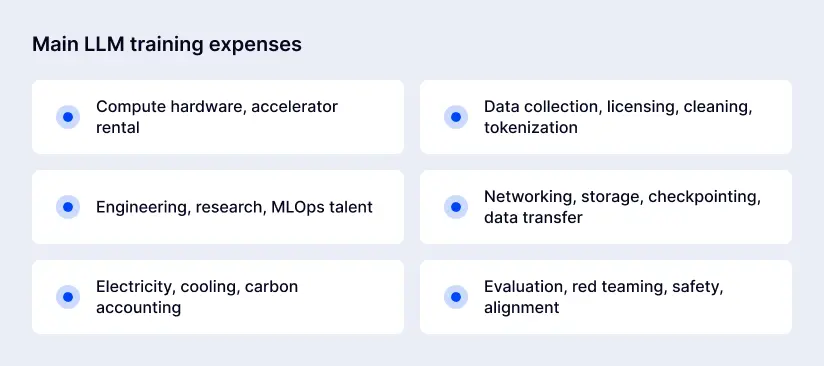
- Compute hardware and accelerator rental: GPU or accelerator costs for pre-training, fine-tuning, experiments, and retries. The total depends on GPU hours, cluster size, hourly rates, and hardware utilization.
- Data collection, licensing, cleaning, and tokenization: Costs of acquiring permitted data and turning it into a usable training corpus. This includes licensing, deduplication, privacy filtering, quality checks, formatting, and tokenization.
- Engineering, research, and MLOps talent: Salaries or service fees for ML engineers, data engineers, researchers, MLOps specialists, security professionals, and QA teams.
- Networking, storage, checkpointing, and data transfer: Infrastructure costs for storing raw and processed datasets, model checkpoints, experiment logs, and model versions.
- Electricity, cooling, and carbon accounting: Direct operating expenses for companies running their own AI infrastructure, plus energy and sustainability reporting costs. Data-center electricity demand increased by 17% in 2025, driven in part by AI workloads.
- Evaluation, red teaming, safety, and alignment: Costs of testing model accuracy, security, bias, privacy, harmful outputs, and resistance to adversarial prompts. Red teaming identifies safety and misuse risks before the model enters production.
What Are Realistic LLM Training Budgets by Model Scale in 2026?
The reality in 2026 is that large language model training costs vary from $50,000 for a compact domain model to tens or hundreds of millions of dollars for frontier-scale systems. The required investment depends not only on parameter count, but also on training-token volume, architecture, accelerator choice, experimentation, data preparation, and infrastructure efficiency.
Small domain models with 1B to 7B parameters
A 1B–7B parameter LLM generally requires a budget of $100,000–$1.5 million when trained from scratch for a production use case. GPU compute for a 7B model may fall within approximately $50,000–$500,000, but the full budget must also include data engineering, domain-data licensing, MLOps, evaluation, and deployment preparation.
Mid-scale models with 8B to 70B parameters
The budget for an 8B–70B parameter LLM can be estimated at $1 million–$10 million-plus for a complete from-scratch program. At this scale, distributed training, large tokenized datasets, high-bandwidth networking, checkpoint storage, expert staffing, and repeated experiments become material cost drivers.
Frontier and mixture-of-experts models
Frontier and mixture-of-experts (MoE) models normally require budgets from tens of millions to more than $100 million, especially when the project includes original research, broad multilingual data, extensive post-training, and large-scale safety validation.
How Has DeepSeek Changed the Economics of LLM Training?
DeepSeek demonstrated that a frontier-capable LLM can be trained with substantially less final-run compute than earlier public estimates suggested, but it did not make frontier-model development a $5.6 million undertaking. Its results shifted attention toward architecture efficiency, low-precision training, GPU utilization, and transparent cost accounting.
What the reported DeepSeek-V3 figure actually covers
DeepSeek-V3 combined a sparse Mixture-of-Experts architecture with low-precision training and extensive system-level optimization. It showed that architecture and infrastructure efficiency can matter as much as total parameter count.
DeepSeek reported that DeepSeek-V3 used 2.788 million H800 GPU hours: 2.664 million for pre-training, 119,000 for context-length extension, and 5,000 for post-training. At an assumed H800 rental rate of $2 per GPU hour, this equals approximately $5.576 million.
Why final-run compute is not the total development budget
The $5.576 million figure should not be interpreted as the full cost of creating DeepSeek-V3. DeepSeek explicitly states that the estimate covers only the official model training and excludes earlier research and ablation experiments involving architectures, algorithms, and data; it also does not represent the full cost of engineering talent, data preparation, infrastructure development, or the work behind earlier DeepSeek models.
Which DeepSeek efficiency gains can other teams replicate?
Other teams can adopt several of DeepSeek’s cost disciplines:
- Use mixed-precision training where hardware and model stability allow it
- Improve cluster utilization with optimized distributed-training pipelines
- Reduce data waste through strong curation and deduplication
- Benchmarks throughput before scaling GPU capacity
But not every organization can reproduce DeepSeek’s results. MoE routing, FP8 stability, custom communication kernels, and large-scale parallel-training optimization demand deep research expertise and specialized infrastructure.
Training from Scratch vs. Fine-Tuning vs. Open-Weight Adaptation
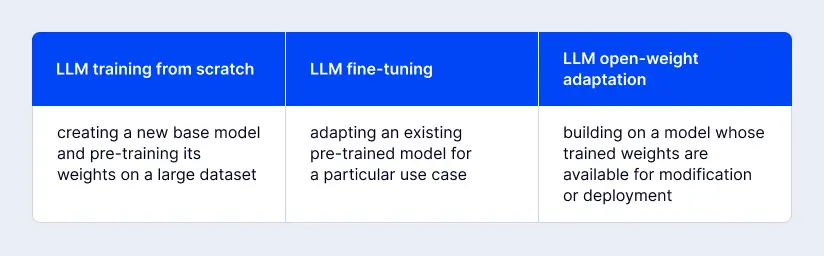
Training from scratch means initializing a new model and pre-training its weights on a large dataset, giving the organization maximum control over the architecture, training data, and resulting model behavior. Fine-tuning means taking an already trained foundation model and updating some or all of its weights with a smaller, task- or domain-specific dataset to improve performance for a particular use case. Open-weight adaptation means building on a model whose trained weights are available for modification or deployment, using techniques such as fine-tuning, LoRA, continued pre-training, or domain-specific alignment instead of paying for base-model pre-training.
LLM training approaches compared
| Criterion | Training from scratch | Fine-tuning | Open-weight adaptation |
|---|---|---|---|
| Starting point | An untrained model architecture with randomly initialized weights | A pre-trained proprietary or open model | Downloadable model weights available under a specific license |
| Primary objective | Build a new foundation model with proprietary capabilities | Improve performance for a defined task, domain, tone, or workflow | Deploy and tailor an existing model while retaining infrastructure control |
| Typical methods | Pre-training on large token corpora, then instruction tuning and alignment | Full fine-tuning, supervised fine-tuning, LoRA, QLoRA, or continued pretraining | Prompt engineering, RAG, fine-tuning, LoRA, continued pretraining, and self-hosted inference |
| Data requirement | Very large, diverse, cleaned, and legally governed corpus | Curated task-specific or domain-specific examples | Proprietary documents, knowledge bases, product data, and optional task-specific training data |
| Time to first usable solution | Months to years | Days to weeks | Days to weeks |
* Most AI labs prefer fine-tuning existing foundation models rather than training new ones from scratch, as it is significantly faster and more cost-efficient. Releases such as Ornith 1.0 and Ornith 1.5 illustrate this approach: they build on available base models and adapt them for improved instruction following, domain performance, or other targeted capabilities.
Full pretraining economics
Full pretraining demands the largest budget because the organization must fund general-language learning across billions of parameters and trillions of tokens. It is justified primarily when proprietary data, sovereignty requirements, or a long-term model strategy create value that existing models cannot provide.
Fine-tuning, LoRA, and continued pretraining
- Fine-tuning updates an existing model with labeled examples.
- Continued pretraining adapts it to specialized unlabeled data using the original self-supervised objective.
- LoRA is a parameter-efficient fine-tuning method that keeps the base model frozen and trains small low-rank adapter layers, reducing compute and storage requirements; if needed, the trained adapter weights can later be merged into the base model for simpler standalone deployment.
When an existing open-weight model is the better choice
It is usually the better option when speed, predictable cost, private deployment, and domain adaptation matter more than owning a new foundation model. The organization can run permitted weights in its cloud or on-premises environment, integrate proprietary CMS or ecommerce data through retrieval, and fine-tune only where evaluation shows a measurable gap.
Cloud vs. On-Premises LLM Training Costs
Cloud infrastructure is usually more cost-effective for occasional or unpredictable LLM training. On-premises GPU clusters can reduce the cost per useful GPU-hour when workloads remain consistently high for several years. The right choice depends on utilization, access to capital, required capacity, security constraints, and whether the organization values flexibility more than long-term infrastructure ownership.
| Criterion | Cloud GPU training | On-premises GPU training |
|---|---|---|
| Upfront investment | Low | Very high |
| Cost model | Pay per use or reserved capacity | Hardware purchase plus power, cooling, maintenance, support, and staffing |
| Time to start | Hours or days, subject to available capacity | Weeks or months for procurement, delivery, installation, and configuration |
| Scalability | High; capacity can be added when available | Limited by installed hardware |
| GPU availability risk | High-demand GPUs may require advance reservation | Capacity is available to the owner, but hardware procurement and replacement remain risks |
| Utilization risk | Low; provider carries most idle-capacity risk | High; organization pays even when GPUs are idle |
| Data control | Depends on provider and configuration | Maximum infrastructure and data control |
| Maintenance | Managed largely by provider | Managed internally or through a partner |
| Best fit | Variable workloads, experiments, short-term projects, rapidly changing hardware requirements | Continuous, predictable, high-utilization workloads with strong data-control requirements |
Cloud GPU pricing, discounts, and capacity risks
Cloud H100 rates vary by provider, region, and commitment, typically ranging from $2 to $10 per GPU hour in 2026. AWS Capacity Blocks and SageMaker training plans can cut prices by 40–75% with advance scheduling and upfront commitments.
Savings Plans lower costs but do not reserve GPUs; Capacity Blocks provide guaranteed capacity for a specified period. Deadline-sensitive LLM projects should secure capacity before committing to delivery dates.
On-premises hardware, depreciation, and utilization
On-premises LLM training requires upfront spending on GPU servers, networking, storage, power, cooling, support, and operations. Total cost of ownership also includes depreciation, electricity, maintenance, security, and idle capacity.
Owned infrastructure pays off only when GPUs stay heavily utilized for training or inference. Cloud resources avoid the cost of idle hardware because teams pay only while workloads run.
When on-premises infrastructure reaches break-even
It happens only when an organization can keep a GPU fleet heavily utilized for several years. One total-cost model identifies 60–70% utilization as the typical break-even zone, with on-premises infrastructure gaining a clearer economic advantage above 70% utilization.
What Are the Hidden Costs After LLM Pretraining?
Pretraining produces model weights, not a finished enterprise AI product. Ongoing costs arise from serving the model reliably, measuring quality, protecting data, meeting governance requirements, and responding to failures in production.
- Inference and model-serving infrastructure: Production LLMs need GPU or accelerator capacity, load balancing, autoscaling, API gateways, vector databases or retrieval services, caching, and token-cost controls.
- Evaluation, updates, and retraining: Model performance can degrade as product catalogs, policies, user behavior, or domain terminology change. Teams may need recurring evaluation datasets, test automation, human review, and retraining or fine-tuning cycles triggered by new business requirements.
- Security, compliance, and AI governance: For enterprise deployments, access control, privacy protection, audit logs, data-retention policies, license management, model-risk assessment, and documented approval processes are a must.
- Observability, maintenance, and incident response: LLM operations require monitoring of latency, errors, throughput, GPU utilization, token consumption, output quality, and unsafe behavior to detect model drift, infrastructure bottlenecks, hallucinations, and security events.
What Drives LLM Training Costs Higher?
LLM training costs rise with model complexity, data requirements, infrastructure inefficiency, and the amount of expert experimentation needed to reach a stable result.
- Model architecture and active parameters: Larger or less efficient models require more compute.
- Data quality and token volume: More tokens and heavier data preparation increase costs.
- Cluster reliability and communication overhead: Failures and synchronization bottlenecks waste GPU time.
- Talent scarcity and research iteration: Specialized experts and repeated experiments add labor and compute expenses.
How to Reduce LLM Training Costs
LLM training costs fall when teams reduce unnecessary FLOPs, increase accelerator utilization, improve data efficiency, and scale infrastructure only after smaller experiments validate the model design.
- Mixture-of-experts, sparsity, and efficient attention: MoE activates only the model components needed for each token to reduce compute and memory use. Sparse layers and efficient-attention approaches can further lower memory and processing requirements.
- Mixed precision, optimized kernels, and parallelism: Use Q8, FP8, or quantization where suitable to improve throughput and reduce memory demand. Optimized kernels and parallel-training strategies keep GPUs productive.
- Data deduplication, curriculum learning, and synthetic data: Remove duplicate and low-quality data before training. Sequence data deliberately and use synthetic examples only with strong quality controls.
- Reserved capacity, spot instances, and GPU scheduling: Reserve GPUs for deadline-critical runs and use lower-cost spot capacity for interruptible workloads. Frequent checkpoints and automatic restarts reduce interruption risk.
- Progressive scaling, checkpoints, and early stopping: Test data, architecture, and throughput on small clusters before scaling. Checkpoints protect against failures, while early stopping prevents spending on underperforming runs.
Should Your Company Train Its Own LLM in 2026?
Most companies should train an LLM from scratch only when proprietary data, model behavior, or infrastructure control creates a clear strategic advantage that existing models cannot deliver economically.
When proprietary pretraining creates strategic value
Proprietary pretraining can be justified when a company needs capabilities that available models cannot provide (e.g., specialized domain knowledge or unique language coverage). It is most defensible for organizations with large proprietary datasets, strong AI development teams, sustained compute budgets, and a clear multimillion-dollar business case.
When fine-tuning, RAG, or APIs deliver better ROI
- Fine-tuning is suitable when the business needs repeatable task behavior, specialized output formats, or brand-aligned responses.
- Retrieval-augmented generation (RAG) is usually better when knowledge changes frequently and answers must be grounded in current, attributable enterprise content.
- Managed APIs or open-weight models are the fastest route when the priority is embedding AI into CMS, ecommerce, customer-service, or internal workflows.
A build-vs-buy decision checklist
Before committing to proprietary LLM training, evaluate whether:
- Does proprietary data create a durable advantage that public models and RAG cannot reproduce?
- Is model ownership essential for product differentiation, data sovereignty, or regulatory compliance?
- Can the company fund the full lifecycle: pretraining, post-training, serving, evaluation, security, and continuous improvement?
- Does the organization have (or can it retain) specialists in LLM research, data engineering, MLOps, AI security, and governance?
- Can the expected business value justify a multi-year total cost of ownership, rather than only the initial GPU budget?
- Would a fine-tuned or open-weight model with RAG meet the accuracy, latency, privacy, and integration requirements sooner?
What Is the Future of LLM Training Economics?
LLM economics will likely split further: frontier pretraining will remain capital-intensive, while adapting capable models for specific enterprise use cases will become faster and less expensive.
- Hardware efficiency and accelerator competition: New accelerators, lower-precision training, and better distributed-training software should improve performance per dollar. However, large training clusters will still require costly networking, power, cooling, and engineering expertise.
- Data constraints and licensing pressure: High-quality public text is becoming harder to obtain, while copyright rules and transparency expectations are increasing pressure to document training-data sources.
- Open-weight competition and falling adaptation expenses: More capable open-weight models give enterprises practical alternatives to building foundation models. Parameter-efficient techniques such as LoRA enable organizations to adapt a pre-trained model by training relatively small additional components, helping reduce adaptation compute and storage requirements.
Why Choose SaM Solutions for AI Development?
With SaM Solutions, businesses easily move from AI concepts to production-ready software. We combine AI consulting, AI proof-of-concept development, enterprise integration, and long-term support. Our experts build LLM-powered applications, contextual search, AI agents, automation, and predictive solutions that connect with existing CMS, ecommerce, CRM, ERP, and data platforms, so businesses can validate value quickly and scale with confidence.
Final Takeaway
The cost of training LLM from scratch is a major business investment driven by compute, data, talent, testing, and operations, not GPU time alone.
For most companies, fine-tuning, RAG, APIs, or open-weight models offer faster, lower-cost value. Build from scratch only when proprietary data and long-term control justify the investment.
FAQ
What is the average cost to train a large language model?
There is no single average because cost varies by model size and budget scope. A small domain LLM may require hundreds of thousands of dollars, a 70B-class model can cost several million dollars, and frontier-model compute can exceed $100 million.
What’s the difference between LLM training and fine-tuning costs?
How long does GPU procurement for LLM training take in 2026?