Why Is Umbraco a Suitable CMS for B2B Companies?


(Prefer videos? Watch a summary of this article below.)
Key Facts
- Umbraco is an open-source .NET CMS for conventional, headless, and hybrid websites.
- Its main B2B advantage is flexibility: companies can connect content with CRM, ERP, PIM, commerce, analytics, and marketing systems.
- It suits corporate sites, portals, and multi-market platforms with custom requirements, as long as the organization plans for development, upgrades, and security.
B2B websites rarely remain simple. As product lines and regions expand, the CMS must support long buying cycles, technical content, integrations, permissions, and sometimes ecommerce or self-service.
Umbraco combines a clean editorial environment with the freedom to shape the surrounding solution around real business processes. For an Umbraco B2B website, that balance can be more valuable than a long list of rigid features.
It is not a no-code shortcut, however. Its value depends on the content model, integrations, hosting, governance, and upgrade strategy.
What Is Umbraco CMS?
Umbraco CMS is a free, open-source content management system built on Microsoft .NET and distributed under the MIT license. Organizations can host it themselves or use Umbraco Cloud, while optional commercial products add capabilities such as forms, advanced workflows, and commerce.
Editors use a browser-based backoffice to manage media, preview changes, schedule publishing, and work within assigned permissions. Developers define the content models, templates, business logic, integrations, and delivery architecture.
It offers an editor-friendly core without prescribing the entire digital stack. For more detail, see our guide to what Umbraco CMS is and how it works.
What Do B2B Companies Need from a Modern CMS?
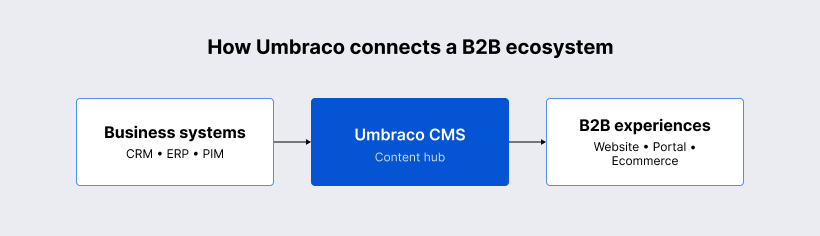
A modern B2B CMS must help buyers find credible information, help internal teams govern it, and exchange data reliably with the systems that run sales and operations. It also needs enough flexibility to accommodate processes that differ by product, account, country, or channel.
Support for complex buyer journeys
B2B purchases may involve researchers, technical evaluators, procurement teams, and final approvers. Each needs different evidence, from use cases to specifications and compliance documents. A suitable CMS should connect these materials without assuming that every buyer follows the same funnel.
Flexible content and product information management
Companies need reusable structures for products, services, industries, resources, and campaigns. Umbraco can model these consistently, while a PIM remains the better system of record for large catalogs. The CMS then combines governed product data with richer editorial material.
Integration with enterprise systems
A B2B site may need CRM data for lead routing, ERP information for account terms, PIM records for products, and automation tools for nurturing. Integration design should define data ownership and failure handling so that one unavailable service doesn’t disrupt the entire experience.
Multi-market content governance
Regional teams need room to localize messages and offers, while headquarters needs brand and compliance control. Effective governance combines reusable global content, local variants, permissions, workflows, and clear rules for translation, review, fallback content, and ownership.
Security, reliability, and scalability
The platform must protect administrative access and remain available during demand spikes. This requires more than a secure CMS core: supported versions, prompt patching, least-privilege access, protected secrets, monitoring, backups, recovery testing, and scalable infrastructure.
Streamline your content management and power up your digital marketing with SaM Solutions’ Umbraco services.
Why Umbraco Is a Strong Choice for B2B Websites
Umbraco is strongest when a company needs a tailored digital platform rather than a standard marketing site assembled from fixed modules. Its open architecture gives technical teams control over data, integrations, presentation, and deployment while keeping routine content work accessible to editors.
Flexible content modeling and custom development
Umbraco defines content through document types, fields, reusable blocks, and relationships. A manufacturer can model machines, accessories, applications, and downloads separately, then reuse them across pages and portals. Developers can add custom search, calculators, configurators, or account functionality in .NET.
Editor-friendly content management
The backoffice can be configured around editors’ real tasks. Clear labels, purposeful blocks, previews, scheduling, and validation reduce reliance on developers. This benefit is not automatic: an overcomplicated content tree can make any CMS difficult, so editorial usability must be a design requirement.
CRM, ERP, PIM, and marketing automation integrations
APIs and custom services can connect Umbraco to Salesforce, Microsoft Dynamics 365, SAP, product databases, and marketing automation tools. Each data domain should have a clear owner — for example, the PIM for specifications and the CRM for accounts — while the site presents the information in context.
Headless and API-first content delivery
Umbraco’s Content Delivery API returns published content as structured JSON to websites, apps, kiosks, and other channels. Headless or hybrid architecture supports independent frontends and content reuse, but adds preview, caching, and deployment work. Our guide to headless Umbraco examines the trade-offs.
Multisite and multilingual content management
Umbraco supports multiple sites and language variants within a shared platform design. Teams can reuse components and models while varying copy, domains, navigation, and local material. Tightly connected sites may share an installation; independently governed or high-traffic properties may be safer as separate projects.
SEO and website performance
Editors can control metadata, canonical URLs, redirects, structured data, sitemaps, and social fields. Developers can optimize rendering, images, caching, frontend assets, and hosting. Umbraco enables a fast, search-friendly site, but rankings and performance still depend on implementation and measurement.
Security, permissions, and content governance
User groups, permissions, version history, and optional approval tooling support controlled publishing. Self-hosted organizations remain responsible for supported releases and patches, while Umbraco Cloud automates parts of hosting and maintenance. Our Umbraco security guide explains this shared-responsibility model.
Scalability for growing digital ecosystems
Companies can begin with a corporate site and later add regional properties, APIs, authenticated areas, or commerce services. Scalability is still an architectural outcome: teams need sensible queries, caching, search, media handling, observability, and infrastructure sized for realistic traffic.
How Umbraco Supports B2B Ecommerce
Umbraco can support B2B ecommerce either through the official Umbraco Commerce add-on, custom development, or integration with a separate commerce engine. The right model depends on catalog size, pricing rules, account structures, order complexity, and the systems that already own commercial data.
Complex product catalogs and technical content
The CMS can present buying guides, specifications, manuals, certificates, and related material. Modest catalogs may live within the solution. For extensive catalogs, a PIM or commerce platform should remain the source of truth, with Umbraco enriching its data through editorial content and navigation.
Account-specific digital experiences
Logged-in customers may need contract pricing, selected assortments, saved lists, repeat ordering, or documents. Umbraco can provide the experience, while identity, pricing, and entitlement data come from CRM, ERP, or commerce services. Clear boundaries reduce duplication and make personalization easier to govern.
Customer and distributor self-service portals
Portals can bring manuals, certificates, support requests, order history, and training into one experience. Umbraco provides the editorial layer, while application services handle transactions and protected account data without exposing back-office systems directly.
Custom ordering and approval workflows
B2B orders may require quotes, purchase-order references, minimum quantities, delegated buyers, or approval. Umbraco can coordinate the experience, but pricing and order rules should remain in the appropriate commerce or ERP layer, so every channel applies them consistently.
Commerce, payment, and logistics integrations
Umbraco Commerce covers products, orders, discounts, payment providers, and shipping methods. Larger environments may connect the CMS to specialized commerce, tax, warehouse, and logistics platforms. In either case, clear status handling, retry rules, audit trails, and monitoring matter more than a long list of connectors.
Umbraco vs SaaS CMS Platforms for B2B
Umbraco usually offers more architectural control than a typical SaaS CMS, while SaaS platforms generally reduce setup and operational responsibility. The better option depends on whether the business values speed and standardization or needs substantial customization, integration freedom, and deployment choice.
| Decision area | Umbraco CMS | Typical SaaS CMS |
| Hosting | Self-hosted or managed through Umbraco Cloud | Vendor-hosted |
| Customization | Deep .NET and frontend customization | Usually limited to vendor extension models |
| Content model | Highly configurable | Often configurable within product constraints |
| Integrations | Custom APIs, middleware, and packages | Prebuilt connectors plus vendor APIs |
| Headless delivery | Conventional, hybrid, or headless | Varies; often API-led on newer platforms |
| Platform updates | Customer or implementation partner manages them; Cloud automates selected updates | Vendor manages the core platform |
| Infrastructure control | High when self-hosted | Low |
| Time to initial launch | Depends on solution complexity and team | Often faster for standard requirements |
| Vendor dependency | Lower at the CMS-code level, though hosting and add-ons may be commercial | Higher dependence on vendor roadmap and pricing |
| Best fit | Distinct processes, complex integrations, custom experiences | Standardized sites with limited technical capacity |
Customization and architectural control
Umbraco lets teams choose frontend technology, integration patterns, hosting, search, and supporting services. A SaaS CMS can be more efficient when requirements fit its model, but costly workarounds may appear when they do not.
Enterprise integration flexibility
Both approaches expose APIs, but Umbraco engineers can add custom backend logic and middleware alongside the CMS. SaaS teams work within provider limits and extension points. Buyers should test difficult integration scenarios during discovery, not decide from connector logos alone.
Platform ownership and vendor dependency
The open-source core diversifies hosting and development choices, but it does not eliminate dependencies on .NET expertise, packages, cloud services, or add-ons. SaaS concentrates responsibility with one vendor, making roadmap, pricing, and data portability more significant.
Maintenance and technical responsibility
Self-hosted Umbraco offers maximum control but also maximum operational responsibility. Umbraco Cloud shifts infrastructure, backups, deployment tooling, and some patch management to the vendor; SaaS usually shifts more. Compare development, licenses, hosting, monitoring, security, upgrades, and governance — not license fees alone.




Common B2B Use Cases for Umbraco
Umbraco works well for corporate sites, partner portals, self-service platforms, international web ecosystems, and content-led ecommerce — especially when each channel needs tailored content and integrations.


When Is Umbraco the Right CMS for Your B2B Company?
Umbraco is a strong candidate when requirements are specific enough to justify a tailored platform and the organization can support a managed development lifecycle. It may be excessive when a standard site, limited integrations, and rapid no-code operation are the main priorities.
| Umbraco is likely a good fit when… | Reconsider or compare alternatives when… |
| Your content and buyer journeys need custom structures | A standard brochure site covers the foreseeable need |
| CRM, ERP, PIM, commerce, or portal integration is central | Prebuilt integrations meet all important requirements |
| You need control over architecture, hosting, or frontend delivery | The organization wants the vendor to own nearly all technical operations |
| Multiple brands, markets, or languages share a platform strategy | Each site is small, independent, and rarely changes |
| Your Microsoft/.NET environment or partner ecosystem is established | No internal or external .NET capability is available |
| The roadmap includes headless, hybrid, portal, or custom application scenarios | A fixed template and feature set is preferable to custom development |
| You have a realistic budget for upgrades, monitoring, and continuous improvement | The purchasing decision is based mainly on avoiding initial license costs |
The decision should follow discovery. Map priority journeys, data owners, editorial roles, integrations, non-functional requirements, and the three-year roadmap; use a proof of concept where technical risk is material.
How to Implement Umbraco for a B2B Website
A successful Umbraco project moves from defining business needs and technical architecture to building, migrating, testing, and launching the solution. After release, regular maintenance and data-led improvements keep the platform secure and effective.
Discovery and requirements analysis
Interview marketing, sales, product, service, IT, and security stakeholders. Define priority journeys, inventory content and systems, assign data ownership, and record non-functional needs. A clear minimum viable scope prevents the first release from becoming a departmental wish list.
Architecture and integration planning
Choose conventional, headless, or hybrid delivery based on channel needs. Decide between self-hosting and Umbraco Cloud, define system boundaries, and document API contracts, authentication, caching, monitoring, and failure behavior. Validate high-risk integrations early.
Development and content migration
Build reusable components and integrations in short increments, with editors reviewing the backoffice. Migration should cover mapping, cleanup, redirects, metadata, media, and validation — not merely database transfer. Automated scripts make test migrations safer.
Testing and launch
Test permissions, integrations, search, forms, accessibility, security, performance, analytics, and recovery. Rehearse migration and deployment, define rollback criteria, and train editors. A staged release may reduce risk for a large Umbraco B2B ecosystem.
Support and continuous improvement
After launch, monitor availability, integrations, search, performance, and conversion paths. Maintain supported versions, apply patches, test backups, and prioritize improvements using analytics and feedback. This rhythm prevents the site from slowly accumulating risk.
Why Choose SaM Solutions for Umbraco Development?
SaM Solutions combines Umbraco delivery with .NET, cloud, integration, ecommerce, UX, QA, DevOps, and maintenance expertise. That breadth helps when the hardest work sits between the CMS and surrounding business systems.
Our teams cover requirements, architecture, UX, implementation, migration, integration, testing, deployment, optimization, and support through full outsourcing, dedicated teams, or staff augmentation.
In one engagement, SaM Solutions upgraded and optimized an Umbraco corporate website, achieving a sixfold increase in page-loading speed and adding four language versions. In another, we migrated a corporate portal from SharePoint to Umbraco, improving content management, access, integrations, and maintainability.
Conclusion
Umbraco suits B2B companies that need more than a generic publishing tool. Its combination of structured content, custom .NET development, integration freedom, multiple delivery models, and deployment choice can support complex websites, portals, multi-market operations, and content-led commerce.
That flexibility makes good technical and operational decisions essential. Evaluate the platform against the hardest journeys and integrations, assign maintenance and security responsibility, and budget for continuous improvement.
FAQ
What is the difference between Umbraco CMS and Umbraco Cloud?
Umbraco CMS is open-source software that a company can deploy on suitable infrastructure. Umbraco Cloud is a managed Azure-based hosting and development platform with environments, deployment tooling, backups, CDN capabilities, and automated maintenance.
Does a company need an in-house .NET developer to manage Umbraco?
What factors determine the total cost of ownership of an Umbraco website?
How often should an Umbraco website be upgraded?