What Is Umbraco? A Complete Guide to the Open-Source CMS


(Prefer videos? Watch a brief summary of this article below.)
Key Facts
- Umbraco is a free, open-source CMS built on Microsoft .NET. The core platform uses the MIT license.
- It works for conventional, hybrid, and headless websites. Teams can use managed cloud hosting or run it themselves.
- The backoffice supports structured content, media, permissions, scheduling, and version history.
- Official paid products cover areas such as workflow, forms, commerce, and support. A public package ecosystem offers further extensions.
- The result sits somewhere between a ready-made publishing tool and a custom web application framework. That middle ground explains much of its appeal.
A company website rarely stays simple. The five-page launch version acquires regional sections, product feeds, campaign pages, customer accounts, approval rules, and several teams requesting different permissions.
Sooner or later, the underlying platform starts to matter.
So, what is Umbraco, exactly? It is an open-source content management system for building tailored digital experiences on the Microsoft .NET stack. Organizations use it when they want more freedom than a fixed site builder provides but do not necessarily need a vast enterprise suite.
That freedom comes with a trade-off. Umbraco does not make every architectural choice on your behalf. Used well, this is an advantage. Used carelessly, it can leave a team with more custom code than it expected.
What Is Umbraco CMS?
Umbraco CMS is a web content management platform built for structured publishing and custom .NET development. It provides an editorial backoffice, but the finished website — or app, portal, or store — is designed around the organization’s own requirements.
The answer to what is Umbraco CMS is therefore broader than “a tool for editing pages.” It is also an application framework. A team can build a relatively simple corporate site or place the CMS inside a larger digital ecosystem connected to customer, product, payment, and marketing systems.
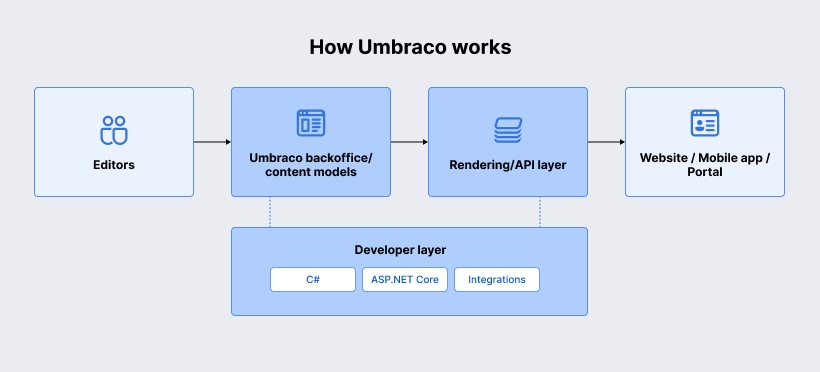
How does Umbraco work?
Developers define document types for articles, products, offices, landing pages, or other records. Each model contains relevant fields, validation rules, reusable blocks, and relationships.
Editors fill in those fields in the backoffice. Umbraco then renders the material via server-side templates or supplies it to another frontend through an API.
Who is Umbraco designed for?
The platform suits businesses that need a tailored solution rather than a preassembled theme. Common users include corporate marketing teams, publishers, retailers, manufacturers, digital agencies, and organizations that run several brands or languages.
Editors need no programming knowledge. Initial development and substantial customization, however, usually call for experienced .NET specialists.
What Is Umbraco Used For?
Now, what is Umbraco used for? Typical projects include corporate websites, customer portals, online stores, intranets, web applications, and multichannel platforms. Its role can be narrow — a publishing layer — or central to a wider digital ecosystem.
| Project type | How Umbraco is used | Typical users |
|---|---|---|
| Corporate website | Manages services, news, careers, locations, and campaigns | Marketing and communications teams |
| Customer portal | Publishes secure, account-specific resources | Customers, partners, and support teams |
| Digital store | Connects editorial pages with products and transactions | Retailers, distributors, and manufacturers |
| Intranet | Organizes policies, forms, news, and internal tools | Employees, HR, and operations teams |
| Headless platform | Supplies structured data to several channels | Product and software teams |
Corporate websites and content portals
Corporate sites tend to gather complexity quietly. One region needs local pages; another department requests a newsroom; legal wants stricter control over publishing.
Umbraco can model those areas separately while preserving a shared design system. For larger customer or partner environments, see SaM Solutions’ CX development services.
Ecommerce websites and digital stores
Umbraco can manage buying guides, campaign pages, category stories, promotions, and other editorial material surrounding a store.
Products, inventory, checkout, and orders may sit in Umbraco Commerce or an external platform. SaM Solutions provides ecommerce development services for projects that extend beyond publishing into storefront engineering and system integration.
Intranets, extranets, and web applications
Not every Umbraco project looks like a public website. An intranet might combine announcements, policies, staff profiles, forms, and departmental tools. An extranet may offer partners contracts, training materials, or product documents.
Because it runs as a .NET application, custom dashboards and business functions can sit beside the CMS.
Composable digital experience platforms
In a composable setup, Umbraco handles editorial material while specialist tools manage search, customer data, analytics, identity, or transactions.
Those parts communicate through APIs, events, or scheduled exchanges. The approach avoids buying one enormous suite. It also puts greater pressure on integration design and data ownership.
What Are the Key Features of Umbraco?
Umbraco combines structured authoring with flexible development. Its core capabilities include content modeling, media management, permissions, publishing controls, version history, APIs, and extension points.


What Technology Is Umbraco Built On?
Umbraco runs on Microsoft’s modern web stack. Its ASP.NET Core and C# foundation makes it especially familiar to organizations already using Microsoft development and cloud technologies.
ASP.NET Core and C#
Backend work follows established .NET patterns, including dependency injection, configuration providers, middleware, services, and Razor views.
Projects use NuGet and the dotnet command-line tools. Existing C# teams can therefore work in a familiar environment instead of adopting an entirely different server-side ecosystem.
APIs and extensible architecture
The architecture allows teams to add endpoints, dashboards, property editors, scheduled tasks, and custom administrative tools.
Its Content Delivery API can return published material as JSON for external frontends. Webhooks can alert another system when a defined event occurs, such as the publication of a page.
Cross-platform deployment
Umbraco can run in supported Windows, Linux, and macOS environments. Production deployments may use virtual machines, containers, public clouds, or private infrastructure.
The sensible choice depends on traffic, compliance, internal skills, recovery targets, and the extent of operational work the organization wants to own.
Is Umbraco Open Source?
Yes. The core source code is publicly available under the permissive MIT license, allowing organizations to use, inspect, modify, and distribute it in accordance with the license terms.
Open-source CMS and community development
Public development gives engineers visibility into the platform. They can inspect behavior, report problems, contribute fixes, and build extensions.
Umbraco Cloud and commercial services
Open-source software does not prevent its creator from selling optional services. Umbraco offers managed infrastructure, support, forms, workflow, optimization, and commerce products.
These services may reduce implementation or operational effort. They are additions to the free core, not a requirement for using it.
Request SaM Solutions’ Umbraco implementation to speed up and optimize your content management workflows.
Is Umbraco Free?
The core CMS is free. A production project is not: design, engineering, migration, testing, hosting, upgrades, and support still require money and time.
Free Umbraco CMS
Organizations pay no mandatory license fee for the core software. They may build a custom implementation and deploy it on infrastructure they control.
That can shift more budget toward useful project work. It should not be confused with a zero-cost website. Skilled development remains a substantial investment.
Paid products, hosting, and support
Potential costs include Umbraco Cloud, commercial packages, official add-ons, enterprise assistance, monitoring, and partner services.
Compare platforms by total cost of ownership rather than license price alone. Infrastructure, backups, incident response, quality assurance, and upgrades are needed in every model.
Can Umbraco Be Used as a Headless CMS?
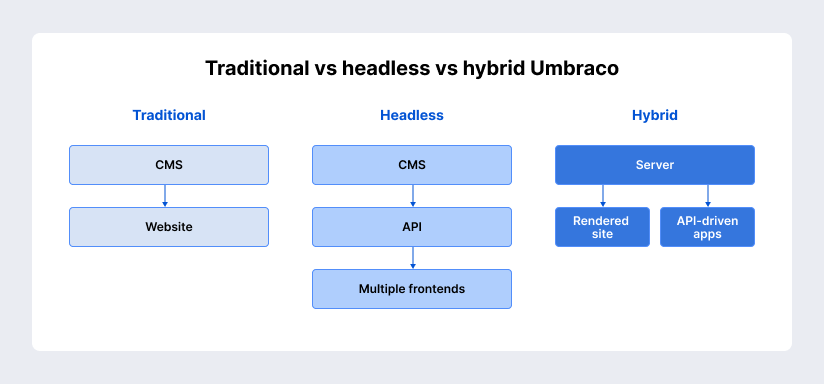
Yes. Umbraco can separate content management from presentation, allowing other websites, applications, devices, or services to retrieve structured material through APIs.
How headless Umbraco works
Editors continue working in the backoffice. A separate frontend — perhaps React, Next.js, Vue, or a mobile application — requests JSON through the Content Delivery API and decides how to display it.
The separation creates freedom, though preview, routing, caching, and authentication may require additional planning.
Omnichannel content delivery
A single entry can feed a website, an app, a kiosk, a partner portal, or an internal display.
Reuse works when fields describe meaning rather than layout. “Product summary” travels well. “Copy under the left-hand image” does not. Good omnichannel publishing begins with good modeling, not with an API.
Hybrid and headless implementation options
Full decoupling is not obligatory. A project can render standard pages on the server while an interactive area or mobile app consumes API data.
This hybrid model preserves familiar CMS behavior where useful and introduces frontend independence only where it earns its keep.
How Can Umbraco Be Extended?
Umbraco can be extended through community packages, official products, plugins, custom modules, APIs, and connections to external platforms.
Umbraco packages and plugins
Packages may add forms, search, redirects, translation tools, property editors, or backoffice utilities.
Before adopting one, check its documentation, licensing, release history, compatibility, and maintainer activity. A package installed in minutes may remain a dependency for years.
Custom functionality and modules
Custom code makes sense when a feature reflects a specific business process. Examples include product selectors, pricing calculators, account dashboards, approval rules, and secure document areas.
Keeping those modules isolated and tested makes the wider application less painful to update later.
Third-party system integrations
External platforms can exchange information through REST APIs, webhooks, queues, scheduled jobs, or file transfers.
The connection is often the easy part. Reliable integration also needs validation, duplicate handling, retries, logging, monitoring, and a practical recovery process when only half a transaction succeeds.
Which Platforms Can Be Integrated with Umbraco?
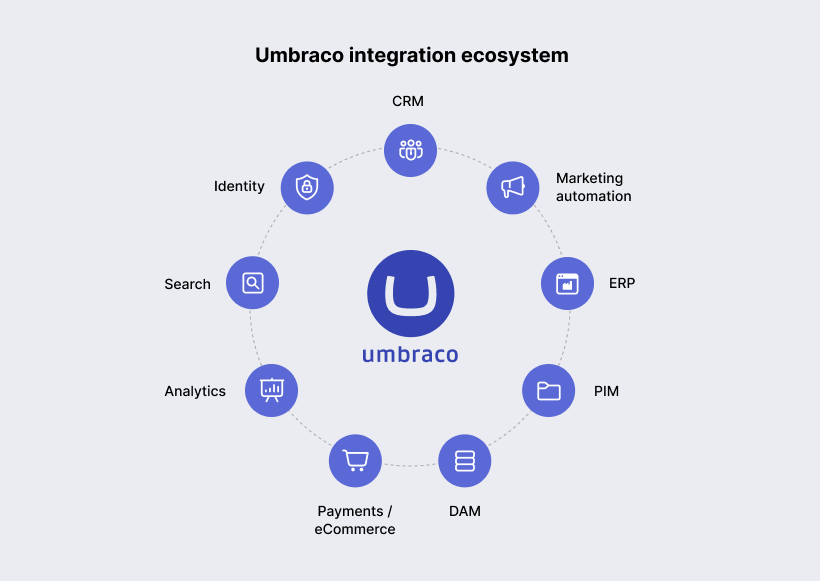
Umbraco can connect to most systems that expose stable APIs or data interfaces. CRM, marketing automation, ERP, PIM, DAM, payment, search, identity, and analytics platforms are common examples.
CRM and marketing automation systems
Forms, account changes, and behavioral events can flow into CRM or marketing tools. Customer details may return to the site for personalization or prefilled fields.
Before exchanging personal data, define the rules for consent, retention, access, and ownership. Technical access alone is not a governance strategy.
ERP, PIM, and DAM platforms
ERP and PIM systems often remain authoritative for prices, inventory, product attributes, and identifiers. A DAM may own original images and usage rights.
Umbraco can consume that data and add editorial context without becoming an accidental second master database.
Payment and ecommerce solutions
Payment gateways, tax services, checkout engines, and order systems can connect through vendor APIs or a dedicated commerce layer.
The official Umbraco Commerce add-on is one option; external platforms are another. Sensitive payment details should remain with compliant providers.
What Are the Benefits of Umbraco for Businesses?
The main benefits are adaptability, structured publishing, Microsoft-stack alignment, extensibility, and control. Their value depends less on the logo than on the quality of the implementation.
Flexibility and customization
Teams control the data models, frontend, permissions, integrations, and editorial experience. The platform can follow real business rules instead of forcing every requirement into a generic template.
Freedom needs boundaries, though. Without conventions and documentation, customization quickly becomes clutter.
Scalability for growing projects
Scalability is not just a traffic question. Growth may bring more brands, markets, languages, products, editors, assets, and connected systems.
Reusable structures, caching, deployment automation, and clear data ownership help the platform expand without needing a redesign every year.
User-friendly editing experience
The backoffice can be shaped around actual editorial work. Clear labels, helpful validation, realistic previews, and restrained permissions reduce mistakes.
This deserves early user testing. Editors will spend years with the administrative interface, long after stakeholders stop admiring the launch-day homepage.
Security and long-term maintainability
The .NET ecosystem supports mature development and deployment practices, but security is never automatic.
Teams must install supported updates, protect credentials, restrict permissions, review dependencies, monitor activity, and test backups. Clean custom code also makes future upgrades less risky.
Active developer community
Umbraco’s community contributes documentation, discussions, packages, bug reports, and code.
That shared knowledge helps developers troubleshoot and avoid rebuilding common features. For a critical platform, community support should complement clear internal or contractual ownership — not replace it.
Umbraco vs Other CMS Platforms
No CMS is best in every setting. The right choice depends on technical skills, editorial needs, customization, budget, governance, and what the organization expects to maintain over several years.
Umbraco vs WordPress
| Area | Umbraco | WordPress |
|---|---|---|
| Main stack | ASP.NET Core and C# | PHP and MySQL-compatible databases |
| Strong point | Tailored .NET solutions | Fast setup and a vast plugin market |
| Typical fit | Integrated sites, portals, and applications | Blogs and standard marketing websites |
WordPress may be faster when a suitable theme and mature plugins already cover the need. Umbraco often fits better when custom models, .NET integration, or substantial application logic sit at the center of the project.
Umbraco vs Drupal
| Area | Umbraco | Drupal |
|---|---|---|
| Main stack | .NET and C# | PHP |
| Strong point | Custom Microsoft-oriented development | Complex structured publishing |
| Typical fit | Tailored business platforms | Multilingual, governance-heavy sites |
Drupal brings mature tools for structured information and granular publishing. In practice, team expertise matters enormously. A strong Drupal group may deliver better results with Drupal; an experienced .NET team may move faster with Umbraco.
Umbraco vs Sitecore
| Area | Umbraco | Sitecore |
|---|---|---|
| Commercial model | Free core with optional paid tools | Enterprise commercial platform |
| Scope | Flexible CMS with connected services | Broader digital experience suite |
| Typical fit | Custom stacks with controlled licensing | Enterprises seeking an integrated DXP |
Sitecore offers a broader commercial portfolio around personalization, customer data, and digital marketing. Umbraco can be leaner when a business prefers specialist tools, although assembling them may demand more integration work.
When Should You Choose Umbraco?
Choose Umbraco when structured publishing, custom .NET development, external integrations, and a tailored editing experience are central requirements — not merely nice additions.
Projects that are a good fit for Umbraco
Good candidates include multilingual corporate sites, customer portals, integrated stores, partner platforms, and content-rich applications.
The fit is particularly natural for organizations already using C#, Azure, Microsoft identity services, or related tools. It also suits teams wary of committing to a single vendor suite.
When another CMS may be more suitable
A small campaign site might be cheaper on a hosted builder. A simple blog may benefit from WordPress themes and plugins. A global marketing operation seeking one integrated commercial suite may prefer a larger DXP.
Requirements should decide. Habit should not.
Streamline your content management and power up your digital marketing with SaM Solutions’ Umbraco services.
How to Get Started with Umbraco
Begin with discovery rather than installation. Map audiences, information types, languages, permissions, integrations, traffic, compliance obligations, and operational ownership before choosing an architecture.
Umbraco Cloud deployment
Umbraco Cloud provides managed infrastructure, deployment tooling, and project environments. Its service uses Microsoft Azure and Cloudflare, reducing some routine hosting work.
Teams should still examine regions, support terms, limits, deployment behavior, and likely costs as usage grows. Managed does not mean decision-free.
Self-hosted Umbraco deployment
Self-hosting gives an organization more control over infrastructure, network design, data location, and release processes.
In return, it owns patching, monitoring, certificates, backups, scaling, databases, incident response, and disaster recovery. That responsibility needs people and procedures, not merely a server.
Choosing an Umbraco development partner
Look beyond attractive portfolio screenshots. A capable partner should understand architecture, migration, integration, testing, DevOps, accessibility, performance, and upgrades.
Ask how the team evaluates packages, documents custom work, transfers knowledge, and supports the platform after launch. Those answers reveal more than a sales demo.
Why Choose SaM Solutions for Umbraco CMS Development?
SaM Solutions combines CMS delivery with broader software engineering. Our Umbraco services include implementation, migration, modernization, custom development, integration, optimization, and ongoing support.
That breadth matters when the public website is only one piece of a larger system. Product records may come from an ERP. Customer accounts may depend on CRM and identity services. A portal might need bespoke application logic.
SaM Solutions can support end-to-end delivery, a dedicated team, or targeted staff augmentation. Explore our Umbraco development services for a new build, migration, or extension of an existing platform.
Conclusion
Umbraco is a flexible open-source CMS for organizations that need structured publishing without surrendering control of the surrounding architecture. It can power a corporate site, portal, store, or API-driven product — and grow across several of those roles.
The platform does not remove the need for good decisions. Content models, integrations, packages, permissions, infrastructure, and upgrade planning still determine whether the project ages gracefully.
Built with care, Umbraco offers room to change without requiring the business to replace its foundation whenever the website grows.
FAQ
Is Umbraco suitable for multilingual websites?
Yes. Umbraco can manage language variants, regional sections, and language-specific user access within one implementation.
A multilingual project still requires decisions on translation workflows, fallback rules, localized URLs, regional approvals, hreflang tags, and SEO. The platform provides the structure; the organization must define the process.
How SEO-friendly is Umbraco?
How much does Umbraco website development cost?
Can an existing website be migrated to Umbraco?