Top 10 AI-Powered Learning Experience Platforms in 2026


(If you prefer video content, please watch the concise video summary of this article below)
Key Facts
- AI-powered LXPs personalize learning at scale. With the help of adaptive algorithms, they analyze learner behavior and dynamically adjust learning paths in real time.
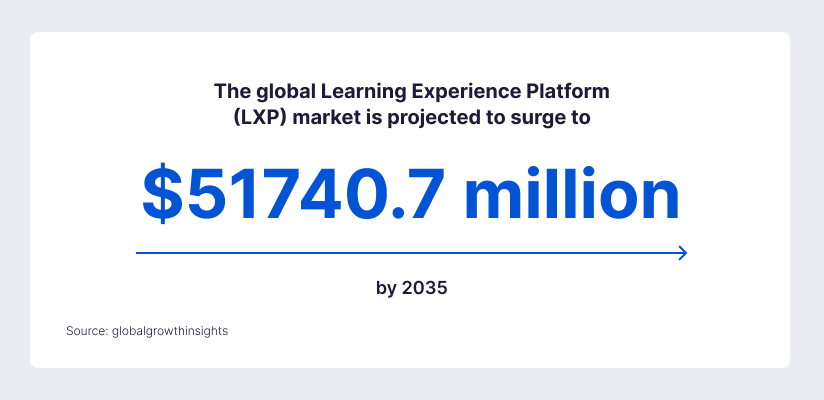
- The LXP market is rapidly expanding. The global Learning Experience Platform market is projected to reach $51,740.7 million by 2035.
- AI increases training efficiency and ROI. Organizations that adopt AI-powered learning platforms report up to higher ROI.
- Modern AI-LXPs go beyond course management. They combine adaptive learning and advanced analytics to support continuous, self-directed learning.
Artificial intelligence (AI) is rapidly transforming how organizations deliver training and development. AI-powered learning experience platforms (LXPs) — advanced successors of traditional Learning Management Systems — are becoming essential for companies to personalize learning at scale and boost workforce skills.
In this post, we’ll explore what AI-powered LXPs are, how they enhance learning experiences, their key benefits and features, the top 10 platforms leading the market in 2026, tips for choosing the right solution, future trends, and why SaM Solutions can help you harness this technology.
Get AI software built for your business by SaM Solutions — and start seeing results.
What Is an AI-Powered Learning Experience Platform?
An AI-powered Learning Experience Platform (LXP) is a next-generation system that uses artificial intelligence to deliver a more personalized, user-centric, and data-driven learning journey. Unlike traditional LMS software that mainly manages and tracks courses, an LXP focuses on continuous, self-directed learning — often curating content from multiple internal and external sources. The global Learning Experience Platform (LXP) market is projected to surge to $51740.7 million by 2035.
AI in learning experience platforms powers this personalization: platforms leverage machine learning algorithms to analyze learners’ profiles, behaviors, and skill gaps and then automatically recommend relevant content or learning paths. In other words, an AI-LXP doesn’t just serve up static courses; it dynamically adapts to each learner.
How Does AI Enhance Learning Experiences?
AI enhances learning experiences in several game-changing ways:
- First and foremost, it is personalization. AI systems can analyze vast amounts of data about a learner — from quiz results to content preferences — and then adjust the path in real time.
- Another huge enhancement is efficiency and speed. AI can automate labor-intensive aspects of L&D, from content creation to administrative tasks.
- AI also enables real-time feedback and adaptive assessment. Intelligent tutors and chatbots can give instant answers to learners’ questions at any hour, or provide on-the-spot hints in an e-module. Instead of waiting for the next coaching session or instructor review, employees get immediate feedback on their performance.
- Modern platforms use AI analytics to monitor metrics like quiz scores, content engagement, and even sentiment — offering instructors real-time dashboards of learner progress (e.g. completion rates, knowledge gaps).
- AI brings data-driven insights that were previously unreachable. Advanced analytics can identify trends across thousands of learners — such as which skills are lacking in the workforce or which content is most effective — enabling evidence-based improvements to training programs.
Key Benefits of AI-Powered Learning Platforms
AI-powered platforms deliver a host of benefits that directly address common training challenges. Let’s look at some of the key advantages:
Perhaps the most celebrated benefit is the ability to offer personalized paths. Traditional training often forces all employees through the same content, which can bore some and overwhelm others. AI fixes this by tailoring the journey to each learner.
AI-powered platforms excel at providing real-time feedback and assessments, which is a game-changer for reinforcement. Instead of waiting for the end of a course or a scheduled test, learners get an instantaneous evaluation of their work.
Thanks to advances in natural language generation and large language models, an AI can now draft lesson outlines, create quiz questions, or even produce entire micro-modules with minimal human input.
AI-powered platforms come with advanced analytics capabilities that provide deep insights into effectiveness and workforce development. These platforms don’t just track completion rates they employ machine learning to find patterns and correlations that would escape a manual review.

Essential Features of AI Learning Platforms
Not all learning platforms are created equal. Truly AI-powered platforms typically offer a set of essential features that enable the benefits we discussed. When evaluating solutions, here are the key AI-driven features to look for:
Adaptive learning algorithms
Adaptive algorithms are the heart of an AI platform’s personalization capability. These algorithms adjust the content and difficulty based on the learner’s performance and interactions. By constantly measuring proficiency and adjusting the journey, adaptive learning creates a truly individualized experience.
AI-driven recommendations
Recommendation engines are a staple of modern digital platforms (think Amazon or YouTube suggestions), and in platforms, AI-driven recommendations play an equally powerful role.
Natural Language Processing (NLP)
Natural Language Processing (NLP) is an AI technology that enables computers to understand and interact with human language. Its common application is AI chatbots or virtual assistants that use NLP to engage in conversational Q&A with learners.
Gamification and engagement tools
To keep learners motivated, many AI platforms incorporate gamification and engagement tools — and AI takes these features to the next level. Gamification means using game-like elements such as points, badges, leaderboards, or challenges in a non-game context like learning.

Top 10 AI-Powered Learning Experience Platforms in 2026
Now let’s look at ten of the leading AI-powered platforms making waves in 2026. These platforms have distinguished themselves by leveraging AI to deliver exceptional learning experiences. We’ll highlight what sets each apart:


Leverage AI to transform your business with custom solutions from SaM Solutions’ expert developers.
How to Choose the Right AI Learning Platform
With so many options on the market, choosing the right AI-powered platform for your organization can be a challenge. Here are some key considerations and criteria to guide your decision:
First, assess the platform’s scalability and performance. Also consider support for global deployment: if you have a distributed workforce, the platform should handle users from different regions without latency issues.
The platform will not operate in isolation — you’ll want it to connect with your HR systems, content repositories, communication tools, and possibly other enterprise systems.
Ensure the platform conforms to standards like WCAG 2.1 for web accessibility so that employees with disabilities (visual, auditory, motor, cognitive impairments) can use it.
Not all “AI-based” platforms do true adaptive learning — some might only do simple recommendations. You want to know if the platform can dynamically adjust content or pathways for each learner.
AI learning platforms can range widely in price — from relatively affordable SaaS licenses to large enterprise contracts — so it’s important to assess what value you’re getting relative to the cost. According to the research, companies that adopt AI-driven learning have reported increase in ROI from their training investments.
Future Trends in AI-Powered Learning
Looking ahead, the future of AI-powered learning is incredibly exciting. We can expect several trends to shape the next generation of experiences:
VR and AR are already playing a key role in training — allowing learners to practice skills in immersive simulated scenarios.
Future platforms will make learning more empathetic: the system responds not just to what you do, but how you feel, making virtual learning more humanized.
As content volumes explode, AI will become even more vital in curating and maintaining resources. These agents might even consider trends (e.g., a surge in interest in a new programming language) and proactively add content about it.
The concept of learning will extend beyond one’s current job. AI is set to power personal career-long companions.
In corporate learning, we’ll likely have AI tutors specialized in different domains. Instead of a generic chatbot, you might have “Sales Coach AI” or “Coding Tutor AI,” fine-tuned on those knowledge bases.
On the less glitzy side, as AI permeates learning, organizations will focus more on the ethical use of AI and the grounding of AI agents.
AI will enhance collaborative learning. It might pair up employees for peer learning based on complementary skills (kind of like a matchmaker), or form AI-moderated study groups that ensure everyone participates.

Why SaM Solutions
Implementing an AI-driven platform or customizing one to your unique needs can be a complex endeavor — and that’s where SaM Solutions comes in. We are a global company with a track record of delivering robust, scalable solutions across industries.
For example, SaM Solutions developed a powerful AI-based educational platform for learning English that significantly streamlined the teaching and learning process, encouraging self-driven learning among students. This is just one case demonstrating our ability to build user-centric, high-performance systems.
We follow the highest standards (GDPR, ISO 27001, etc.) and implement robust security measures, so your learner data and IP are protected at all times — a commitment aligned with our broader enterprise software projects.
Conclusion
AI-powered learning experience platforms are revolutionizing corporate training and skill development. By providing personalized, engaging, and data-driven journeys, these platforms help organizations develop talent more effectively — and help learners reach their full potential.
In 2026, we see that AI is no longer a “nice-to-have” in L&D; it’s become an essential component. AI makes learning proactive, continuous, and tailored, which is a win-win for both organizations and their people.
FAQ