LLM Transformer Architecture: Everything You Need to Know


(If you prefer video content, please watch the concise video summary of this article below)
Large Language Models (LLMs) have made headlines with their human-like text generation, powering AI services from chatbots and virtual assistants to translation tools and content generators. In this article, we’ll find out about the core components of transformer architecture, areas of application, and the future of this technology. Let’s get started!
What Is a Transformer Architecture in LLM?
The Transformer architecture in LLM is the neural network blueprint that defines how a large language model processes and generates text. What is Transformer Architecture in LLM? In an LLM, this architecture is built from layers of self-attention and other components that allow the model to analyze entire sequences (sentences or paragraphs) at once and learn complex language patterns.
Introduced by Google researchers in 2017, the Transformer design replaced earlier sequential models (like RNNs) by enabling much more parallelization and better handling of long-range dependencies in text. It quickly became the foundation for today’s most advanced language models — for instance, well-known systems such as BERT, GPT-3, GPT-4, and many others all rely on the Transformer architecture to achieve their remarkable fluency and understanding. In short, when we talk about an LLM transformer architecture, we mean the core technical structure that makes these AI systems capable of understanding context and producing coherent language.

Core Components of Transformer Architecture
Transformers consist of multiple core parts that work together to turn raw text into meaningful output. These include components for representing the input text as numbers (tokenization and embedding) and an encoder-decoder framework for processing input and producing output. The architecture also relies on attention mechanisms that let the model focus on relevant context, feedforward neural layers that refine information at each step, and special techniques like normalization and residual connections to keep the network stable and efficient during training.
Tokenization and embedding
Transformers start by breaking down text and converting it into a numerical form the model can understand. This happens in two steps: tokenization (splitting text into small units) and embedding (turning those units into vectors).
- Word embeddings: Each token (for example, a word or sub-word piece) is mapped to a vector of numbers known as an embedding. These vectors are learned such that tokens with similar meaning end up with similar numeric representations.
- Positional encoding: Since word embeddings alone don’t contain information about word order, transformers add a positional encoding to each token’s vector to indicate its position in the sequence. This is essentially an extra set of numbers that the model adds to the embedding of the 1st word, 2nd word, 3rd word, etc., in a sentence.
Encoder-decoder structure
Many transformer models use an encoder-decoder structure, which means the model has two main parts: one to read and encode the input, and another to decode (generate) the output.
- Role of encoder: The encoder’s job is to take the input text sequence and convert it into an internal representation that captures the meaning and important features of that input.
- Role of decoder: The decoder uses the encoder’s output (the context vectors) to generate a desired output sequence, one token at a time. At each step of generation, the decoder looks at the encoder’s representation of the input and what it has already generated itself to decide what the next word should be.
Attention mechanisms
The attention mechanism is the key innovation in Transformers that enables them to handle language so effectively.
- Self-attention: In self-attention, each word in the input looks at other words in the same input sequence to gauge their importance. This mechanism allows the model to capture relationships between words, even if those words are far apart in the sentence.
- Multi-head attention: Rather than computing just one set of attention weights, transformers have multiple attention “heads” (imagine running the attention mechanism in parallel several times).
- Masked attention: When a transformer is generating text (for example, the decoder writing a translation or a language model like GPT producing a continuation of a prompt), it uses masked self-attention. Masked attention is a technique that prevents the model from “seeing” future tokens that it hasn’t generated yet. In other words, at any point the model only attends to earlier positions in the sequence, not any positions ahead.
Feedforward neural networks
Within each transformer block, after the attention mechanism, there is a feedforward neural network layer that further processes the data for each token. This component is essentially a tiny multi-layer perceptron (two linear layers with an activation function in between) that transforms the output from the attention sub-layer into a new representation.
Normalization and residual connections
Transformers also use normalization and residual connections to stabilize training and enable very deep networks. These techniques ensure that even extremely large models (with dozens or hundreds of layers) can be trained effectively without issues like vanishing gradients or unstable convergence.

How Transformers Process Language
Transformers process language by converting text into a form the model can analyze, using attention mechanisms to understand context, and then generating output text one step at a time. In essence, they transform an input sequence (like a sentence or document) into an output (like a translated sentence, an answer, or a continuation of the text) through a series of well-defined stages.
Step-by-step input processing
Below is a step-by-step look at how a transformer model handles language input and produces a result.
- Tokenization of input text: Splits the raw text into small units called tokens (such as words or subwords). This creates a sequence of tokens for the model to process.
- Conversion to embeddings: Each token is turned into a numeric vector (embedding) that represents its meaning. These embeddings allow the model to handle text as numbers while preserving basic word relationships.
- Adding positional information: A positional encoding is added to each token’s embedding to indicate its order in the sequence. This helps the transformer understand the word order in the input.
- Passing through encoder layers: The token embeddings (with positional info) are fed through multiple identical encoder layers. Each layer further refines the token representations and deepens the model’s understanding of the text.
- Applying self-attention mechanism: Inside each encoder layer, the self-attention mechanism lets each token look at all the other tokens in the sequence. This helps the model determine which other words are important for each token’s meaning.
- Processing via feedforward networks: After the attention step, each token’s representation goes through a small feed-forward neural network. This network further transforms each token’s data to capture more complex patterns.
- Layer normalization and residual flow: Each layer uses residual (skip) connections and layer normalization to stabilize the learning process. The skip connections carry the input forward to preserve information, and normalization keeps values in a steady range.
- Contextual representation output: After the final layer, the model outputs a set of context-rich vectors for the input tokens. Each output vector encodes its token’s meaning as influenced by all the other words in the sequence.
Contextual understanding via attention
Thanks to the attention mechanism, transformers develop a deep contextual understanding of language. The model doesn’t treat words in isolation; instead, at each layer it looks at how each word (token) relates to every other token in the input. This means the meaning of each word is interpreted in context — for example, the word “bank” will be understood differently in “bank of the river” versus “bank loan” because the surrounding words (“river” in one case, “loan” in the other) signal which sense of “bank” is meant.
Output generation
When it comes to generating text output, the transformer uses its contextual knowledge to produce language one token at a time. The model evaluates the current context (which includes the original input’s encoded representation and anything it has already generated) and predicts a probability distribution for what the next token should be. Typically, the token with the highest probability is selected as the next word (though sometimes a bit of randomness or sampling is introduced to make the output more varied or human-like).
Get AI software built for your business by SaM Solutions — and start seeing results.
Training and Optimizing LLMs
Building a large language model involves a two-step learning process: first pre-training on massive amounts of text to learn general language patterns, and second fine-tuning on specific tasks or domains to specialize the model’s abilities. Given the enormous scale of modern LLMs, training and running them is extremely computationally intensive, so a lot of effort goes into the process optimization. Below, we discuss each phase of training and the challenges involved.
Pre-training: unsupervised learning
In the pre-training phase, an LLM is trained on an extremely large corpus of text (for example, all of Wikipedia, huge collections of books, news articles, and web pages) without any explicit human-provided labels. The model learns by predicting parts of the text, essentially using the text itself as its own teacher. For instance, one common training approach is to have the model predict the next word in a sentence: the model sees “The cat sat on the _” and it has to guess “mat.” If it guesses incorrectly, the model adjusts its internal parameters slightly in the direction of making a better guess next time. By doing this billions of times on diverse text, the model gradually learns the statistics of language — from basic grammar rules to broad facts about the world, idioms, and writing styles.
Fine-tuning: task-specific adaptation
Once the base model is pre-trained, it can be fine-tuned on a smaller, task-specific dataset to specialize it for a particular application. Fine-tuning typically involves supervised learning: the model is given example inputs and the desired outputs (often labeled by humans), and it adjusts its parameters to reduce errors on that task. For example, to fine-tune an LLM for customer support, the training data might consist of sample customer questions and appropriate agent responses; the model is trained further on these such that it learns to produce helpful, correct answers in a customer service context.
Computational challenges
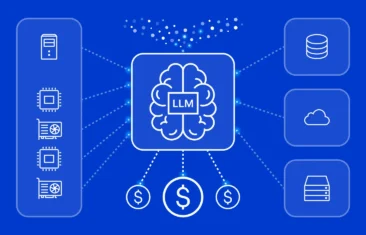
The power of LLMs comes with significant computational challenges. Training a transformer with billions (or tens of billions) of parameters requires immense computing resources. For context, training a state-of-the-art LLM from scratch can take weeks or months on specialized hardware, such as dozens or hundreds of high-end GPUs running in parallel. This kind of computation is extremely expensive – it can cost millions of dollars in electricity and cloud computing time for a single large model training run. The model also requires huge amounts of memory; often the model is too large to fit in the memory of a single GPU, so it must be spread across multiple devices and coordinated carefully.

Applications of Transformer Models
Transformer-based models have dramatically improved a wide range of AI applications. In the realm of natural language processing (NLP), transformers are now the go-to technology for tasks such as translation, text summarization, content generation, and question-answering, often delivering results that were unattainable with previous methods. Beyond text, the transformer approach has also been applied to other fields — including computer vision and audio processing — showing its versatility in handling different types of data. Below are some of the key application areas where transformer models are making an impact:
NLP
- Machine translation: Transformers have revolutionized machine translation by providing more fluent and accurate translations between languages. Using an encoder-decoder structure, a transformer can read a sentence in, say, Spanish (encoding the meaning of that sentence) and then generate its translation in English (decoding).
- Text summarization: Summarization systems powered by transformers can digest a long document or article and produce a concise summary capturing the essential points. This is extremely useful for tackling information overload – for example, summarizing news articles, research papers, or lengthy reports into a few sentences.
Beyond NLP: vision and audio
The transformer architecture has been adapted for image-based tasks in what are called Vision Transformers (ViT) and related models. Instead of words, these models break images into patches (imagine dividing an image into a grid of small sections) and treat those like a sequence of “visual tokens.” Transformers are also increasingly used in audio and speech applications.
Ready to implement AI into your digital strategy? Let SaM Solutions guide your journey.
Future of Transformer Architecture
The transformer architecture is still rapidly evolving. Researchers and engineers are continually finding ways to make transformers more scalable, more efficient, and more trustworthy. Future developments will likely yield models that can handle even more data (and longer inputs) with less computational cost, while also addressing important challenges around ethical use and interpretability. Here are some trends and considerations shaping the future of LLM Transformer architecture explained:
Scalability and efficiency improvements
One major focus is making transformers scale up (and out) more efficiently. Scalability here means two things: enabling models to have more parameters or handle longer text, and doing so without an explosion in required resources. Although current top-tier LLMs are incredibly large, there is ongoing work to push these limits in a cost-effective way. For instance, new variations of the attention mechanism are being developed to better handle very long sequences of text (tens of thousands of tokens or more) without the computation growing prohibitively slow or expensive. Techniques like sparse attention or efficient attention approximate the full attention calculation, allowing the model to focus only on the most relevant parts of very long texts. This could let future LLMs process entire books or lengthy documents in one go, opening up use cases like comprehensive legal document analysis or long-form content generation with full context.
Ethical and interpretability challenges
As LLMs become more powerful and widely used, ensuring they are ethical, fair, and interpretable becomes paramount. One challenge is that these models can inadvertently learn biases present in their training data. If the texts the model learned from contain stereotypes or unfair representations of certain groups, the model might reflect or even amplify those in its outputs. This raises concerns about fairness – for example, would an LLM-based hiring tool accidentally favor or disfavor candidates based on gender or ethnicity, simply due to patterns in its training data? Mitigating these biases is a crucial area of future work: it involves techniques like curating the training data to be more balanced, fine-tuning models with explicit bias reduction in mind, or applying post-processing filters to the model’s outputs.
What Does SaM Solutions Offer?
SaM Solutions provides businesses with the infrastructure and expertise to leverage transformer-based LLM technology cost-effectively. Deploying large language models in-house is often prohibitively expensive due to the need for powerful hardware and specialized teams. To address this, SaM Solutions delivers solutions based on open-source LLMs that can be deployed within the client’s own infrastructure.
A key component of our offering is data privacy and compliance. Unlike public AI APIs, SaM’s deployments allow all data to remain encrypted and isolated in the client’s environment — whether on-premises or in a private cloud. We adhere to strict security standards and privacy regulations, ensuring that sensitive content such as internal documents or customer data is protected. This empowers companies to use advanced LLMs for document analysis, automated communication, or intelligent search — without compromising confidentiality or regulatory compliance.


Conclusion
Transformer architecture has become the engine behind the most advanced language AI systems, fundamentally changing what software can do with human language. We’ve seen that by using mechanisms like self-attention, these models can grasp context and produce remarkably coherent text, enabling applications from fluent machine translation to insightful document analysis. For businesses, the rise of LLMs powered by transformers means access to tools that can automate customer communication, sift through large volumes of text for insights, and support decision-making in ways not possible before. As the technology continues to improve — with models becoming more efficient and with more safety guardrails built-in — understanding the Transformer architecture isn’t just a technical detail; it’s key to unlocking how AI can truly transform an organization. With the right strategy and partners in place, leveraging LLMs can be a feasible, secure, and highly rewarding endeavor for companies ready to embrace this new era of AI.
FAQ