Umbraco Headless CMS: A Complete Guide to Modern Digital Experiences


(Prefer videos? Watch a brief summary of this article below.)
Key Facts
- Umbraco CMS supports headless and hybrid delivery via its Content Delivery API; Umbraco Heartcore is the vendor’s dedicated headless SaaS.
- The open-source platform runs on ASP.NET Core and C# and can be hosted on an organization’s infrastructure or in the cloud.
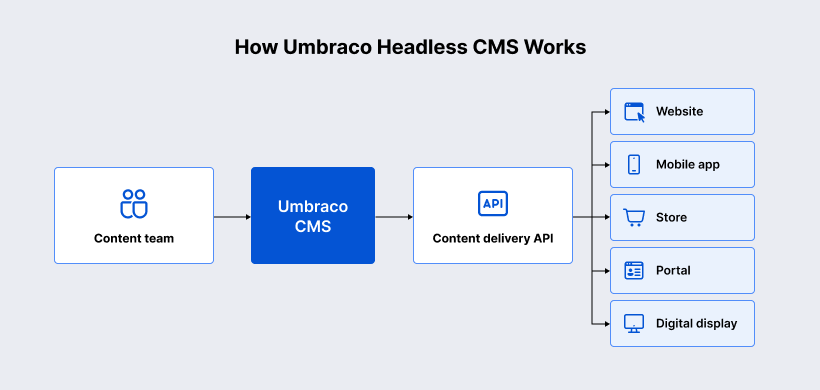
- A headless setup separates editorial management from presentation, allowing the same structured material to serve websites, apps, portals, and other channels through APIs.
- The model adds frontend freedom and reuse, but teams must own more of the work on preview, caching, testing, routing, and integration.
Umbraco can serve as a central editorial system across multiple digital touchpoints, with editors working in a single backoffice while developers control each presentation layer. Because the CMS supports traditional, headless, and hybrid approaches, teams can choose the delivery model per project.
What Is Umbraco Headless CMS?
Umbraco headless CMS is an implementation in which Umbraco manages structured content, media, permissions, and publishing, while a separate frontend retrieves data via an API. The open-source CMS uses the Content Delivery API for this model. At the same time, Heartcore offers a managed API-first service that lets teams change presentation technology without rebuilding the editorial repository.
How headless architecture works
Headless architecture keeps the backend focused on authoring and governance, treating presentation as an independent application concern. A React website, native app, portal, or display can consume the same entries and render them differently. That freedom is valuable when channels evolve at different paces, although the delivery layer then requires its own routing, preview, caching, and release strategy.
How Umbraco delivers content through APIs
The platform exposes published material via APIs, enabling external clients to query it without relying on CMS-rendered templates. The Content Delivery API supports published items, field selection, expansion, preview access, and localized responses; preview data requires authorization. Heartcore adds managed REST endpoints, GraphQL, a Preview API, and a Content Management API.
Why Should Businesses Choose a Headless CMS?
Businesses should choose a headless approach when a single managed source must serve multiple independently developed experiences across web, mobile, commerce, partner, and in-store channels. Reuse can simplify omnichannel publishing, provided the organization accepts the extra engineering required around delivery.
| Benefit | Business value | Practical effect |
|---|---|---|
| Frontend freedom | Technology can match the use case | Web and mobile teams can use different stacks |
| Multi-channel reuse | Shared information is maintained once | One update can reach several touchpoints |
| Independent releases | Presentation can evolve separately | UI changes need not alter the CMS |
| Integration flexibility | The CMS fits a wider platform | Commerce, CRM, search, and personalization can connect through APIs |
| Scalability options | Delivery can be tuned independently | CDN, caching, SSR, or static generation can match traffic patterns |
| Longer content life | Structure survives redesigns | Existing models can feed a new frontend |
How Does Umbraco Headless CMS Compare with Traditional CMS Platforms?
Traditional Umbraco renders pages inside the same application, keeping preview, templates, and routing together; headless Umbraco returns structured data to an external application. Traditional delivery is often simpler for a single website, while headless delivery becomes more useful as channel count and frontend specialization grow.
| Area | Traditional Umbraco | Headless Umbraco |
|---|---|---|
| Presentation | CMS-side templates | Separate application |
| Delivery | Rendered page response | Structured API response |
| Frontend stack | Usually aligned with .NET | Any client able to consume the API |
| Preview | Naturally tied to the site | Must be connected to the external frontend |
| Omnichannel use | Possible, but web-centric | Built around reuse across channels |
| Deployment | Fewer moving parts | CMS and clients can ship independently |
| Complexity | Lower for conventional sites | Higher due to API, caching, and integration concerns |
| Best fit | Primarily website-led experiences | Multi-experience platforms |
Which Features Make Umbraco Headless CMS Suitable for Enterprise Projects?
Enterprise value comes from combining editorial control with an extensible .NET backend and independent delivery applications. The CMS provides authoring, preview, scheduled publishing, version control, permissions, APIs, and headless or hybrid delivery; the surrounding architecture determines how well those capabilities meet enterprise requirements.
Content modeling
Content modeling gives teams predictable structures instead of storing every page as loosely organized markup. Document types and reusable components can represent products, articles, locations, campaigns, or regulatory notices with consistent fields. In a headless system, that discipline matters because the schema becomes the contract between editors and every consuming frontend.
API-first content delivery
API-first content delivery lets clients request structured data and decide how to render it. The open-source CMS provides the Content Delivery API, while Heartcore offers managed REST and GraphQL interfaces plus CDN-backed delivery. Teams seeking code-level control may prefer the open CMS; teams prioritizing managed headless infrastructure may prefer Heartcore.
Multi-channel publishing
Multi-channel publishing works when editors create channel-neutral information, and each client adapts it to its format. A product description or help article can feed a website, app, portal, and display without four editorial copies. The CMS supports multilingual, multichannel delivery to websites, mobile apps, IoT devices, and other frontends.
Security and permissions
Security must protect both editorial access and the API boundary. Backoffice roles should restrict who can edit or publish sensitive material, while frontend applications should avoid exposing management credentials and protect preview paths. Umbraco requires an API key for unpublished Delivery API preview data, demonstrating that authorization belongs in the solution design from the outset.
Scalability and performance
Scalability improves when editorial processing and audience delivery can be optimized separately. Frontends may use CDN caching, static generation, server-side rendering, edge caching, or application caches without changing how editors work. Umbraco Cloud offers CDN and scaling features, while Heartcore includes Cloudflare-backed delivery for material and media.
Streamline your content management and power up your digital marketing with SaM Solutions’ Umbraco services.
Which Technologies Integrate with Umbraco Headless CMS?
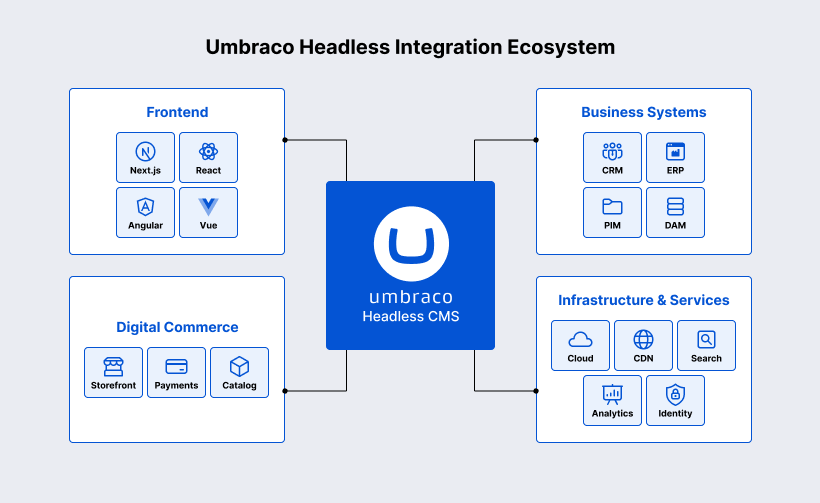
Headless Umbraco is meant to sit inside a broader application landscape. Its API-driven approach and open .NET foundation let teams connect presentation frameworks, cloud services, commerce, CRM, search, analytics, and other systems without pushing every responsibility into the CMS.
Front-end frameworks
Frontend teams can use Next.js, React, Angular, Vue, SvelteKit, or other web technologies because clients consume structured responses rather than CMS-specific templates. Native mobile applications and specialized devices can follow the same pattern. The framework choice should therefore reflect rendering strategy, developer skills, SEO needs, and performance targets rather than a limitation imposed by Umbraco.
Cloud services
Cloud services can provide hosting, caching, search, monitoring, queues, serverless functions, and identity around the CMS. The CMS can run on self-managed infrastructure or in cloud environments, while the managed Cloud service adds Azure hosting, deployment workflows, updates, database services, security features, and CDN capabilities. Architects can therefore choose how much operational responsibility to keep.
Commerce and CRM platforms
Commerce and CRM platforms should usually remain systems of record for their own domains. Pricing, inventory, and orders can stay in commerce or ERP, customer state in CRM, and editorial stories in Umbraco; APIs or middleware combine them for the final experience. This separation keeps ownership clear and supports personalization without copying fast-changing business data into the editorial repository.
How Is an Umbraco Headless CMS Solution Implemented?
A reliable implementation begins with boundaries and data contracts: teams should decide what Umbraco owns, which systems remain authoritative elsewhere, and how clients handle APIs, preview, localization, caching, search, and failures. Those choices prevent the solution from becoming a loose collection of endpoints.
Planning and architecture
Planning maps user journeys to systems, channels, and owners before document types are created. Architects define the backend topology, schemas, API exposure, integration flows, identity boundaries, caching, environments, and deployment pipeline, then test them against real traffic and editorial scenarios. A prototype around the hardest journey often exposes risky assumptions early.
Content migration
Content migration should convert legacy pages into reusable structures rather than copy old markup into a new container. Teams inventory sources, remove duplicates, map fields to the new model, preserve identifiers and SEO metadata where required, and automate repeatable imports for larger estates. Good migration produces reusable information; poor migration simply recreates the old site in a newer backend.
Development and testing
Development should treat the schema and API response as a versioned contract. Automated tests can cover mappings, endpoints, authorization, localization, and integration logic, while frontend tests cover rendering, accessibility, routing, and fallback states. Performance tests should include uncached paths as well as normal cached traffic, because aggressive caching can hide inefficient requests until invalidation or load spikes occur.
Deployment and optimization
Deployment should separate application code, configuration, and editorial data so each can move safely through environments. CI/CD, observability, cache rules, rollback procedures, and post-release checks reduce the risk created by independently shipped components. Optimization should then follow evidence from API latency, frontend metrics, cache hit rates, errors, and editorial bottlenecks.
Request SaM Solutions’ Umbraco implementation to speed up and optimize your content management workflows.
Which Industries Benefit Most from Umbraco Headless CMS?
Headless Umbraco is most useful for organizations that reuse substantial editorial content across multiple digital experiences, such as ecommerce, healthcare, financial businesses, and manufacturers. The strongest signal is usually a combination of multiple channels, complex integration, structured information, and long-lived products rather than the industry name alone.


What Challenges Should You Consider Before Adopting Umbraco Headless CMS?
The main challenge is operational complexity: teams must explicitly manage API consumption, frontend hosting, preview, caching, monitoring, integration testing, and cross-application releases. Headless is worthwhile when that added responsibility solves a real multi-channel or product need.
Development complexity
Development becomes more distributed because the CMS and consuming applications can have different repositories, runtimes, dependencies, and release schedules. A schema change may affect several clients, and a single API failure can surface differently across channels. Contract tests, clear deprecation rules, and disciplined schema governance keep that flexibility manageable.
Content governance
Content governance becomes harder when the same entry appears in contexts that an editor cannot see in one page preview. Teams need clear field names, validation, component guidance, useful preview paths, and ownership rules for shared material. Good governance lets editors publish confidently without having to learn the implementation details of every consuming application.
Maintenance considerations
Maintenance covers more than the CMS. Teams must plan CMS and .NET upgrades, frontend dependencies, API compatibility, search indexes, CDN rules, security patches, observability, and integration changes. The model stays maintainable when each component has an owner and upgrade path; otherwise, flexibility gradually turns into operational debt.
Why Choose SaM Solutions for Umbraco Headless CMS Development?
SaM Solutions can support a headless Umbraco initiative across architecture, .NET backend engineering, frontend development, API integration, migration, testing, cloud deployment, and optimization. That breadth matters because difficult problems often sit between layers, so a delivery partner should integrate editorial, application, data, and operational concerns into one maintainable implementation.
Conclusion
Umbraco provides a practical path to headless delivery without forcing every project into one architecture. The open-source CMS includes headless and hybrid capabilities via the Content Delivery API, while Heartcore serves teams wanting managed REST and GraphQL services, preview, and CDN.
The deciding question is whether headless Umbraco solves a concrete delivery problem. It fits well when several frontends need the same structured material, independent release cycles matter, or CMS, commerce, CRM, and other services must work as a composable platform. Yet, for one conventional website, traditional or hybrid delivery may reach the same business goal with less engineering overhead.
FAQ
Is Umbraco a headless CMS?
Yes. Is Umbraco a headless CMS in every deployment? No: the open CMS supports traditional, hybrid, and headless modes through its Content Delivery API, while Heartcore is the dedicated headless SaaS. Teams can therefore choose the delivery style that matches their architecture rather than adopting headless by default.
What licensing options are available for Umbraco Headless CMS?
Can Umbraco Headless CMS be hosted on-premises?
Does Umbraco Headless CMS support multilingual editorial teams?