Sitecore XP 10.5 Release


Key Takeaways
- Sitecore XP 10.5 is primarily a stability and longevity release. It brings the platform onto a newer technology baseline, strengthens security, and extends the support horizon.
- Businesses planning to remain on Platform DXP should consider upgrading, particularly if they use XP 10.0–10.3 or rely on aging infrastructure.
- The move requires coordinated planning because Solr 10 is mandatory and connected modules, customizations, and hosting environments may also need updates.
- Sitecore’s roadmap protects existing investments while introducing modern editing, headless, AI, workflow, and publishing capabilities in stages.
Sitecore XP 10.5 is a long-term platform release focused on security, reliability, compatibility, and easier modernization rather than a large set of new marketing features. For organizations that intend to keep using Sitecore’s deployable Platform DXP, it offers a more sustainable foundation for the years ahead.
The release became generally available on August 5, 2026. In a recent webinar, Principal Product Manager Colin te Kempel explained how Sitecore plans to innovate without forcing customers to abandon mature websites, integrations, and content operations.
This makes 10.5 more than a maintenance update. It also signals how Sitecore expects Platform DXP to develop alongside its newer cloud and AI products.
A Brief History of Sitecore XP Updates
Sitecore XP 10.x has evolved from deployment and developer improvements toward stronger security, API-based integration, and gradual modernization. Version 10.5 consolidates that work and prepares the platform for a more modular release model.
| Release | Date | Main direction |
| 10.0 | August 2020 | Improved cloud and container deployment and introduced modern tools for development teams. |
| 10.1 | February 2021 | Made upgrades easier and improved the scalability and efficiency of data operations. |
| 10.2 | November 2021 | Continued operational improvements and expanded tools for managing customer data. |
| 10.3 | December 2022 | Strengthened API-first integration and support for headless digital experiences. |
| 10.4 | April 2024 | Prioritized security, accessibility, performance, and interoperability with Sitecore’s SaaS portfolio. |
| 10.5 | August 2026 | Updated the technology baseline, added a longer support runway, and laid the groundwork for gradual platform modernization. |
Sitecore also delivered hotfixes, security updates, modules, and smaller platform releases between 10.4 and 10.5. For customers, this points to a future in which improvements arrive more frequently instead of being held for occasional major upgrades.
Regardless of the Sitecore version you currently use, SaM Solutions guarantee a fast and secure upgrade to the newer version of your choice.
What’s New in Sitecore XP 10.5?
Sitecore XP 10.5 updates the supported infrastructure, improves security and reliability, and refreshes the authoring interface. The most important upgrade requirement is the move to Solr 10, which makes 10.5 a planned project rather than a routine patch.
| Area | What changes | Why it matters to the business |
| Infrastructure | XP 10.5 runs on .NET Framework 4.8.1 and supports Windows Server 2025 and SQL Server 2025. It no longer supports older options, including SQL Server 2019. | Organizations gain a current, supported foundation but may need to coordinate the Sitecore upgrade with wider infrastructure renewal. |
| Search | Sitecore XP 10.5 requires Solr 10; Solr 8 and 9 are not supported. | Search migration can affect project scope, testing effort, and downtime planning — especially in highly customized implementations. |
| Security | The release addresses critical vulnerabilities and makes several administrative and integration features safer by default. | A stronger baseline can reduce exposure and simplify compliance, although established processes may need adjustment. |
| Authoring | Content Editor and Experience Editor receive updated styling, typography, and accessibility improvements without changing familiar workflows. | Marketing teams benefit from a cleaner interface with limited retraining or disruption. |
| Performance and reliability | Sitecore has improved multisite rendering, publishing, indexing, caching, and other high-volume operations. | Large estates should see a more stable platform and fewer operational bottlenecks. |
| Platform services | Identity Server 9 is delivered as a separate module, and other modules continue to follow their own release schedules. | Businesses must verify compatibility across the whole Sitecore environment, not only the core platform. |
The release notes list many smaller fixes. From a management perspective, their combined value matters more than any individual change: fewer outdated dependencies, better security defaults, and a platform designed to remain supportable longer.
There are still upgrade risks. Changes to search, security behavior, monitoring, deployment tools, and custom extensions can affect existing solutions. Technical teams should map official breaking changes to the current implementation and confirm module compatibility before setting the project schedule.
Should I Upgrade My Sitecore XP to 10.5?
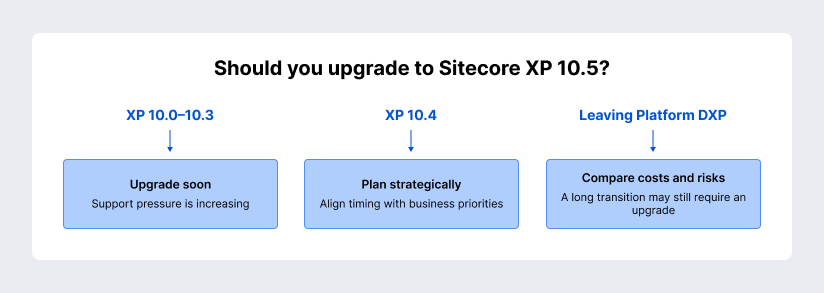
You should seriously consider upgrading if Sitecore XP will remain a strategic platform for the next several years or if your current version is approaching the end of support. Organizations running a stable XP 10.4 environment have more flexibility, but they should still include 10.5 in their medium-term roadmap.
The support lifecycle is a strong reason to act. XP 10.5 has mainstream support through December 31, 2029, extended support through 2032, and sustaining support through 2034; extended support for XP 10.0 and 10.1 ends on December 31, 2026.
| Current situation | Recommended approach |
| Running XP 10.0–10.3 | Prioritize an upgrade assessment. The support, security, and infrastructure benefits are likely to justify moving. |
| Running a stable XP 10.4 implementation | Plan the upgrade around infrastructure cycles, business priorities, and module availability rather than treating it as an emergency. |
| Maintaining a heavily customized solution | Allow extra time for discovery and regression testing. Custom search, integrations, and deployment processes may drive the cost. |
| Planning to leave Platform DXP | Compare the cost of upgrading with the migration’s duration and risk. A multiyear transformation may still require a supported source platform. |
Before approving the investment, decision-makers should ask five questions:
- How long will the organization continue using Platform DXP?
- Which parts of the infrastructure must be upgraded at the same time?
- Are all business-critical modules and integrations compatible?
- How much custom code and technical debt will need remediation?
- What level of testing, downtime, and rollback protection does the business require?
The assessment should produce a clear scope, budget, schedule, and risk profile. A generic recommendation to “stay current” is not enough for a complex enterprise estate.
What’s the Future of Sitecore XP?
Sitecore plans to keep investing in Platform DXP while modernizing it in stages rather than replacing it with one disruptive release. Existing websites and business processes can remain in place as customers adopt new editing, delivery, integration, and AI capabilities when they are ready.
The roadmap also points toward a modern .NET host for headless services so customers can eventually remove .NET Framework from that part of the stack.
The webinar highlighted a few areas of future development:
- A modern editing experience. Sitecore is developing a responsive editor that combines page and content editing, brings workflow actions into context, and integrates Sitecore Stream. It is expected to coexist with the current editors during the transition.
- Protection for existing websites. Many established Sitecore implementations use the Model–View–Controller (MVC) architecture. Sitecore intends to continue supporting these websites by maintaining a dedicated .NET Framework Content Delivery server, avoiding a compulsory rebuild to stay on the platform.
- A clearer path to headless. Headless delivery separates content management from the customer-facing application. New services on a modern .NET host will make it easier to adopt this model for selected websites or projects while retaining other parts of the existing estate.
- Modernized platform functions. Launchpad, Forms, APIs, workflow, and publishing are all on the roadmap. A unified publishing model is intended to support traditional delivery and Experience Edge without requiring a complete rearchitecture.
- AI-assisted content operations. Sitecore Stream already brings AI capabilities to Platform DXP. Model Context Protocol (MCP), a standard that lets AI assistants use approved tools and data, could also support conversational, goal-based actions through the proposed XM Marketer MCP — with human review retained.
Sitecore is following a gradual replacement model: introduce new capabilities alongside established ones, and customers decide when to adopt or retire each part. This approach lowers migration risk and allows modernization spending to follow business value instead of a vendor-imposed deadline.
For leaders, the roadmap has four practical implications:
- Keep the platform and its modules reasonably current.
- Reduce deep customizations that make every upgrade expensive.
- Strengthen automated deployment and testing for more frequent releases.
- Consider headless delivery for meaningful new initiatives, even if existing MVC sites remain in operation.
Roadmap items are not commitments or features included in XP 10.5. They do, however, show that Sitecore sees Platform DXP as an evolving product rather than a legacy system awaiting replacement.
Summing Up
Sitecore XP 10.5 gives existing customers a more secure, stable, and longer-supported foundation while preserving their current websites and authoring processes. For businesses that expect to use Platform DXP beyond the next few years, an upgrade assessment is a prudent step.
The decision should be based on support deadlines, infrastructure readiness, customization, module compatibility, and the organization’s broader modernization plans. With the right preparation, 10.5 can reduce operational risk today and create more options for headless delivery, AI-assisted work, and gradual platform renewal tomorrow.
SaM Solutions’ Sitecore team can assess your current environment, identify business and technical risks, and build a practical upgrade or modernization roadmap — from initial planning through implementation, testing, and support.