Umbraco vs Sitecore: Which CMS Is Better for Your Business?


(Prefer videos? Watch a summary of this article below.)
Key Facts
- Umbraco is an open-source .NET CMS with a free core and paid Cloud/Commerce tiers, built around simplicity and developer freedom.
- Sitecore is an enterprise DXP bundling CMS, personalization, analytics, and commerce into one licensed platform for large, complex organizations.
- Both run on .NET, support headless delivery, and scale to multisite, multilingual deployments — the split shows up in cost, governance, and built-in marketing automation.
- Umbraco suits mid-market teams, agencies, and B2B sites that want fast time-to-value and low total cost of ownership.
- Sitecore fits enterprises running personalization-heavy, high-traffic, multi-brand experiences where licensing spend buys built-in capability instead of custom integration work.
Ask five .NET developers to compare Umbraco and Sitecore, and you’ll get five different answers depending on which project shaped them most. That’s because the Umbraco vs Sitecore decision isn’t really about which CMS is “better” — it’s about which one matches the size, budget, and ambition of what you’re building. A five-person marketing team launching a corporate website and a 400-person enterprise running personalized commerce across twelve markets have almost nothing in common operationally. Yet both get pointed at the same two platforms because both happen to run on .NET.
This guide breaks down the Sitecore vs Umbraco question from the angle that actually matters to a business owner or IT director: not feature checklists, but fit. We’ll walk through what each platform is, where they genuinely overlap, where the Umbraco and Sitecore difference becomes a real constraint or a real advantage, and which one to choose depending on whether you’re running ecommerce, B2B lead generation, an enterprise portfolio of sites, or a marketing-led content operation.
If you’re weighing a migration between the two, we’ve also covered the scenarios and risks worth planning for before you commit.
What Is Umbraco?
Umbraco is an open-source content management system built on ASP.NET and .NET Core, first released in 2005 by Danish developer Niels Hartvig. It’s licensed under MIT, which means the core CMS — Umbraco CMS, sometimes called “Umbraco Community” — is free to download, self-host, and modify. Around that free core, Umbraco HQ sells commercial add-ons: Umbraco Cloud for managed hosting and deployment pipelines, Umbraco Commerce for online stores, Umbraco Forms, and Umbraco Workflow for approval processes.
The philosophy is developer-first and editor-friendly. Content structuring uses “Document Types” that a developer defines once, after which editors work inside a clean, tree-based backoffice without touching code. Because it’s a .NET application, it plugs neatly into existing Microsoft environments — Azure, SQL Server, Active Directory — and any C# developer can pick it up without learning a proprietary framework from scratch.
Umbraco also ships with a genuinely open architecture: no forced hosting provider, no licensing meter counting page views, and community packages covering everything from SEO tooling to headless delivery via its Content Delivery API.
What Is Sitecore?
Sitecore is a commercial digital experience platform (DXP) headquartered in the US, built on the .NET stack and first launched in 2001. Where Umbraco is a CMS with modules bolted around it, Sitecore is architected the other way: a suite — Sitecore XM Cloud or XP for content management, Sitecore CDP for customer data, Sitecore Personalize for real-time experience targeting, Sitecore Send for email, and Sitecore OrderCloud for commerce — sold as an integrated, licensed whole.
That breadth is the point. Sitecore targets organizations that need to unify content, customer data, and personalization logic across dozens of sites, brands, or regions, then act on that data without stitching together five separate vendors. The trade-off is complexity and cost: implementing Sitecore properly usually means a specialized systems integrator, a multi-month rollout, and an annual license fee that scales with traffic, sessions, or contact volume, plus infrastructure hosted on Sitecore’s cloud or your own Azure tenancy.
Editors get a rich, marketing-oriented interface with built-in A/B testing and behavioral personalization; developers work inside a more opinionated, layered architecture that rewards experience with Sitecore-specific patterns like the Helix framework.
Umbraco vs Sitecore: Core Similarities
Before the differences, it’s worth noting the common ground that puts both platforms on the same shortlist.
| Similarity | Umbraco | Sitecore |
| Runtime | ASP.NET / .NET Core | ASP.NET / .NET Core |
| Deployment | Self-hosted, Azure, or Umbraco Cloud | Azure, private cloud, or Sitecore-managed cloud |
| Headless delivery | Content Delivery API | GraphQL/REST, JSS/Next.js |
| Editor experience | Tree-based backoffice | In-context Experience Editor |
| Multisite support | Native multi-tree, multi-domain | Native multi-site, multi-tenant |
| Extensibility | Open community packages | Marketplace and partner modules |
Microsoft .NET ecosystem
Both platforms live inside the Microsoft world, which is the single biggest reason enterprises with a .NET investment default to comparing these two rather than pulling in a PHP or Node-based CMS. Your existing C# developers, Azure DevOps pipelines, and Active Directory identity setup transfer with minimal friction. It also means both platforms benefit — and occasionally suffer — from the same .NET release cadence, IIS quirks, and SQL Server dependency patterns.
Custom website development
Neither is a drag-and-drop SaaS builder in the Wix sense. Both expect a developer to define the content architecture, templates, and integrations before an editor ever touches the backoffice. That’s a deliberate trade: less out-of-the-box speed than a no-code tool, but far more control over performance, data structure, and how the site behaves at scale.
Content management for marketing teams
Once the developer groundwork is done, both platforms give marketing teams a genuinely usable editing experience — structured fields instead of raw HTML, content previews, versioning, and scheduled publishing. On either platform, marketing teams can update copy, swap images, and launch landing pages without opening a ticket with IT for routine changes.
Multilingual and multisite projects
Running a UK site, a German site, and a US site from one installation is standard practice on both. Umbraco handles this through language variants tied to content nodes; Sitecore does it through its site and language configuration layered across its content tree. Both avoid the common CMS trap of needing a separate installation per market.
Third-party integrations
CRM systems, marketing automation platforms, payment gateways, analytics suites — both platforms are built to connect outward rather than trap you inside a closed system. Umbraco leans on its open package ecosystem and standard .NET connectors; Sitecore leans on its partner marketplace and a longer history of enterprise integration patterns with tools like Salesforce and Dynamics.
Scalable digital experiences
Given the right architecture and hosting, both platforms can serve high-traffic, multi-region deployments. Umbraco does this through horizontal scaling on Azure App Service or Kubernetes; Sitecore does it through its own cloud infrastructure and content delivery layer, typically with a bigger budget attached to reach the same throughput.
Umbraco vs Sitecore: Key Differences
This is where the differences between Umbraco and Sitecore shape a buying decision.
| Dimension | Umbraco | Sitecore |
| Platform type | Open-source CMS, commercial add-ons | Commercial, all-in-one DXP |
| License cost | Free core; Cloud/Commerce from hundreds/month | Enterprise licensing, five to six figures annually |
| Personalization | Basic segmentation | Real-time behavioral, native |
| Analytics | External tools (GA4, etc.) | Native dashboards |
| Ecommerce | Umbraco Commerce module | OrderCloud commerce engine |
| Implementation time | Weeks to a few months | Several months to over a year |
| Best-fit team size | SMB to mid-market | Mid-market to enterprise |
Platform type and market positioning
Umbraco positions itself as a flexible, developer-friendly CMS — content management first, with everything else added as needed. Sitecore positions itself as a full DXP where content is just one module among customer data, personalization, and commerce. That single distinction cascades into almost every other row above: Sitecore charges and architects for the whole suite whether you use all of it or not, while Umbraco lets you pay only for what you add.
Technology stack and development approach
Umbraco feels close to plain ASP.NET MVC — Razor views, standard controllers. Sitecore adds more layers — rendering variants, item-based modeling, JSS/Next.js for headless — and its developers are scarcer and pricier to hire.
Content editing experience
Umbraco’s backoffice is famously clean — a left-hand content tree, a properties panel, and not much else to learn. Sitecore’s Experience Editor is more visual, letting marketers click directly on a live page to edit components. But that visual layer adds configuration overhead for developers and a steeper learning curve for new editors.
Scalability and performance
Umbraco scales like any well-built .NET app: load balancing, caching, a properly sized database. Sitecore’s role-based architecture (separate Content Management, Delivery, and Processing instances) handles enterprise traffic well but needs more DevOps investment upfront.
Personalization and marketing automation
This is Sitecore’s headline differentiator. Sitecore Personalize can trigger real-time content changes based on visitor behavior, segment, or predictive scoring, all inside the platform. Umbraco’s native personalization is comparatively basic — audience targeting through content variants — though third-party tools can close much of the gap for teams that don’t need Sitecore’s full behavioral engine.
Analytics and reporting
Sitecore tracks journeys and conversions in native dashboards. Umbraco assumes you’ll bring GA4 or a BI tool, keeping the CMS lighter but analytics external.
SEO capabilities
Both support clean URLs, structured data, and caching. Umbraco’s lighter markup often loads faster by default; Sitecore can match it but needs deliberate architecture to avoid overhead.
Ecommerce functionality
Umbraco Commerce suits mid-sized stores well. OrderCloud is a dedicated, API-first engine for complex B2B/B2C catalogs at enterprise scale and cost.
Third-party integrations
Umbraco leans on a free, active package community. Sitecore leans on certified partner connectors and its own suite — powerful inside its ecosystem, less flexible outside it.
Security and compliance
Both support RBAC, SSO, and encryption. Sitecore’s licensing typically bundles more formal compliance documentation and SLAs; Umbraco compliance work falls more on the implementation partner.
Multilingual and multisite management
Umbraco manages languages at the content-node level, so you need to plan for them as they scale. Sitecore’s multi-tenant architecture is purpose-built for many sites and languages, but it requires a heavier setup cost.
Hosting, cloud, and deployment options
Umbraco offers real choice: self-host, any Azure tier, or Umbraco Cloud. Sitecore increasingly pushes toward its own managed XM Cloud, simplifying ops but increasing lock-in.
Pricing and total cost of ownership
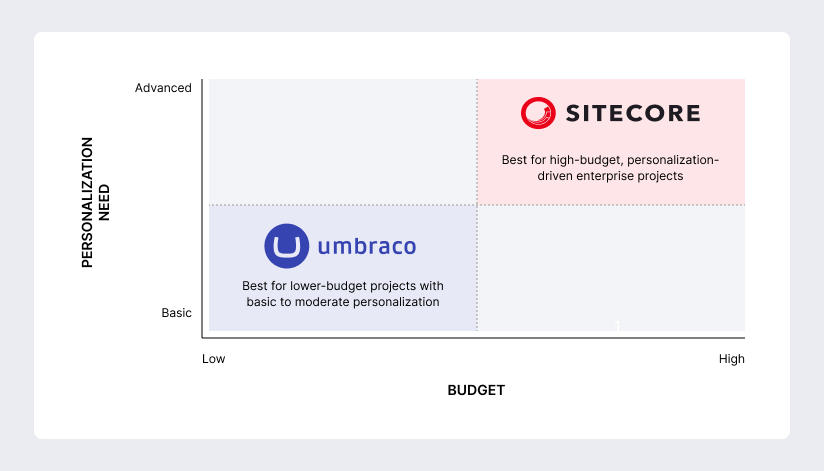
Umbraco’s free core keeps realistic cost in the low tens of thousands annually for mid-sized projects. Sitecore licensing alone often starts in the five figures and climbs to the six figures for enterprise contracts before implementation. This gap is usually the first filter in any Sitecore vs Umbraco decision.
What Are the Pros and Cons of Umbraco?
Umbraco combines flexibility and lower costs with fewer built-in enterprise features. The table below summarizes its main advantages and limitations.
| Pros | Cons |
| Free, open-source core, no licensing fees | Personalization and analytics need third-party tools |
| Clean editor interface, short learning curve | Smaller talent pool than mainstream CMS platforms |
| Full source access, deep customization | Enterprise support requires a paid tier or partner |
| Lower total cost for mid-sized projects | Fewer built-in DXP features than Sitecore |
| Active open-source community | Governance across very large estates needs manual setup |
What Are the Pros and Cons of Sitecore?
Sitecore offers powerful enterprise capabilities but requires higher complexity and investment. The table below highlights its key pros and cons.
| Pros | Cons |
| Personalization, analytics, commerce in one suite | High licensing cost, often prohibitive for smaller teams |
| Enterprise-grade scalability and governance | Longer implementation, often six months or more |
| Strong partner and integrator ecosystem | Steeper learning curve for developers and editors |
| Formal support SLAs for regulated industries | Smaller specialized developer pool, higher rates |
| Mature multisite and multi-brand architecture | Can be overkill for straightforward content sites |
Umbraco vs Sitecore for Ecommerce
Both platforms can support ecommerce projects, but they target different levels of complexity and business needs. The comparison below shows the main differences.
| Factor | Umbraco (Commerce) | Sitecore (OrderCloud) |
| Best for | Mid-sized B2C/B2B stores | Large-scale, multi-catalog commerce |
| Setup complexity | Moderate, developer-led | High, integrator-led |
| Pricing model | Module cost added to CMS | Enterprise, usage-based components |
| Personalized merchandising | Basic, extendable | Advanced, native |
| Time to launch | Faster for standard stores | Slower, built for complex catalogs |
Umbraco vs Sitecore for B2B Companies
Umbraco and Sitecore both support B2B websites, but their strengths differ depending on marketing, integration, and scalability requirements.
| Factor | Umbraco | Sitecore |
| Content-heavy resource centers | Strong, simple to manage | Strong, more automation |
| Lead scoring and nurture | Needs CRM/automation integration | Native via CDP and Personalize |
| Budget fit | Mid-market B2B | Enterprise B2B with marketing ops |
| Multi-region B2B portals | Manageable with planning | Purpose-built for scale |
Umbraco vs Sitecore for Enterprise Websites
Enterprise organizations need strong governance, scalability, and integration capabilities. The table below compares how each platform approaches these needs.
| Factor | Umbraco | Sitecore |
| Governance across many sites | Possible, more manual | Native multi-tenant governance |
| Personalization at scale | Limited without add-ons | Core strength |
| IT and compliance overhead | Lower | Higher, with formal support |
| Vendor ecosystem | Growing, community-driven | Established, enterprise-focused |
Umbraco vs Sitecore for Marketing Teams
Marketing teams will experience different workflows depending on whether they prioritize simplicity or advanced personalization features.
| Factor | Umbraco | Sitecore |
| Editing experience | Simple, low training | Rich, powerful once learned |
| Campaign personalization | Basic segmentation | Real-time behavioral |
| Reporting | External analytics needed | Native dashboards |
| Speed of everyday updates | Fast, minimal friction | Fast after ramp-up |
When to Choose Umbraco
Umbraco fits when you need a fast, affordable, well-governed content platform rather than an all-in-one marketing suite: corporate sites, agency builds, B2B lead-gen, and mid-sized ecommerce where you’d rather integrate best-of-breed tools than pay for a bundle you’ll only partly use. It also suits organizations without a dedicated marketing operations team.
When to Choose Sitecore
Sitecore earns its price when personalization, unified customer data, and multi-brand governance are non-negotiable, not nice-to-haves. Large enterprises with global campaigns, regulated organizations needing formal compliance, and teams with a dedicated MarTech function get the most value. If your team would use ten percent of the feature set, the license is hard to justify.
Migration Between Umbraco and Sitecore
Migration runs both directions: some companies move to Sitecore as personalization needs grow; others move to Umbraco when licensing outpaces the value they extract.
Common migration scenarios
- Umbraco to Sitecore: growth into personalization-heavy marketing across an expanding site portfolio.
- Sitecore to Umbraco: right-sizing after paying enterprise licensing for standard-site functionality.
- Legacy CMS to either: leaving outdated systems for whichever platform matches the new scale.
- On-premises to cloud: moving to Umbraco Cloud or Sitecore XM Cloud without switching platforms.
Risks to consider before migration
Content modeling rarely maps one-to-one between platforms, so plan for remapping content types and templates rather than a straight lift-and-shift. URL structures need careful redirect planning to protect SEO equity built up over years. Custom integrations — CRM sync, payment gateways, marketing automation — typically need to be rebuilt, not just reconnected.
And budget for a parallel-run period: cutting over a live, revenue-generating site without a staged rollback plan is the single most common cause of migration incidents.
Why Choose SaM Solutions for Umbraco and Sitecore Development?
SaM Solutions works across both platforms rather than pushing clients toward whichever one we specialize in, so we recommend based on your project, not our bench allocation.
Our .NET teams have delivered custom Umbraco builds for mid-market and B2B clients who needed speed and cost control, alongside Sitecore implementations for enterprises that needed the full DXP feature set — including migrations in both directions when a client’s needs outgrew their original platform choice.
That means an honest cost-versus-capability assessment before we write a line of code, and support through launch, scaling, and beyond.
Unlock the full potential of customer experience with our expert CX development services.
Final Comparison: Which CMS Should You Choose?
Strip away the vendor language, and the decision comes down to three questions:
- Do you need built-in personalization and unified analytics badly enough to pay enterprise licensing, or would a lighter CMS plus targeted integrations get you there for less?
- How many sites, brands, and languages are you actually governing today, and realistically, in three years?
- And what’s your team’s appetite and budget for a longer, integrator-led build versus a faster, developer-led one?
Answer those honestly, and the Umbraco vs Sitecore choice tends to make itself. Umbraco usually serves mid-market businesses and B2B companies with moderate personalization needs better because it costs less and is faster to launch. Large, multi-brand enterprises with dedicated marketing operations are usually better served by Sitecore’s bundled capability, despite the price, since the alternative is assembling the same capability from separate vendors.
FAQ
How long does implementation usually take for each CMS?
A standard Umbraco build typically takes a few weeks for a straightforward corporate site and two or three months for a more complex, multisite project. Sitecore implementations usually take four to six months and can extend well beyond a year for full enterprise DXP rollouts involving personalization and multi-brand governance.
Which platform is better for a headless architecture?
Do both platforms support AI-powered content workflows?
How should companies estimate CMS migration costs?